City and countryside
Cities have always maintained relationships between urban areas and open spaces inside and outside urban boundaries. Historically, cities developed up to a defined limit. The boundaries of ancient and medieval cities were often determined by a wall enclosing a range of uses and urban spaces, such as squares and entertainment areas. Girouard (1985) and von der Dollen (1990) have shown how the edges of the built-up areas of cities were progressively transformed in Europe from the Middle Ages by the relocation of uses, such as monasteries, hospitals, noxious industries or palaces, and by the spread of housing. New towns often grew out of settlements on the fringes of old towns, and were enclosed by a second wall. Ribbon developments tended to radiate along arterial routes from the town gates as precursors to suburban developments. The transition from urban to suburban to peri-urban spaces marked the types of changes in social and economic life in cities and in transport technologies.
Strong relationships existed between town-dwellers and countrysides arising out of the physical proximity of the town to surrounding rural areas. As towns developed up to and outside their walls, they increasingly relied on agricultural produce from farms in the countryside. Mumford (1961:333) described the ‘persistently rural character of the medieval town’, which arose from both quick access from town to country for recreation and a range of other activities, and the large areas of open space within town and city limits. He argued that up to the 19th century many European towns which had not grown significantly from medieval times retained gardens and orchards. ‘The typical medieval,’ he stated, ‘had a far higher standard for the mass of the population than any later form of town, down to the first romantic suburbs of the 19th century’. Von der Dollen (1990:328) supported this argument, claiming that in medium-sized towns and large cities ‘usually, sufficient space was enclosed within the second town wall circuit to cope with growth up to the inaugural phases of industrialization’. For example, of 405 ha enclosed within the walls of Cologne in 1815, over a quarter was still in agricultural use (Stoob 1979 cited in von der Dollen 1990). Much of Rome was used for vineyards or grazing well into the 18th century, including the Forum and Colosseum which were used for sheep grazing (Haskell and Penny 1981).
Open spaces within medieval urban areas generally comprised private gardens, public spaces such as markets, squares and parks, royal parks and areas of land such as open areas around cathedrals (Mumford 1961). During the 17th and 18th centuries, European cities, such as Paris, London, Berlin and Vienna, developed promenading spaces for citizens. City and town walls began to be pulled down and their footprint used as open space or developed as parkland, particularly through tree planting. Large areas of formerly royal parkland became available for public use, or were subdivided into farms. The Bath model of combined housing and parkland developments, first seen in Royal Crescent in 1767–1774, was widely imitated. It first appeared in London in the early 19th century through the St John’s Wood, and then in John Nash’s Regent Park developments. This ‘mixture of city and country’ led to the combination of villas and parklands that spread all over Britain from c.1820 (Girouard 1985:279).
The setting aside of large areas of parkland within cities arose from a desire to perpetuate the union between countryside and city. The 19th-century parklands movement was aided by the 19th-century Romantic preoccupation with nature, and a growing concern with public health and the overcrowding and diseases associated with cities. Parks were established for public benefits. They were seen as places which could provide for a range of natural and recreational uses, help break up polluting industrial uses and clean the air. In many new cities, including those created in Australia, large areas of parkland were set aside, often in inner parkland rings, as in Melbourne and Adelaide. Melbourne’s extensive network of inner-city parkland was originally conceived by Robert Hoddle as a parkland ring for the city. Similarly, expanding old European cities, such as Berlin, often provided extensive areas of parkland and lakes for recreation inside the cities and on their fringes.
The 19th-century concern for the countryside and its protection emanated mainly from an intellectual and affluent minority. However, increased social and spatial mobility in the 20th century expanded the connections between city and country, creating today’s global spaces ‘where city and country folk meet’ (Friedmann 2010:152). Increasing numbers of people have been able to live in regional or rural locations and work in cities, or to live in cities and gain easy access to rural locations for recreation and other purposes. These trends were assisted by a romanticised view of the countryside and a rising middle class, and have led to increasing conflict between land uses. The result was ‘a breakdown of the division between town and country, and the gradual erosion of the power base of rural landowners, as urban populations extended their influence into the countryside’ (Blacksell and Gilg 1981:1).
Nevertheless, a long tradition in western countries conceptually separates city from countryside. The city has often been viewed with suspicion, as has its capacity, whether real or imagined, to change the countryside. This tradition draws from many sources, including the Enlightenment, the Romantic Era and the 1960s Counter-culture movement. It is also based practically on the desire of large numbers of people to protect lifestyles and agricultural, environmental and other rural values. Bourne et al. (2003) summarised such positions: ‘Leo Marx contrasted the country and the city as “two worlds, one identified with rural peace and simplicity, the other with urban power and sophistication:”’ (1964:18–19). Williams (1973) wrote that the image of the country versus the city was one of the deep paradoxes of western culture. The strong historical and personal connections between urban dwellers and nearby rural areas have perhaps best been captured by literary expressions. Herman Melville wrote of this connection in Moby Dick:
Circumambulate the city of a dreamy Sabbath afternoon … Posted like silent sentinels all around the town, stand thousands upon thousands of mortal men fixed in ocean reveries … But these are all landsmen; of week days pent up in lath and plaster – tied to counters, nailed to benches, clinched to desks. How then is this? Are the green fields gone?
To Ishmael, the main character in Moby Dick, only a return to timeless nature outside cities, represented by oceans, could regenerate individuals and enable them to discover life’s meaning. The renewing power of nature and its links to personal identity are captured in modern arguments about the importance of rural areas around cities for human health, urban liveability and mental well-being. This message has particular resonance in a world where already over 50% of us live in cities, a figure predicted to rise to 70%. Such vast urban agglomerations are the antithesis of nature, obliterating all signs of whatever existed before worlds dominated by concrete, asphalt and steel. Already, a digital virtual nature has replaced substance for many millions of inhabitants of urban areas extending over hundreds of kilometres.
The concept of the urban fringe was therefore linked closely to the idea of maintaining connections between town and countryside. It was also related to the notion of the green belt proposed by British and US writers and practitioners from the late 19th century, such as Ebenezer Howard, Patrick Geddes and Lewis Mumford. It was discussed by Herbert Louis in 1936, in the context of the geographical development of greater Berlin, through the work of the German-American M.R.G. Conzen (1969) and Golledge (1960). An early use of the term ‘urban fringe’ was by T.L. Smith in 1937 to define ‘the built-up area just outside the corporate limits of the city’ (Pryor 1968:202). Spectorsky used the term ‘exurban’ in 1955. In The Exurbanites he wrote that:
The word ‘exurb’ (and its derivatives ‘exurban’ and ‘exurbanite’) carries no connotation of something that has ceased to be, of something in the past; rather, what is intended is a clarification of something extra that has characterised the journey of the exurbanites, out and away from the city, in a wistful search for roots, for the realization of a dream, for a home (Spectorsky 1955:6).
Adell (1999:5) cited several early uses of similar concepts. Kurtz and Eicher (1958) tried to differentiate the ‘urban fringe’ from the ‘suburbs’, while Wissink (1962) went further, recognising ‘pseudo-suburbs, satellites and pseudo-satellites, and inner and outer urban fringe’. Among many others, Andrews (1942) distinguished between ‘urban fringe’ and ‘rural–urban fringe’, while Duncan and Reiss (1956) considered the territories surrounding the city as being either ‘rural non-farm areas’ or ‘rural farm areas’. The term ‘peri-urban’ can incorporate all these terms.
Concept of the peri-urban landscape
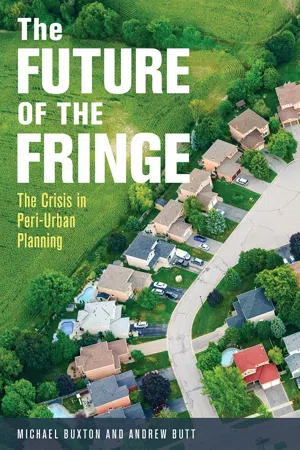
Peri-urban regions are those areas on the urban periphery into which cities expand or which cities influence. They are the rural or semi-rural areas which extend from the city edge to a distance defined variously by commuting time to the nearby metropolis or by spatial characteristics, such as the density of rural settlement and types of land uses. Peri-urban land is usually taken to refer to predominantly non-urban land extending to an outer boundary up to 150 km from the city edge.
Many cities define their metropolitan edge through formal or informal urban growth boundaries. Beyond the urban edge, peri-urban areas may take many forms. They may comprise a heterogeneous jumble of rural and urban land uses mixed with various forms of housing. Alternatively, they may form traditional rural landscapes including productive agriculture, vegetation and scenic landscapes. Many peri-urban areas include formal green belts. Where a green belt exists, rural land extending beyond a green belt can form part of an extended peri-urban area.
The designation of land as peri-urban can be a complex procedure for many reasons. The inner boundary at an urban edge can be indistinct, often consisting of a confusing mixture of urban developments extending in linear fashion along roads, and merging with small ‘rural-residential’ lots and traditional farms of various types and sizes. Much urban development leap-frogs away from a defined urban edge, placing pockets of housing and expanded townships in traditionally rural areas and thus making it difficult to identify a clear urban edge. Fast transport connections and the abandonment of traditional farming practices can extend the outer boundary of peri-urban areas. Metropolitan areas can enclose rural land traditionally classed as peri-urban, and gradually encroach on it. Much peri-urban land appears to be ‘land-in-waiting’ for the expansion of a nearby metropolis, and devoid of traditional rural values.
The massive scale of urbanisation and the impacts on peri-urban areas are global phenomena that are helping to determine the future of civilisation and the Earth itself. The importance of peri-urban areas to human populations and natural processes make the future of peri-urban areas a major global problem. Urban impacts on these areas are now globally significant in that the collective spread of cities potentially threatens to reduce world food production, increase energy consumption, further degrade coastal areas, deplete habitat and natural resources including water resources, and reduce biological diversity. Yet no global institution, and few intergovernmental or international cooperative processes, have considered protective measures or responded adequately to the global threat to peri-urban areas. No international peri-urban policies exist. Where approaches intersect, such as the current Sustainable Development Goals relating to cities, biodiversity and land and farming, these do not have a well articulated vision for peri-urban regions. The few intergovernmental regional processes and related policies have not led to binding agreements. This intergovernmental and global policy vacuum on peri-urban issues contrasts with action to develop agreements on a wide range of other global issues. The future of peri-urban areas is left to states and cities and consequently peri-urban policy is fragmented, varied and often non-existent.
The future of massive urban agglomerations is bound inextricably with the future of peri-urban areas. All outward urban expansion occurs into peri-urban areas, altering and usually destroying vital environmental, economic and social values. The productiveness of urban areas and the well-being of their citizens will depend on the quality and type of relationships between cities and their hinterlands. A future that values urban hinterlands is very different from the model of a world dominated by a relatively few globalised cities which have more to do with each other than with their surrounding regions or other urban settlements. The most productive cities in the 21st century may be those settlements which are the best environmental performers. If so, then the prosperity and liveability of cities will lie in their connections with their regions; cities which destroy these connections will have bleak futures.
Peri-urban regions hold high strategic, spatial, social, economic and environmental significance. They contain a range of important natural resources. Much of our food production and other agricultural activity occurs in them. They provide ecosystem services, landscape and other environmental values, and often contain significant reserves of habitat and biological diversity. They usually include urban water catchments and storages. Many are important recreational and tourist areas, and may contain essential infrastructure such as airports or waste disposal facilities. Peri-urban areas also fulfil important personal and social needs. They allow urban dwellers to continue to relate to countryside, and provide preventative mental and physical health and other social services.
Uncertainty increases the importance of these regions, the need to protect their assets and values and to plan their future. The twin spectres of climate change and energy constraint add to the significance of these regions in times of uncertainty about food security, and the supply and costs of energy and natural resources. Fresh produce may already travel thousands of kilometres to urban consumers. The amount of food shipped between countries increased four-fold in the last four decades of the 20th century, and the trend is increasing (Weekes 2006). Lovelock (2006:13) has encapsulated concern at this uncertainty. Speaking of the UK, he wrote:
Our future food and energy supplies can no longer be taken as secure from a world that is devastated by climate change … Once the Earth begins to move rapidly to its new hotter state, climate change will surely disrupt the political and trading world. Imports of food, fuels and raw materials will increasingly become inadequate as the suppliers in other regions are overwhelmed by droughts and floods.
As...