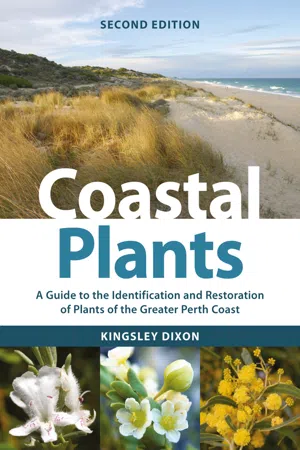
The greater Perth coast is a biodiverse and ecologically vulnerable region, with its unique native plant species threatened by clearing, invasive species, fire and climate change. This second edition of Coastal Plants has been updated and expanded to provide a definitive guide to 128 of the most common plants of the Perth coastal region. It includes the key species used in coastal restoration, along with important weeds. The description of each species is accompanied by a distribution map and diagnostic photographs of the whole plant, flowers, seeds and fruits. The book also contains introductory chapters on the biology and ecology of the coastal plants, their biogeography, and practical approaches to the restoration of coastal dune vegetation.
Coastal Plants is distinctive in its focus on restoration, which makes it valuable for community groups and individuals interested or involved in coastal natural history or restoration activities.
Part 1 Ecology and biology of plants of the west coast
Australia is more biodiverse than 98% of other countries. As one of the 19 mega-biodiverse countries on Earth, Australia, through its 65 million years of evolutionary isolation as the island continent, developed species and ecosystems that are world-class and unique – 80% of our plant and animal species are found only in Australia. For the biodiversity hotspot of south-west Australia, the uniqueness of the biodiversity is even higher with 99% of species found here and nowhere else.
As the island continent, these long periods of genetic isolation have meant that Australia’s biodiversity has adapted in remarkable ways to some of the world’s poorest soils and most hostile environments. Understanding how Australian species operate ecologically presents challenges, particularly where conservation of biodiversity is involved.
A consequence of our unique species and ecosystems is that adopting conservation, restoration and management approaches from other regions of the world and applying them in the Australian context is simply not feasible and rarely appropriate. Such practices ignore the complex and unique ecological processes that drive diversity and function in Australian, and particularly the south-west Australian native ecosystems, Australia’s primary biodiversity hotspot, now complemented by the east coast rainforest ecosystems.
Resolving effective means for developing the knowledge base to protect, manage and rehabilitate Australia’s unique species and ecosystems represents a significant challenge for conservation and restoration scientists and practitioners. Nowhere else is this more evident than for the fragile coastal fringe of south-west Australia where the intersection between human activities and ecological disruption pervade the marine and coastal environments. And with more than 80% of Australians now living within 80 km of the coast, the impacts of human activity on coastal biodiversity is resulting in loss of ecological integrity with many areas particularly adjacent to urban environments facing continued degradation processes.
The Western Australian coast
The Western Australian coastline hosts a remarkable 1227 vascular plant species, about the same number of species as found in the British Isles, of which 10% (166 species) are weeds (adapted from Beard 1990 and FloraBase online information).* This equates to the richest and most diverse native biodiversity of any mediterranean coastal region. The reasons for such richness are unclear, but are possibly linked to the extraordinary diversity of the coastal hinterland that acted as the potential donor for many coastal species.
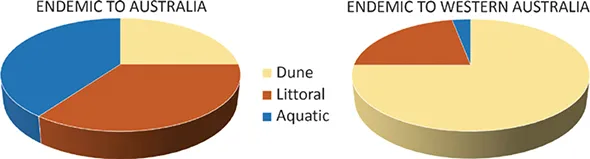
Species richness can be looked at in other ways. For example, the number of species that are unique to an ecosystem (endemic) reflects soil qualities, evolutionary processes (e.g. ecological isolation, geological stability, phylogeny, breeding biology) and continental/regional isolation. Figure 1 shows the uniqueness values for coastal species at the Western Australian and Australian levels (from Beard 1990). Aquatic species have a more cosmopolitan distribution followed by species of the littoral zone (i.e. near-coastal environments) with dune species (those of consolidated or moderately mobile sediments) having the highest local endemism of the coastal zone.
The terrestrial component of the Perth coast is a rich resource of biodiversity. With 147 species of native plants found in the dunes of the Perth metropolitan coast, the plants provide almost year-round flowering, fruiting, seeding and habitat opportunities for insect, reptile and bird life.
Although the number of species in the Perth coastal dunes is low compared to the hyperdiverse inland vegetation of the Swan Coastal Plain or the Mt Lesueur National Park (860 native flowering plant species), coastal dune plants exhibit remarkable diversity in growth form with remarkable adaptability to the stringencies of life on the coast. For example, the 10 major plant families (in terms of species number and abundance) found in Western Australia retain representative species in the dune vegetation, including the Myrtaceae, Proteaceae, Fabaceae/Mimosaceae, Goodeniaceae, Ericaceae, Asteraceae, Poaceae, Orchidaceae, Chenopodiaceae and Liliaceae (sens. lat.).
Why, in comparison to hinterland floras, are coastal dune ecosystems relatively species poor? A key factor relates to the long periods of time necessary for inheritable adaptive traits to develop and resolve new species on new soil types and substrates. Since the coastal soils of the west coast are geologically recent (hundreds to tens of thousands of years compared to the more ancient (tens of millions of years) substrates of the species-rich hinterland), insufficient time has elapsed for the evolution of species adapted to the unique alkaline pH and structure of coastal soils and substrates (i.e. limestone). The ecological volatility of the coastal environment also means that only species with fast-growing attributes are likely to survive.
Similarly, plants of coastal environments have ecological attributes reminiscent of plants from other ‘young landscapes’ such as post-glacial regions, including North America and northern Europe. Though geographically large, post-glacial and coastal ecosystems are relatively species poor (in comparison to more inland areas of south-west Australia, for example) with many species possessing high growth rates with seed that moves long-distances that is often reflected in low genetic variation.
Figure 1. Percentage endemism of coastal species for Western Australia and Australia based on the three key ecosystems: aquatic (plants living in water including emergent species); littoral zone (between high water and low water mark often on margins of estuaries, lakes and rivers); and coastal dunes including consolidated and mobile sands.
Conservation planning
Protecting the diversity of plants and animals in coastal dunes is complex, long-term and resource intensive, though easier to rehabilitate and restore in comparison to the geologically older ecosystems such as banksia woodland or jarrah forest.
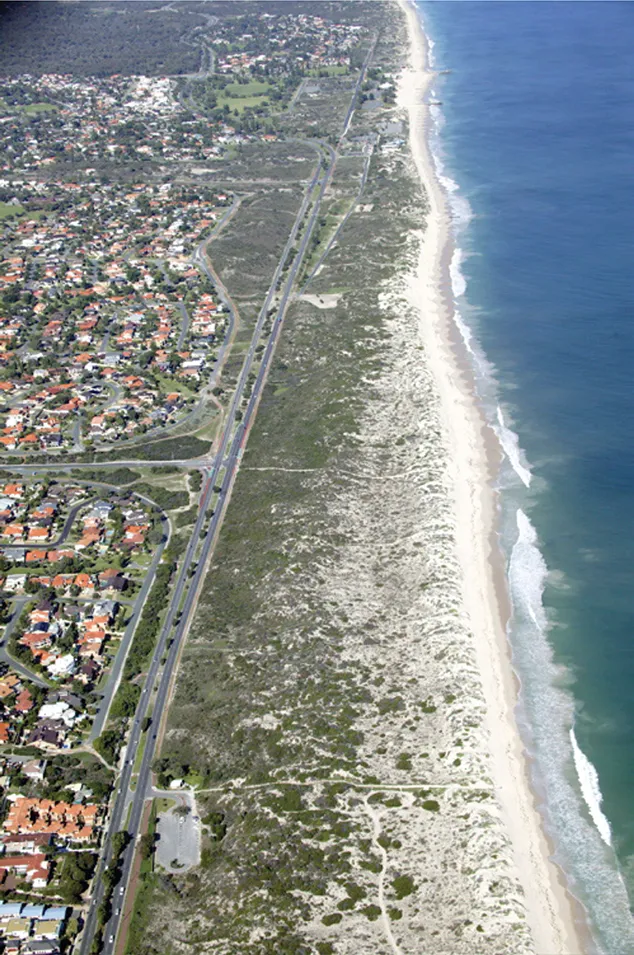
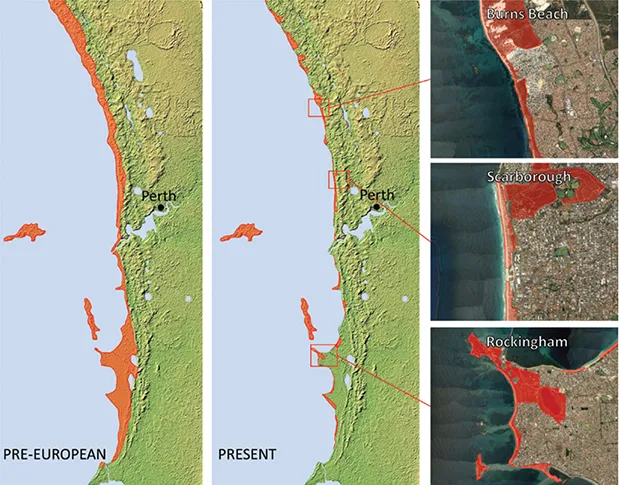
The ecological footprint of humans along the Western Australian coast is most pronounced in the extensive metropolitan sprawl of Perth where it is estimated that less than 5% of Quindalup Dune ecosystems remain (Figure 2).
Direct impacts through infrastructure developments (e.g. housing, roads, beach development, groynes) and indirect impacts (such as invasive plants, feral animals, fire, erosion and pests and diseases) have contributed to a rapid decline in the ecological integrity of dune ecosystems. For example, most metropolitan coastal dunes that retain natural plant cover have some form of ecological disturbance, through tracks (formal or informal), weed incursion, feral animals or development. Weeds exploit both natural and artificial disturbances in dune communities with highly invasive species such as the South African rose pelargonium (Pelargonium capitatum) and the diminutive annual Crassula glomerata being unbiquitous in dunes along much of the west coast.
Figure 2. Digital terrain image showing pre-European and current extent of the Quindalup Dune System (red) along the Swan Coastal Plain with insert images highlighting how remnant areas are now surrounded in urban development.
Maps from Google Earth.
As with many other ecosystems in the south-west Australian biodiversity hotspot (an area south-west of a line from Shark Bay to Eucla), disturbance and weeds represent major ecological perturbations that result in significant degradation and ecological dysfunction. Once a disturbance cycle is established, the degradation process will continue unless intervention occurs. Dedicated and well-resourced management over the long term is necessary to return disturbed coastal areas to a level of natural ecological resilience; however, monitoring and remedial actions may be required on very long time frames.
Degradation of coastal dune habitats outstrips restoration efforts by orders of magnitude. Redressing this imbalance and creating coastal environments where there is a zero net impact on native biodiversity values remains a significant challenge for planning agencies and land management organisations. Significantly, cumulative impacts in coastal ecosystems are rarely considered in making even the most modest of planning decisions. The walkway, carpark extension, building or exercise area that is constructed today is a permanent loss of coastal habitat, and each and every development adds to the cumulative loss of coastal ecosystems.
Unlike most other Australian capital cities, Perth has a number of significant coastal assets that retain a moderate to high level of ecological integrity. The most significant and intact coastal ecosystems include Warnbro Sound, Garden Island, Rottnest Island, Point Peron and Woodman Point, margins of Cockburn Sound, Campbell Barracks (Dept. of Defence), Bold Park, Whitford Nodes, coastal precincts in the Town of Cambridge, City of Stirling, and the City of Joondalup including Ocean Reef marina northwards.
Planning efforts along the coast have resulted in a number of studies* that attempt to balance development with conservation. However, on-ground activities for protection and enhancement of biodiversity values rely on local authority planning and management plans. Importantly, local government plays a critical role in protection and management of coastal environments, often with direct management responsibilities. Thus it is important that there are technically competent staff to manage the conservation and social complexities of coastal management.
Coastal management must be guided by well-considered coastal management plans that are locally relevant to the protection of biodiversity and ecological values while providing necessary guidelines for coastal restoration activities. Generic restoration guides are provided through the Western Australian Planning Commission, Natural Resource Management groups and Coastwest (e.g. the Coastal Planning and Management Manual**); however, rehabilitation and restoration activities should be aligned with the principles in the National Standards for the Practice of Ecological Restoration in Australia published by the Society for Ecological Restoration Australasia (see the next box with information on the recovery wheel that is a useful means to assessing the success and trajectory of restoration and rehabilitation projects). By ...
Table of contents
Cover
Title Page
Copyright
Contents
Preface
Acknowledgements
Part 1: Ecology and biology of plants of the west coast
Part 2: Ecological restoration of coastal dune vegetation
Part 3: Biogeography of coastal plants in the Perth region
Part 4: Species guide
Appendix: Coastal plants on which butterflies or sun-moths breed
Index
Trusted by 375,005 students
Access to over 1.5 million titles for a fair monthly price.
Study more efficiently using our study tools.
Frequently asked questions
Yes, you can cancel anytime from the Subscription tab in your account settings on the Perlego website. Your subscription will stay active until the end of your current billing period. Learn how to cancel your subscription
No, books cannot be downloaded as external files, such as PDFs, for use outside of Perlego. However, you can download books within the Perlego app for offline reading on mobile or tablet. Learn how to download books offline
Perlego offers two plans: Essential and Complete
Essential is ideal for learners and professionals who enjoy exploring a wide range of subjects. Access the Essential Library with 800,000+ trusted titles and best-sellers across business, personal growth, and the humanities. Includes unlimited reading time and Standard Read Aloud voice.
Complete: Perfect for advanced learners and researchers needing full, unrestricted access. Unlock 1.5M+ books across hundreds of subjects, including academic and specialized titles. The Complete Plan also includes advanced features like Premium Read Aloud and Research Assistant.
Both plans are available with monthly, semester, or annual billing cycles.
We are an online textbook subscription service, where you can get access to an entire online library for less than the price of a single book per month. With over 1.5 million books across 990+ topics, we’ve got you covered! Learn about our mission
Look out for the read-aloud symbol on your next book to see if you can listen to it. The read-aloud tool reads text aloud for you, highlighting the text as it is being read. You can pause it, speed it up and slow it down. Learn more about Read Aloud
Yes! You can use the Perlego app on both iOS and Android devices to read anytime, anywhere — even offline. Perfect for commutes or when you’re on the go. Please note we cannot support devices running on iOS 13 and Android 7 or earlier. Learn more about using the app
Yes, you can access Coastal Plants by Kingsley Dixon in PDF and/or ePUB format, as well as other popular books in Biological Sciences & Ecology. We have over 1.5 million books available in our catalogue for you to explore.