![]()
1
Australia’s Alps – the Brindabellas, the Snowy Mountains and Victoria’s High Country
The funny thing is that when you’re there, among them, you know all the answers, everything you ever wanted to know. You can see exactly what life’s all about. But it evaporates as soon as you come away. Perhaps that’s why you keep going back. Doug Scott, British mountaineer, on the experience of visiting mountains.1
Of course, Scott was probably talking about mountains three or four times the size of any in Australia. His experiences as a mountaineer presumably involved hanging on to cliffs by his fingernails, sitting blizzard-bound in a very small tent and enduring numerous other high mountain miseries. But perhaps other people’s experience of mountains is similar even when the style or effort involved is different. Scott’s spiritual exhilaration was certainly shared by Paul Edmund Strzelecki, whose ‘ardour of discovery’ on first ascending Mount Kosciuszko2 in 1840 reminded him of ‘Liberty, Patriotism and love’, as he wrote to his beloved friend Adine, at home in Poland. To Strzelecki, ‘Mount Kosciusko is seen cresting the Australian Alps, in all the sublimity of mountain scenery ... [it] is one of those few elevations ... [which] presents the traveller with all that can remunerate fatigue’.3 No doubt his exhilaration came from being the first European to be there, but as we pant to the top of even a well-trodden peak, many of us have felt a similar thrill.
In 1834, John Lhotsky, setting out from Sydney for the Australian Alps, also felt the exuberance that comes with physical freedom and adventure, with leaving everyday worries and cares behind – although it’s to be hoped that we don’t all use the mountains as an escape from the law:
I left behind me all Bills of Exchange, Courts, Summonses, Attorneys, Editors of Newspapers, Gaols and such like and exulted in the feeling that abandoning all these delights of ultra-civilised society, I should once again enjoy for some time, a freedom nearly approaching the state of nature.4
Another attitude, that the Alps were there primarily to be exploited for material human benefit, is also basic and longstanding. In the late 1800s, John Gale, a well-known Queanbeyan journalist (and later known as the ‘Father of Canberra’), spent many happy hours exploring the nearby mountains. Appreciative though he was, his enjoyment was strangely contradictory:
I had a splendid view of a male lyre-bird gambolling near to me on a bare rock. He had come down from the higher ground and was making towards cover nearer the river. When he gained the rock he paused in his progress, and pirouetted in the exuberance of his joy, bounding with long springy strides, his gorgeous tail trailing train-like behind him ... ‘Things we see when we haven’t a gun!’ A lyre-bird’s tail in its best plumage would probably have been mine that morning had I carried a breech-loader instead of a rod.5
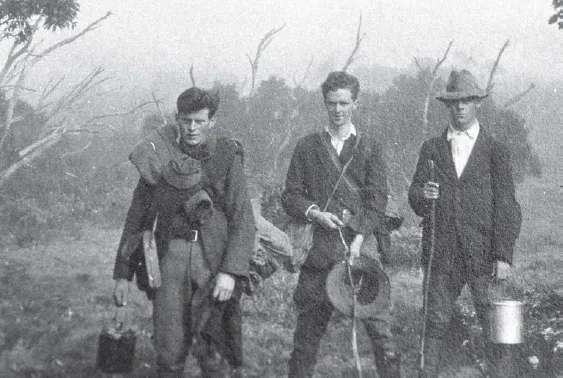
Figure 1.1: Pre-war hikers. Equipment may have changed, but the spirit of adventure continues. Source: DEPI, Victoria.
This is a graphically concise statement of what must be one of the most bizarre human qualities: appreciation of the beautiful in nature coupled with a desire to kill it, take it home and stick it on the mantelpiece. We are a bit shocked now by Gale’s lust for a trophy, as fashions have changed in our attitude to the slaughter of wildlife. But Gale’s heedlessness pales into insignificance compared with other activities that have changed the mountains since his day and have not been rejected so readily.
Use of the Alps to satisfy various personal and economic needs and wants was conducted almost without regulation or accountability in the 19th and early 20th centuries. Disruption of the Aboriginal tribes’ seasonal visits to the mountains and rapid destruction of their relationship to land occurred as logging, mining, widespread free-ranging sheep and cattle grazing and clearing for agriculture proceeded. Some of the early activities were conducted with such freedom and thoroughness that only when the integrity of the landscape itself was seriously threatened were some controls imposed.
In 1932, Baldur Byles, an up-and-coming young forester, sounded early alarm signals about widespread damage resulting from grazing the alpine and subalpine areas. On a 6-month long inspection conducted for the Commonwealth Forestry Bureau of the headwaters of the Murray River, he compared the condition of the upper Murray catchment with the Taurus Mountains in Turkey, which he had visited in 1930. In the Taurus the destruction of forest cover had gone much further than in Australia, and as a result:
... drainage is not by rivers but by torrents overflowing with water in winter but almost dry in summer. The torrent beds are filled with boulders which every year are hurtled down from the mountain-tops to the valleys and from the top of the valleys to the bottom.6
In his report, Byles went on to conclude that a conservative approach to land use made more sense than allowing damaging processes to continue:
In the mountains of the Murray catchment the damage is, by comparison, only just beginning and the problem is one of prevention rather than cure; surely it is better to stop the process of forest destruction than to ... leave future generations the work of repairing the damage that should never have been allowed to take place.7
Byles’ report recognised that the Alps are the vital source of the water systems of south-eastern Australia, where most of us live, and the damage that so alarmed him had happened in a frighteningly short 100 years. This makes it surprising that the changes he warned of were only slowly officially recognised as a potential disaster. Although land degradation had begun to destroy the efficiency of this catchment, with resultant deterioration to the quality and quantity of alpine water resources, Byles’ warning had little effect until 1957. Then, a report instigated by the Australian Academy of Science found:
... catchments are in danger if there is any loss in the infiltration capacity due to a deterioration of vegetative cover, and in great danger if this deterioration is likely to lead to accelerated soil erosion, which could, in time, reach devastating proportions.8
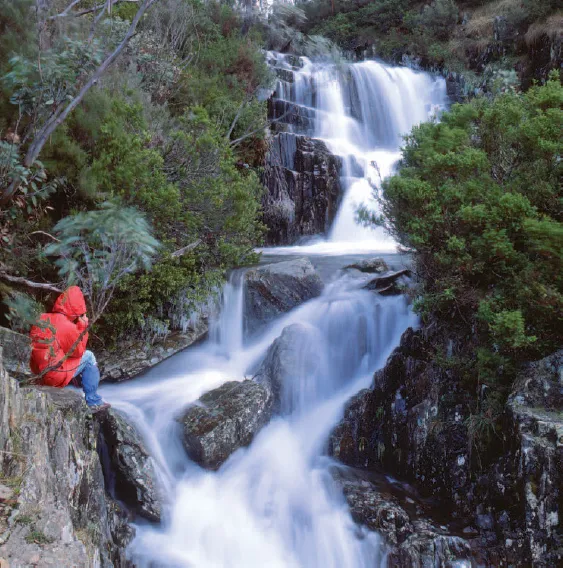
Figure 1.2: Camp Creek near Mount Bogong, Alpine National Park. Source: David Tatnall.
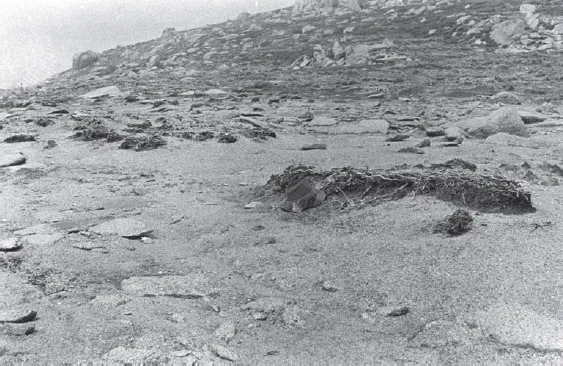
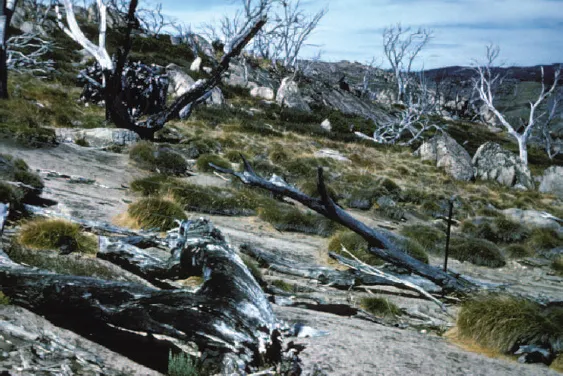
Figure 1.3: Soil and vegetation loss in the Snowy Mountains, 1931. Note Byles’ hat (centre). Source: Baldur Byles, Roger Good Collection.
Figure 1.4: Soil and vegetation loss after grazing and fire near Dainers Gap, Snowy Mountains, 1959. Source: Alec Costin, Roger Good Collection.
This same report also warned of the damage being caused by the acclaimed Snowy Mountains Hydro-electric Scheme, which was then in its middle stages of implementation. This warning was the basis of a lengthy public dispute over the value and effectiveness of parts of the scheme, and of its level of environmental care. The scientists also considered a third land use, tourism and recreation, as a possible alternative. But overall, the future of the mountains was in nature conservation, said the report, written by eminent ecological authorities of the day. ‘This increasingly important aspect of our high mountain catchments cannot be neglected’.8
During the last 60 years, grazing, Byles’ initial focus, has been removed from the mountains. National park protection for nature conservation has changed the legal status of the land and its management. But activities associated with power generation and irrigation and with ski resort development have dominated recent changes to the landscape. These activities have included the creation of several vast lakes made by damming alpine streams, and the construction of power stations, roads, lifts and tows, car parks, food and shopping outlets and accommodation.
What does ‘conservation’ mean? In everyday terms, it could be interpreted to mean something like ‘saving a place for the uses I’d like and getting rid of the others’. But Baldur Byles and the Academy of Science committee were clearly arguing that in the long term everyone loses if natural places are damaged by unsuitable, short-term use. If such important places are not valued for what they can do best, the loss is not just personal and aesthetic, but also economic and social. As Alec Costin, ecologist and principal author of the AAS Report, wrote at the time:
We need such undisturbed areas more than the developments which are possible in them. If we cannot save a few of the best, it does not say much for our scientific, cultural and spiritual standards.9
Not many Australians think of the Alps as a foundation of their wellbeing. The use of the mountains in the last 50 years has featured conservation, development and recreation and tourism, to the point where there is often conflict between them. Such conflict may not be apparent to many of the 5 million or so visitors to the Alps each year. For them, they are a place to visit for a winter weekend of skiing and socialising – a place of car parks, bars and ski tows. Most of the fine detail of the landscape is hidden beneath the snow; the panoramas and peaks are a delightful backdrop to a great weekend.
The Australian Alps National Parks
Mainland Australian alpine and/or subalpine areas are found in eleven national parks and reserves, stretching from Canberra through New South Wales (NSW) to eastern Victoria,...