![]()
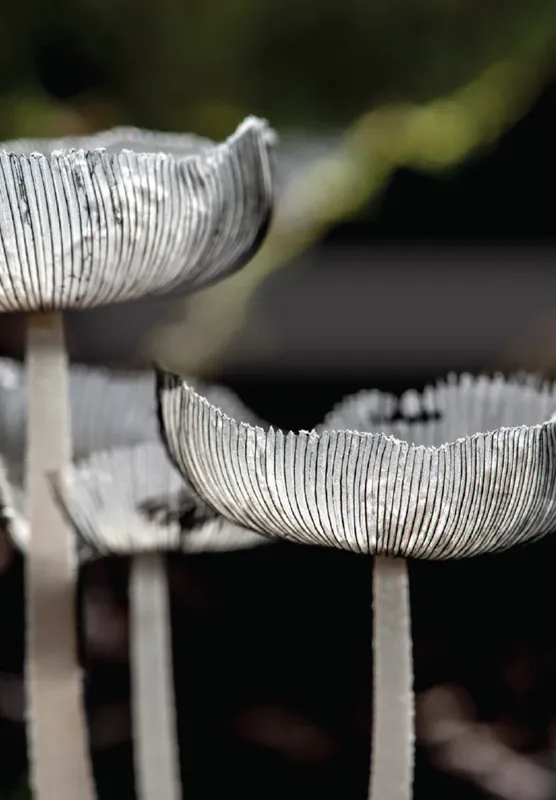
Opposite: Gray shags (Coprinus cinereus) roll up their caps to expose their spore-laden lamellae.
Chapter 1
An introduction to entangled worlds
Low mists span the hills of Victoria’s Great Dividing Range. The crops are now harvested and surpluses pickled and bottled. A handful of remaining wildflowers flash their last blooms of colour. Slipping through the slanting light of the Wombat Forest, our senses awaken to the change of seasons. Autumn. All is subtly muted, softened. Dampness subdues the usual crack of sticks and leaf litter underfoot. Birdcall and the buzz of insects diminish with the cooling air. And it smells different. Distinctively different. At first it seems the forest is winding down for the winter. However, something stirs beneath the leaf litter, beneath the soil. With extraordinary reproductive zeal, fungi reveal their whereabouts as their sporebodies push through the forest floor. We have come to meet with mushrooms.1
‘Look!’ exclaims Angelica, my five-year-old companion. We squat down beside a Russula. Vermillion red, its cap maps tiny peregrinations – slid, rasped and bitten through by unknown wayfarers. Each trail traces a tiny journey in search of shelter or food. Angelica flips onto her stomach and peers under its cap. ‘Look!’ she exclaims again, pinching off a slug with her fingers, its stalked eyes rapidly contracting. I open my field guide. There are at least a dozen reddish russulas. Angelica examines the images, sliding a slug-slimed finger across each. ‘Nup, it’s none of ’em’, she asserts dismissively and continues prodding the slug. I ask her how she can be so sure. She shoots me a pitying look then explains how none has a slug or the same pattern of holes. She is right. The field guide meticulously illustrates idealised specimens, depicting morphological features for identification. But each is also an isolated entity, concealing larger stories of interactions with unseen creatures, of connecting ecosystems, underpinning the forest’s existence, our existence, life.
This is an inquiry into fungi. Into people. Fungi and people. Kingdoms, ecosystems, landscapes, underworlds. It focuses less on individual species and more on relationships. Between fungi and fungi. Fungi and plants. Fungi and animals including Homo sapiens. Fungi and soil. Fungi and life. Complex entanglements, interrelations, circulations. In particular, I explore the histories that shape the ways fungi are understood and valued. Over the years, I have interacted with people who interact with fungi, including mycologists (those who study the science of fungi) and mycophagists (those who eat fungi), farmers and field naturalists, aesthetes and artists, conservationists and rangers, and those who seek fungi for reasons beyond food or science. Through their impressions of the natural and cultural histories of fungi, I have sought to understand why these organisms are regarded so differently from other forms of life. My hope is to provide a stimulus for the more appropriate inclusion of fungi within the bigger picture of nature, biodiversity and conservation. A more fungal way of thinking might even awaken a new ecological consciousness to enrich the ways we interact with the natural world.
The extraordinary lives of fungi are explored through a collection of voices in anecdotes, histories and science gleaned across the world and across societies. Their accounts come alive through direct engagement with fungi in their habitats – forests, woodlands, grasslands, deserts, backyards and unexpected places. I have tried to reflect fungi in their various guises, not just to classify them, but also to convey their lyrical essence. In doing so I hope to inform and inspire care, so that to exclude fungi from concepts of nature or conservation might seem as perverse to the reader as it did to me, motivating me to write this account.
Beyond mushrooms to mycelium
Without fungi, life is radically diminished. Fungi regulate the biosphere and support Earth’s ecological functioning. Yet the exceptionally few mushrooms with the capacity to dismantle human livers or kidneys are the ones deemed worthy of attention by a spectacle-obsessed press. This is most apparent in the English-speaking world. Shark attacks sell newspapers splendidly, but once the swimming season ends, any notion of gently easing into autumn is quickly expunged by lethal fungal substitutes: ‘Killer mushrooms invade picnic spots’; ‘Potential killers stalk Victoria’s fields’; ‘Wild fungi death trap’; ‘Beware the killer mushrooms’, warn the Australian newspapers. Forget sharks and brace yourself for survival on this threateningly fungal continent. Fungi are seldom considered newsworthy within spheres of human concern except, it seems, when intentionally stalking their human victims.
English language speakers’ common aversion to fungi has long been recognised. Negative portrayals of fungi arise not only through public ignorance and misunderstanding, but also through the scientific focus on their destructive ability. This is unsurprising given the potential of fungi to wreak havoc on crops and bodies, albeit usually in direct response to poor human management. Such ways of thinking about fungi overshadow their many values and human dependence on their existence. In 1957, the controversial ethnomycologist (a person who studies the human use of fungi) Robert Wasson popularised the terms ‘mycophilia’ and ‘mycophobia’, referring to the love and fear of fungi. Although Australia’s sparse mycological history and negative press portrayals of fungi are typical of English-speaking nations, attitudes to fungi today might not be as polarised as Wasson supposed. As interest grows in both fungal ecology and foraging for edible mushrooms, Australia is shifting from a traditionally mycophobic position towards a greater spectrum of attitudes. It is an exciting transitional time, although there is still a good way to go until fungi are appreciated as a vital part of life. But just for a moment, imagine how things could have been different for fungi, as well as for Homo sapiens.
Had biology taken another route to understanding nature – a route that valued interactions as much as individual identities – the living world might have been perceived in an entirely other way. Darwin’s oft-quoted description of foliage on his ‘tangled bank’ in the concluding paragraph of On the Origin of Species (1859) acknowledged the inherent interdependency of species. Whether metaphorical or real, his tangled bank could be considered as an early precursor to the concept of ‘ecosystems’ coined by British botanist Arthur Roy Clapham in the early 1930s. The idea of interdependencies between organisms is not new, and less formulated concepts go back more than two millennia to Theophrastus. However, the human need to define boundaries is the premise of hierarchical taxonomic schemes of classification and is fundamental to the way many people think. Consequently, the autonomy of species had more sway than ideas about interactions and set the foundations for the path of biology. However, imagine opening a biology textbook, or say a gardening book, and there on the first page loomed an enticing illustration of a mycelium as the archetype of the living organism. If fungi were considered as representational of biology, current concepts of nature might be very different. Such an approach begins with recognising nature as systems of relations, rather than being premised on separation and cataloguing. It acknowledges the fluid nature of life processes. Thinking of mycelia as the biological prototype advances the idea of Natural Selection underpinned by competition, to one that includes cooperation and complementation as ways of understanding interactions. This way of thinking helps shift limited conceptions of fungi as isolated sporebodies or species, to the sophisticated and cooperative biological collective of mycelia. Consider the organisational and communication networks of human societies that course beneath the soil – the fibre optics of the Internet, electrical cables, sewerage systems, train networks and tunnel roads. It becomes startlingly obvious how they mirror mycelia. As human threats push species to extinction, the need to better understand relationships and processes might override Linnaean routines for naming.
Although many scientists advocate the significance of symbioses, the biological autonomy of species still governs much scientific thinking, research funding and conservation. To define something only by its identity risks underestimating its interrelations. As long as we reduce organisms to ‘objects’ or ‘bounded entities’ we are prone to thinking about them as ‘things’ rather than in the context of their processes. Mycology (the scientific study of fungi) has revealed the staggering diversity and complexities of fungi, but less attention has been given to mycelial fungi as living systems. This is not an attack on mycology and its revelations, but a call towards the depth and mystery of the fungal kingdom. Returning to the forest floor, I am not suggesting we throw away our field guides. Recognising something as different and being able to name it imbues it with meaning and significance. It is not possible to refer to what a fungus is without identifying it and categorising it in some way, to differentiate it from another fungus, or a numbat. I simply ask why identity has historically overshadowed relationships and processes and show how it perpetuates limited ideas about nature. Rethinking fungi involves a switch from regarding a sporebody as a thing, subject to naming, plucking or representation, to acknowledging interactive processes. Ideas about the fluidity of nature abound in the thinking of many indigenous cultures including those of Aboriginal Australians. The concept of ‘Country’, for example, recognises this continuity. Country is multidimensional, representing more than species, land or water. It has future and past, exists in and through time. It is life. Country is an all-embracing notion of belonging, being owned by place and connection. Aboriginal ideas of animals as part of kin, rather than as taxonomic species, upend European approaches to biodiversity conservation that rely on defining individual species.
Mushrooms provide an obvious tangible link to humanity. However, the bigger fungal picture unfolds in the dynamism of their mycelia. Mycelia are characteristically connective, versatile, complex, heterogeneous, changeable and resilient. Mycelia, rather than just sporebodies, offer a compelling framework to contemplate the full potential of fungi. Most plants rely on mutually beneficial symbioses with fungi for their survival. This tangle of relationships is central to life and evolution, not an alternative or secondary strategy. Although symbioses were long considered an anomaly, they are now regarded as foundational and a general mechanism of evolutionary innovation. Or perhaps think of it this way – what organism do you know of that lives in isolation from others? Despite our need to separate and categorise, organisms are not autonomous. Life is symbiotic.
Thinking, un-thinking, re-thinking fungi
I do not recall eating mushrooms in my Australian childhood. I am not sure why they never appeared on my dinner plate, but suspect they were too ‘foreign’ or ‘undefinable’ for my mother to contemplate buying. They were not meat, and they were not quite vegetable and she was certainly not about to go digging for them in the dirt. The fact is, it had never actually occurred to me to eat them. I had seen the benign and insipid mushrooms (Agaricus bisporus) in the supermarket but somehow never linked them with the incredible representations of fungal life in the bush. I knew neither was animal or vegetable, but the similarity between the supermarket mushrooms and those in the bush ended there. Those in the wild were life forms of sheer beauty and bizarreness. Their aesthetics intensified my curiosity. I wanted to know why they looked like they did and what they were doing.
My most immediate concern was that I had no idea how to walk in the bush. I was terrified of treading on things. Every footstep crushed stuff; tiny lichens and mushrooms, mosses and sundews, spiders sleeping inside curled leaves. There was no space to tread. How heavy did I need to be before the fungal webs of mycelia beneath the leaf litter would be destroyed? What was blatantly obvious even to a child’s mind – or perhaps because I had a child’s mind – was that everything in the bush was connected. Connectivities were more obvious than the distinctiveness of things. Clambering about in the bush triggered a lifelong urge to document these unseen microcosms in the hope they might not get trodden on and their connections severed. In this book I aim to present a more inclusive concept of fungi by proposing a shift in thinking – from thinking of sporebodies as discrete entities, to considering fungi as sophisticated entangled systems. I also propose a challenge for their inclusion within what is valued. I see it as a transition from thinking about fungi (inserting them in human consciousness) to un-thinking fungi (in the limited ways they have been perceived historically) to re-thinking fungi (within broader contexts and dimensions).
The fungal folk (as I am calling the people who have special relations with fungi) I have met offer insights from diverse cultural backgrounds to consider fungi in different ways. While more people care about fungi in Australia today than historically, fungi remain largely absent from an ecological awareness that includes other life forms. Conservation in Australia has mostly attempted to manage nature though a command-and-control approach, rather than acknowledging and protecting its inherent connectedness. A growing environmental awareness and concern in the 1970s saw the rise of an ecological consciousness along with the establishment of more national parks. It was during this time that fungi also penetrated the remote edges of public awareness. Given the ubiquity and ecological significance of fungi, almost all environmental issues involve them. Declining air, water and soil quality, species extinction, catastrophic fire and the overarching issue of climate change all affect fungi, but the effects are seldom noticed or documented. As fungi operate on slow timescales in invisible realms, they are especially prone to changes and impacts that slip below the radar, unnoticed and unmonitored. If a fungus species or a thousand fungus species succumb to extinction in the subterrains of the soil, would anybody notice? I suspect only a few, and only then if the fungi were known in the first place.
The lack of acknowledgement of fungi in Australian environmental management and biodiversity conservation is my starting point. To be endowed with chlorophyll or a backbone is to be deemed charismatic. Such organisms have historically been the focus of conservation. In recent decades conservation shifted from species to ecosystem and landscape scales that integrate functions, processes and interactions. However, the ambiguity of concepts such as ‘biodiversity’ mean that all groups of organisms require representative flagships and dedicated advocates. Red Lists (inventories of the conservation status of species) have helped prioritise conservation efforts. The Red-listing of fungi has been crucial to their inclusion in European conservation. The near absence of fungi on Australian Red List equivalents partly explains their exclusion from Australian biodiversity conservation. However, the conservation dimension of this book is not a plea to squeeze another group onto lists of species to conserve. It is not a manual on how to save the fungus kingdom. There are no dot-point lists of recommendations or policy guidelines. First we need to ask what saving fungi means, as well as the implications of not saving them. It begins with examining human–fungus relationships. This means understanding their history of exclusion from what is valued and questioning the frames of reference that shape how we think about the natural world. It means...