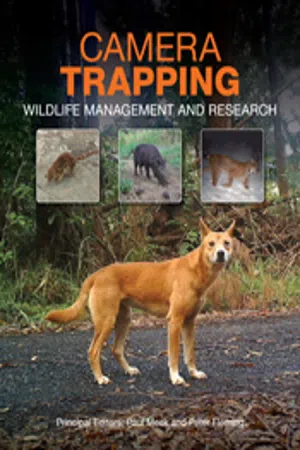
Camera Trapping
  1. 392 pages
  2. English
  3. ePUB (mobile friendly)
  4. Available on iOS & Android
eBook - ePub

About this book

Camera trapping in wildlife management and research is a growing global phenomenon. The technology is advancing very quickly, providing unique opportunities for collecting new biological knowledge. In order for fellow camera trap researchers and managers to share their knowledge and experience, the First International Camera Trapping Colloquium in Wildlife Management and Research was held in Sydney, Australia.

Camera Trapping brings together papers from a selection of the presentations at the colloquium and provides a benchmark of the international developments and uses of camera traps for monitoring wildlife for research and management. Four major themes are presented: case studies demonstrating camera trapping for monitoring; the constraints and pitfalls of camera technologies; design standards and protocols for camera trapping surveys; and the identification, management and analyses of the myriad images that derive from camera trapping studies. The final chapter provides future directions for research using camera traps.

Remarkable photographs are included, showing interesting, enlightening and entertaining images of animals 'doing their thing', making it an ideal reference for wildlife managers, conservation organisations, students and academics, pest animal researchers, private and public land managers, wildlife photographers and recreational hunters.

Frequently asked questions

Yes, you can cancel anytime from the Subscription tab in your account settings on the Perlego website. Your subscription will stay active until the end of your current billing period. Learn how to cancel your subscription.
No, books cannot be downloaded as external files, such as PDFs, for use outside of Perlego. However, you can download books within the Perlego app for offline reading on mobile or tablet. Learn more here.
Perlego offers two plans: Essential and Complete
  • Essential is ideal for learners and professionals who enjoy exploring a wide range of subjects. Access the Essential Library with 800,000+ trusted titles and best-sellers across business, personal growth, and the humanities. Includes unlimited reading time and Standard Read Aloud voice.
  • Complete: Perfect for advanced learners and researchers needing full, unrestricted access. Unlock 1.4M+ books across hundreds of subjects, including academic and specialized titles. The Complete Plan also includes advanced features like Premium Read Aloud and Research Assistant.
Both plans are available with monthly, semester, or annual billing cycles.
We are an online textbook subscription service, where you can get access to an entire online library for less than the price of a single book per month. With over 1 million books across 1000+ topics, we’ve got you covered! Learn more here.
Look out for the read-aloud symbol on your next book to see if you can listen to it. The read-aloud tool reads text aloud for you, highlighting the text as it is being read. You can pause it, speed it up and slow it down. Learn more here.
Yes! You can use the Perlego app on both iOS or Android devices to read anytime, anywhere — even offline. Perfect for commutes or when you’re on the go.
Please note we cannot support devices running on iOS 13 and Android 7 or earlier. Learn more about using the app.
Yes, you can access Camera Trapping by Paul Meek, Peter Fleming, Guy Ballard, Peter Banks, Andrew Claridge, Jim Sanderson, Don E. Swann, Paul Meek,Peter Fleming,Guy Ballard,Peter Banks,Andrew Claridge,Jim Sanderson,Don E. Swann,Don Swann in PDF and/or ePUB format, as well as other popular books in Biological Sciences & Veterinary Medicine. We have over one million books available in our catalogue for you to explore.

Table of contents

  1. Cover
  2. Title
  3. Copyright
  4. Contents
  5. Preface
  6. Acknowledgements
  7. Introduction
  8. Principal editors
  9. Editors
  10. List of contributors
  11. Part 1 Camera trapping for animal monitoring: case studies
  12. Part 2 Camera technology, constraints and pitfalls
  13. Part 3 Survey design
  14. Part 4 Data management and analyses
  15. Part 5 Conclusion
  16. Index