![]()
PROGRESS IN BAUXITE MINING
![]()
7
Mining and ecological restoration in the jarrah forest of Western Australia
John M Koch
Summary
The jarrah forest is a unique vegetation community restricted to the Darling Plateau in the south-west corner of Western Australia. It is flanked by the predominantly cleared coastal plain to the west and the almost totally cleared Wheatbelt to the east. Having a relatively undisturbed natural vegetation community close to Perth gives the area special significance. Alcoa is privileged to be allowed to mine in this sensitive environment and accordingly applies the highest standards of environmental management in its operations. Drinking water production, timber, conservation and recreation are the main land uses in the forest and restoration aims to reinstate these values after mining. Mining in this relatively intact natural ecosystem close to Perth requires high standards of environmental practice in all areas. This paper describes in detail, three significant aspects of environmental sensitivity and how they are managed: jarrah dieback disease, drinking water catchment and biodiversity impact.
Management of jarrah dieback disease is backed by a strong history of applied research, both within and external to Alcoa. Management includes knowing where the pathogen is present, restricting vehicle movement from infested to uninfested areas, cleaning vehicles before entering uninfested areas, preventing infested and uninfested soils mixing, preventing water draining from infested to uninfested areas, training all field staff and planners, monitoring the spread of the disease attributable to mining, and investigating the causes. Extremely small rates of dieback disease spread due to mining have resulted from these management practices.
Water catchment protection is underpinned by clear standards and protocols, government reporting requirements, continual monitoring, and high standards of earthworks and other engineering controls. Drinking water standards have never been compromised by Alcoa’s operations in Perth’s water catchment areas.
Successful management and restoration of biodiversity stems from the concept that Alcoa’s mining is a transient land use and that mining is not complete until restoration has been carried out. Flora is successfully returned by maximising the diversity of species originating from the natural topsoil seed bank, applied seed and planting of difficult or ‘recalcitrant’ species. Fauna restoration requires the return of suitable habitat for fauna species as well as removal of any barriers to animal success, in particular feral animal predation. Alcoa funds feral fox control in the jarrah forest and is actively involved in rare species re-introductions in areas within and around its mining operations.
Key enablers to ensure high standards of environmental management are:
•Management support – Gaining financial, staff resources and moral support from senior management is probably the most important task a mine environmental scientist can achieve.
•Objectives, targets and auditing – Measurable targets agreed to by management are required for improvements to be made. These are standard components of any Environmental Management System (EMS).
•Research – Understand the biology/ecology of the system and use this knowledge for restoration.
•Applying the research – This is often more difficult than the research itself and also requires management support and staffing.
Introduction
Alcoa currently operates two mines in the jarrah forest in the south-west of Western Australia, Willowdale mine 140 km SSE of Perth and Huntly mine 80 km SSE of Perth. The total area mined and rehabilitated each year is 500–600 ha. A detailed description of the mining and restoration process is provided in Koch (2007) and previously in Gardner (2001).
More than 1.3 million people live within an hour’s drive of the bauxite leases in the Darling Range. Recreational use of the forest region is extensive with several National Parks, State Parks, Nature Reserves and Forest Parks, many picnic sites, the long-distance walking and cycling tracks, the Bibbulmun Track and Mundi Bindi Trail – all important scenic and recreational attractions for the people of Western Australia. The jarrah forest has a long history of wood production and the mines are within Perth’s drinking water catchments. Because of the proximity to the main concentration of population in Western Australia, Alcoa’s mining operations are constantly under public scrutiny. As a consequence, Alcoa’s environmental performance is strategically important to the company’s future in the region. Alcoa currently commits ~8% of its mine operation costs to post-mining restoration processes and associated research. The average cost of restoration is approximately A$34 000 per hectare (Gardner and Bell 2007).
Alcoa’s first mine restoration in 1966 returned soil to the mined out pits and planted exotic pine trees and eucalypts (Tacey 1979). The objective at that time was to restore the mined areas to a productive land use, primarily timber. Over the years the aim of the restoration has changed to become consistent with operating in a diverse forest ecosystem. In 1990, Alcoa published the current restoration objective: ‘To restore a self-sustaining jarrah forest ecosystem, planned to enhance or maintain water, timber, recreation and conservation values.’ (Gardner 2001, p. 4). Meeting and exceeding stakeholders expectations has led to continuous improvements such that Alcoa’s restoration practices are generally considered successful and some of the best in the world (see Koch and Hobbs 2007, Fig. 7.1).
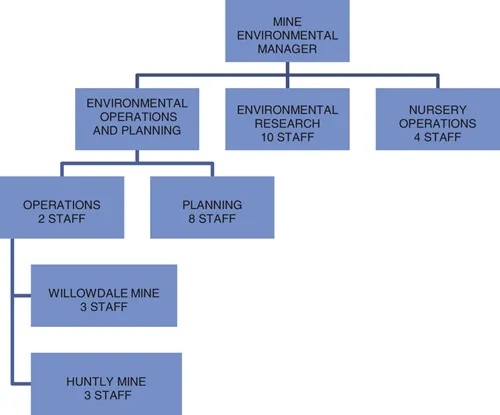
Figure 7.1: Structure and staff numbers for Alcoa’s mine environmental group.
The jarrah forest is flanked by the predominantly cleared coastal plain to the west and the almost totally cleared Wheatbelt to the east. Having a relatively intact natural vegetation community close to Perth gives the area special significance. Alcoa is privileged to be allowed to mine in this sensitive environment and accordingly applies the highest standards of environmental management in its operations. The purpose of this paper is to describe Alcoa’s mining operations, the potential environmental impacts of the mining and give detailed accounts of how dieback disease, water and biodiversity are managed in this en vironment.
Environmental management requires resources
Responsible environmental management in a sensitive ecosystem requires a substantial input of resources by mining companies. Environmental management in the 21st century is a complex process including ongoing government reporting, compliance with various licences and permits, measurement of a wide range of environmental parameters and ongoing auditing of environmental performance. In addition there is a policing role, an internal consulting role, a training and educational role, and sometimes a research role for environmental staff. This large workload cannot be carried by one person and indeed will require at least several full-time staff. These staff also need to be adequately resourced and must have senior management support and empowerment to fight the inevitable battles that will develop across the divide of ‘production and profit’ versus ‘environmental responsibility’. Alcoa’s mining environmental staff currently number ~30 (Fig. 7.1). This number indicates recognition of the importance of the environmental function and also provides the environment with a strong voice within the company. All these components combine to produce high levels of environmental performance at Alcoa’s Western Australian mine operations.
Alcoa’s mining and restoration sequence
Current practices involve pre-mine surveys of heritage values, dieback mapping, flora and fauna surveys, vegetation mapping and bauxite exploration. No drill lines are cleared for bauxite drilling. Once an area is proven for mining then timber is harvested, remaining vegetation is cleared, topsoil and overburden is stripped, caprock (part of the bauxite resource) is blasted or ripped and then the bauxite is mined.
The restoration process is: landscaping and pre-ripping, overburden and topsoil return, return of logs and rocks for fauna habitat, contour rippin...