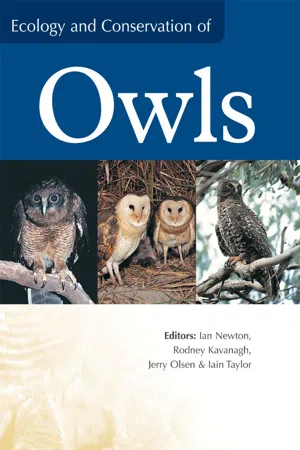
Ecology and Conservation of Owls
- 380 pages
- English
- ePUB (mobile friendly)
- Available on iOS & Android
Ecology and Conservation of Owls
About this book
Owls in Australia are difficult to find and study, so comparatively little is known about their biology. Even less is known about the status, taxonomy, and biology of those species and sub-species living in tropical and subtropical environments and on islands. Many island species and subspecies are at risk, some have already been lost.
Ecology and Conservation of Owls includes sections on population ecology, distribution, habitat and diet, conservation and management, and voice structure and taxonomy. It contains a number of review chapters that bring together findings from a wide range of previous research, including recent developments in owl taxonomy and systematics, and studies of population limitation in northern hemisphere owls. The chapters in this book derive from papers presented at the Owls 2000 conference held in Canberra, Australia, which was third in a series of international meetings on owls.
Frequently asked questions
- Essential is ideal for learners and professionals who enjoy exploring a wide range of subjects. Access the Essential Library with 800,000+ trusted titles and best-sellers across business, personal growth, and the humanities. Includes unlimited reading time and Standard Read Aloud voice.
- Complete: Perfect for advanced learners and researchers needing full, unrestricted access. Unlock 1.4M+ books across hundreds of subjects, including academic and specialized titles. The Complete Plan also includes advanced features like Premium Read Aloud and Research Assistant.
Please note we cannot support devices running on iOS 13 and Android 7 or earlier. Learn more about using the app.
Information
Table of contents
- Cover
- Title
- Copyright
- Dedication
- Foreword
- Contents
- Preface
- Acknowledgments
- Referees
- Introduction to Australian owls
- Part 1: Population ecology
- Part 2: Distribution, habitat and diet
- Part 3: Conservation and management
- Part 4: Voice, structure and taxonomy