![]()
1. Introduction
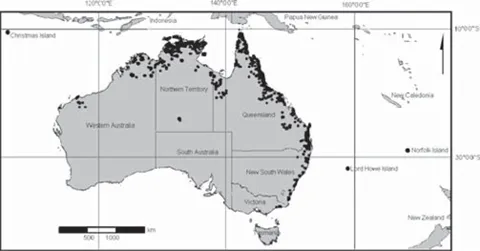
This account deals with the 60 species in 21 genera of palms, family Arecaceae, that are indigenous to the Australian geopolitical region, which includes the Australian continent and the off-shore territories of Christmas Island, Lord Howe Island and Norfolk Island. For continental Australia, 54 species in 17 genera are currently recognised, while there are four species in three genera on Lord Howe Island and one species on both Christmas Island and Norfolk Island (Du Puy and Telford 1993; Green 1994) (Fig. 1.1).
Considering the great diversity and number of palm species in nearby areas such as New Guinea, with c. 280 species in 31 genera (Barfod et al. 2001; Baker and Dransfield 2006) and the comparatively small island of New Caledonia with 38 species in 10 genera (Pintaud and Baker 2008), the Australian palm flora is not a prominent element in the overall context of the Australian flora. The limited distribution and/or absence of palms from suitable habitats in tropical northern Australia are notable, as other areas of the world with similar climates and environments often have a relatively greater abundance. Two somewhat different scenarios may be the cause of this:
Figure 1.1 Distribution of the Arecaceae in Australia and offshore territories.
• a formerly diverse palm flora has largely been extirpated across much of the continent through long- and short-term climate change;
• the low vagility of palms into Australia from nearby palm-rich areas.
These aspects will be discussed further in Chapter 3, ‘Historical biogeography’, and Chapter 4, ‘Distribution and ecology’.
Despite the relatively small number of species in Australia, diversity at higher classification levels is considerable, with all the five subfamilies in the Arecaceae represented. Two of the subfamilies are represented by a single species in Australia: the Nypoideae (a monospecific subfamily) with Nypa fruticans (mangrove palm) and the Ceroxyloideae (globally eight genera, 42 species) with Oraniopsis appendiculata. The Calamoideae also has relatively moderate representation, with only one genus with eight species in Australia (globally 21 genera, c. 620 species). The most diversified subfamilies in Australia include the Arecoideae with 13 genera and 26 species (globally 107 genera, c. 1250 species) and the Coryphoideae with five genera and 24 species (globally 46 genera, c. 450 species). The largest genus in Australia is Livistona, in the Coryphoideae, with 18 species of 36 species world-wide. Other significant genera include the endemic Archontophoenix with six species, and Linospadix with five endemic species (plus two species in New Guinea), in the Arecoideae. Aspects of relationships between taxa and other phylogenetic themes will be presented in Chapter 5, ‘Systematic arrangement’ and subsequent chapters.
A number of genera with species in Australia have their centre of distribution and diversity in New Guinea and central or western Malesia. These are represented in Australia by a single or a few outlier species: these genera include Arenga, Caryota, Corypha, Hydriastele, Licuala and Ptychosperma. An unusual feature of the Australian palm flora is the relatively high number of endemic monotypic genera, including Laccospadix, Oraniopsis, Carpentaria, Normanbya, Wodyetia, Hedyscepe and Lepidorrhachis. This may be an artefact of taxonomy rather than an expression of biological diversity, as the relationships of some are presently unresolved. Other genera are Howea, with two species endemic to Lord Howe Island, and Rhopalostylis with two species, one which occurs on Norfolk Island and the Kermadec Islands (the latter is politically part of New Zealand) and one which is endemic to New Zealand.
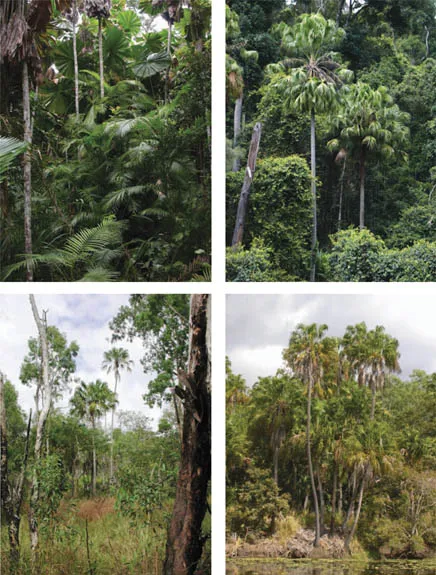
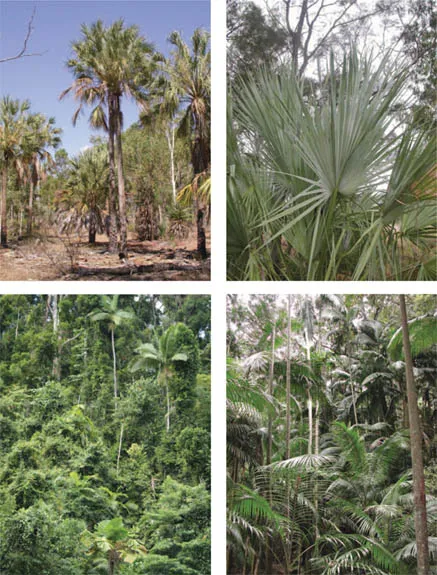
In Australia, most palm species occur in tropical regions that have high rainfalls (Fig. 1.2). In many habitats, palms do not form a significant element in the vegetation and only few grow gregariously. In Australia, 60% of the palm species occur in rainforest habitats. This is lower than the approximate 75% of palm species that occur in rainforest globally (Dransfield 1978). The lower percentage of rainforest palms is explained by the presence in Australia of Livistona which, with 18 species, is the continent’s most diverse palm genus. Only one species of Livistona occurs in rainforest (L. australis) (Fig. 1.2); the others occur in monsoon forest, woodland, savanna, littoral forest and riparian forest, in monsoonal or semi-arid regions where rainforest is absent (Fig. 1.2). Where palms do occur in low-rainfall habitats such as open woodlands and savannas, they most often occupy niches where subsurface water is available for most of the year, or in environments that are seasonally inundated and have a high watertable for some months (Fig. 1.2). There are no palm species in Australia that are obligate xerophytes, although some may experience periods of seasonal drought and possess xerophytic characteristics such as wax on the leaf surface (Fig. 1.3). These species are often associated with habitats that have strongly seasonal rainfall patterns, occurring in northern monsoonal areas or inland Australia. Environmental requirements and ecological amplitude of Australian palms will be examined in Chapter 4, ‘Distribution and ecology’.
Forty-four palm species occur in Queensland, of which 26 are endemic to that state. The Northern Territory has 14 species of which four are endemic, and Western Australia has five species of which three are endemic. The palm diversity in Queensland is high for two main reasons: there are vast areas with monsoonal or ever-wet tropical climate that sustain species-rich forest types in general, and there are forests in the extreme north of Cape York Peninsula that harbour a New Guinean element. Ten thousand years ago, when the Torres Strait land-bridge still existed, these forests were coherent with rainforest in New Guinea (Hope 1994). The other Australian states that have palms are New South Wales with four species, all shared with Queensland, and Victoria with one species which also has distribution in New South Wales and Queensland. Eleven species are shared with New Guinea (see Chapter 3); five of these have further distribution in south-east Asia or the south-west Pacific. The latter species are outlier populations of genera that are more diverse in areas to the north or north-west of Australia.
Some low- to moderate-altitude rainforest habitats of north Queensland, such as the Wet Tropics Bioregion and monsoonal Cape York Peninsula, have the highest diversity of palm species in Australia, with up to 12 species occurring together in some localities and occasionally forming palm-rich forests (Fig. 1.3). Other areas of significant diversity include the low- and moderate-altitude rainforest habitats in the MacPherson/Macleay Overlap region of southern Queensland and northern New South Wales, where four species may occur together (Fig. 1.3), and the Top End of the Northern Territory where three species may occur together in any one location. Conversely, some palm species exhibit extreme isolation from other species, such as Livistona alfredii in the Pilbara of Western Australia and Livistona mariae in the Finke River system of central Australia (Fig. 1.4). These isolated species are sometimes referred to as relicts. They have been interpreted as representing the remnants of a flora that occurred in those areas when the climate was wetter (Lothian 1959; Latz 1975) and that have persisted and adapted despite increasing environmental dryness. Alternative views suggest that these populations may be the result of recent long-distance dispersal and are not relict species but are recently evolved entities with some adaptive traits that have allowed them to survive in ‘difficult’ environments.
Palms also occur in some restricted habitats, such as mangroves (e.g. Nypa fruticans) (Fig. 1.5), riparian forests (e.g. Archontophoenix myolensis) (Fig. 1.5) and high-altitude habitats (e.g. Laccospadix australasicus and Linospadix palmerianus) (Fig. 1.5). Many of these species have specialised morphological adaptations or fruit dispersal characteristics associated with those environments.
Figure 1.2 Palm habitats. Top left: Licuala ramsayi var. ramsayi and Calamus spp., lowland rainforest, Licuala State Forest, Mission Beach, north-east Queensland. Top right: Livistona australis, moderate-altitude rainforest, Broken River, Eungella Range, central Queensland. Bottom left: Livistona drudei, near-coastal savanna woodlands, Clemant State Forest, north-east Queensland. Bottom right: Livistona decora, seasonally inundated riparian habitat, Healeys Lagoon, Haughton River catchment, north-east Queensland.
Figure 1.3 Palm habitats. Top left: Livistona lanuginosa, tall open woodland with c. 550 mm rainfall per annum, Deep Creek, Dandenong Park, Burdekin River catchment, north-east Queensland. Top right: Leaves of Livistona lanuginosa have a coating of wax on the surface, a xerophytic adaptation. Bottom left: Archontophoenix alexandrae, Calamus spp., Licuala ramsayi var. ramsayi and Ptychosperma elegans, Lamb Range, north-east Queensland, c. 600 m alti...