![]()
PART I
FIELD GUIDE
![]()
Species descriptions
Basic descriptive notes on each species are given here. Additional information relevant to field identification (particularly for the rarer or commonly misidentified species) is provided under ‘Characteristics’, as applicable, in the respective species account in Part II: Handbook. A separate section at the end of Part I: Field Guide highlights difficult species-pairs and their distinguishing characters. The final section in Part I discusses vagrants or potential vagrants, unconfirmed records and doubtful records.
Among the most problematic, recurrent cases of misreporting in birding circles are the female Swamp Harrier misidentified as the Red Goshawk, and the Grey Goshawk misidentified as the Grey Falcon. That is, there are false reports of Australia’s two rarest and most threatened species, accurate records of which are essential to researchers and wildlife managers.
Osprey Pandion haliaetus
Handbook p. 111, photo p. 84.
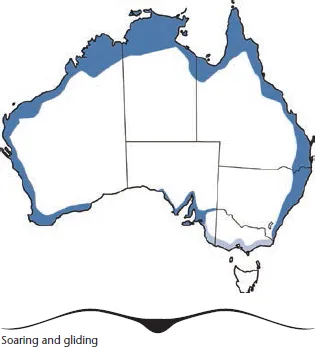
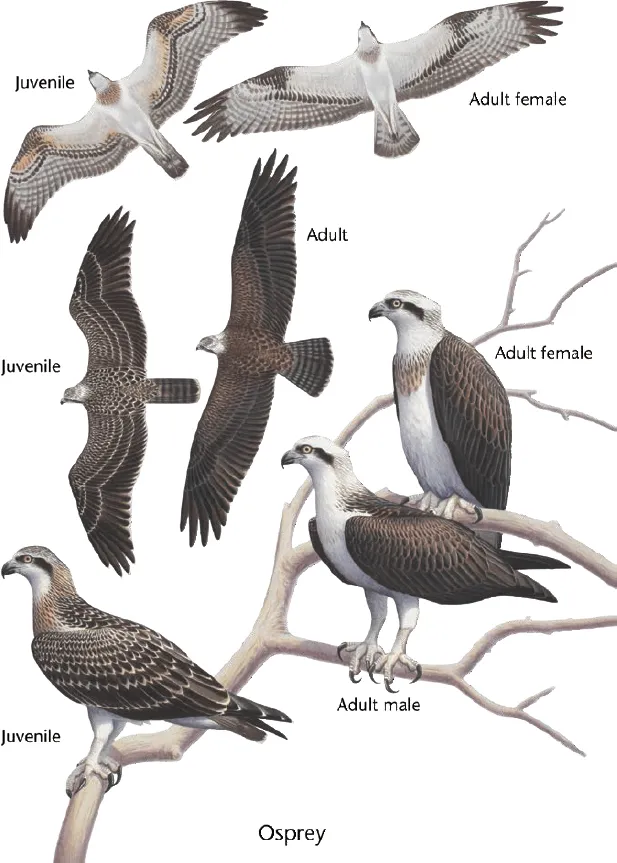
50−66 cm (tail less than half), wingspan 149−168 cm. Male 840–1260 g (average 1013 g), female 830–1910 g (average 1235 g). Intermediate in size between Brahminy Kite and White-bellied Sea-Eagle. Large hawk with long angular wings and heavy feet; long forearm bones, tapered wings like large seabird. Distinctive profile at rest: crested nape, bulging chest, concave belly, prominent carpals, wing tips reaching beyond tail tip. Adult brown with white head and underparts, dark streak through eye and down side of neck, mottled brown breast-band (narrow and faint in males, heavy in females). Underwings faintly barred, with dark carpal patches. Tail barred. Cere grey, eyes pale yellow to orange-yellow, feet pale grey. Juvenile similar but rustier, crown and nape more streaked, upperparts spotted cream (lost with wear), breast-band heavy and broad, eyes orange-yellow to orange. Chick uniquely patterned among raptors: grey-brown down with dorsal stripes and dark eye-stripe with brownish ring around the hindneck.
Solitary hawk of inshore coastal and estuarine waters, occasionally inland rivers and lakes. Flight kite-like and buoyant with shallow, gentle rhythmic wing-beats; soars and glides on bowed wings with curved leading and trailing edges. Silhouette shows prominent head and bill, long narrow wings, square tail. Voice distinctive: plaintive or loud ringing whistles, repeated.
Similar species: immature White-bellied Sea-Eagle with mottled breast-band on otherwise pale underparts, but has broad, rounded upswept wings and shorter wedge-shaped tail; juvenile Brahminy Kite has shorter, broader rounded wings, rounded tail, less projecting head and bill, small feet; soars on flat wings.
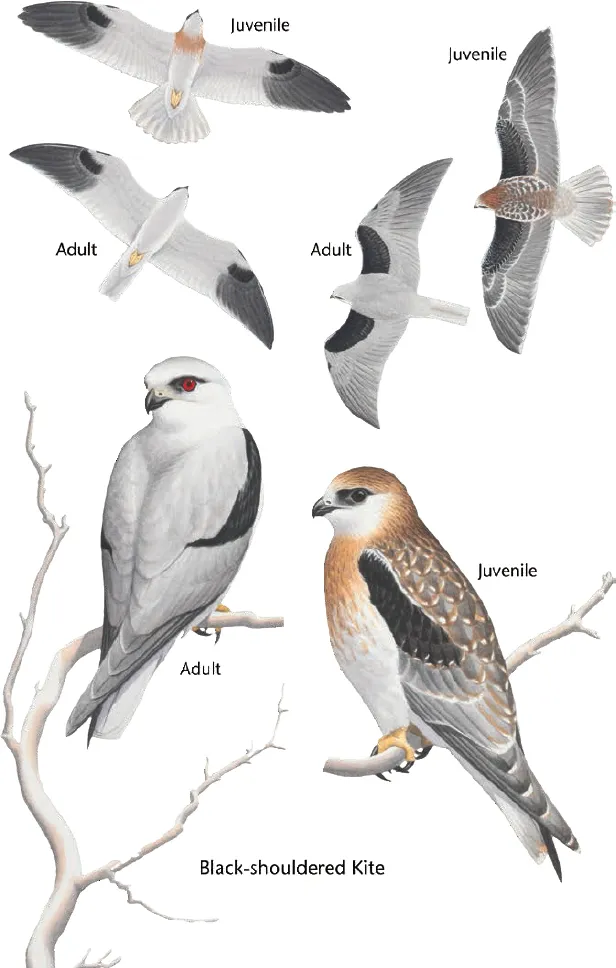
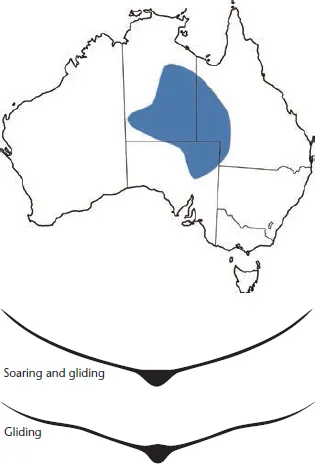
Black-shouldered Kite Elanus axillaris
Handbook p. 113, photos pp. 84–85.
33−37 cm (tail less than half), wingspan 82−94 cm. Male 181–295 g (average 249 g), female 270–340 g (average 293 g). Slightly larger than Nankeen Kestrel, with larger head, broader wings and shorter tail. Adult small white hawk with pale grey back and wings, darker primaries and black patch on each wing between carpals and body. Black carpal spot and dark grey primaries on underwings. Black patch in front of each eye and thin black line above and behind eye. Cere horn to yellow, eyes red, feet rich yellow. Juvenile washed or streaked rusty brown on head, back and breast with feathers of upperparts, including black wing patch, fringed white; cere horn, eyes brown, feet pale yellow. Chick has fawn first down, pale grey second down slightly browner on crown.
Solitary or gregarious, diurnal hawk of open woodland, grassland, farmland with scattered trees; often on poles and wires. At rest sits low on short legs, wing tips reach beyond tail tip. Flight action rapid and winnowing. Glides on raised wings, hovers with legs lowered and tail depressed, drops feet-first with wings raised high over back (compare Nankeen Kestrel). After landing on perch, sometimes flicks tail upwards while giving weak whistling notes. Other common call is harsh wheezing.
Similar species: Letter-winged Kite except for underwing pattern, face pattern and style of flight (for differences, see pp. 18–19). Nankeen Kestrel slimmer, longer tailed and buffier from below, with black subterminal tail band; lacks underwing markings. Grey Falcon lacks black forewing and underwing markings, has barred wings and tail, is an active bird-hunter. Grey Goshawk has short, broad rounded wings lacking black markings; longer tail and legs; glides on bowed wings.
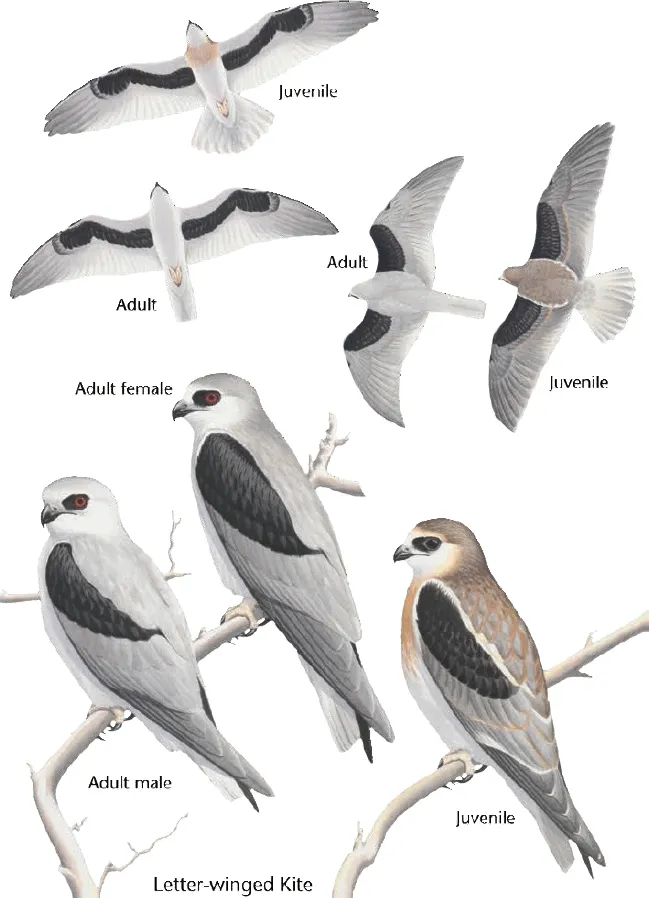
Letter-winged Kite Elanus scriptus
Handbook p. 114, photo p. 85.
34−37 cm (tail less than half), wingspan 84−89 cm. Male 217–333 g (average 289 g), female 290–422 g (average 343 g). Similar in size, colour and proportions to Black-shouldered Kite. Adult white with pale grey back and wings, black patch on wings between carpal and body, although softer and more owl-like plumage. Grey wash on crown and nape, or grey cap; males whiter on crown. Underwings have thick black line from body to carpals, and pale primaries (reverse of Black-shouldered Kite’s underwing pattern). Letter-winged Kite has black patch in front of each eye joining a black ring around eye, enhancing large eyes and owl-like face. Cere dark horn to black, eyes red, feet cream. Juvenile washed brown on head, back and breast, lacking white feather-tipping of juvenile Black-shouldered Kite (other than thin white line along outermost scapulars). Eyes brown. Chick has cream first down, light grey-brown second down (darker on head).
Gregarious, usually nocturnal kite of tree-lined watercourses and adjacent grasslands of eastern arid zone; usually roosts by day in leafy trees, although alert and will flush and soar. Flight action slow and harrier-like, with gliding on raised wings; also sustained kiting on motionless wings raised above body. Hunting behaviour similar to Black-shouldered Kite, but wing-beats slower and deeper. Calls are weak whistling and harsh rasping notes (like Black-shouldered Kite), and harsh slow chatter.
Similar species: distinguished from Black-shouldered Kite by underwing pattern, paler, more translucent flight feathers, and slower, more buoyant and less direct flight. Barn Owl (Tyto alba) and Eastern Grass Owl (Tyto longimembris) similar at night, but owls have larger head, broader rounded wings and long dangling legs.
Square-tailed Kite Lophoictinia isura
Handbook p. 118, photo p. 86.
50−56 cm (tail about half), wingspan 131−145 cm. Male 501 g (a juvenile); female 590–680 g (average 650 g). Similar size to milvine kites (Milvus, Haliastur) and harriers (Circus). Adult brown with...