![]()
PART 1
Review of fire effects on soil properties
![]()
1
The sedimentary record: the very early acquisition of fire by hominins
Ferran Estebaranz-Sánchez, Laura Martínez and Paulo Pereira
Introduction
The acquisition of the capacity to manipulate fire represents one of the major biological, behavioural and cultural changes in human evolution (Pyne 1994; Brown et al. 2009; Wrangham and Carmody 2010; Parker et al. 2016). Charles Darwin (1871) highlighted fire’s evolutionary importance in his book The Descent of Man, affirming that it was ‘probably the greatest [discovery], except language, ever made by man’. However, the use of fire has caused not only a paradigm shift for hominin evolution, but a change in the natural history of the Earth and life itself (Pyne 1994; Pausas and Keeley 2009), because biotas have been forced to adjust to new fire regimes and new fuel complexes (Pyne 1994). Despite its importance, there is no consensus concerning not only when hominins first developed the ability to make fire, but what it means to make fire, within the context of differentiating opportunistic/sporadic fires versus intentional/stable fires.
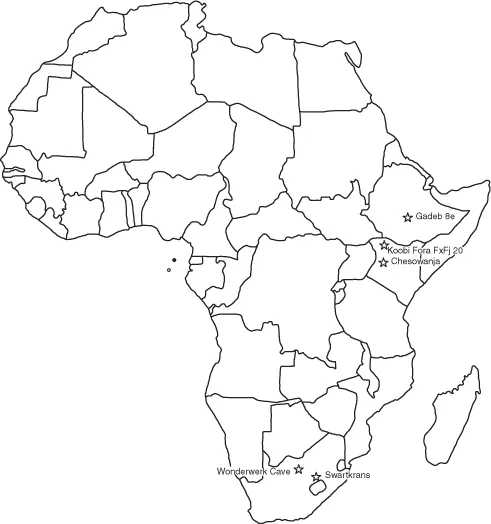
Some authors have suggested that evidence of occasional and opportunistic use of fire may be traced back more than 1 million years (Brain and Sillen 1988; Brain 1993; Beaumont 2011; Berna et al. 2012; Pickering 2012; Gowlett and Wrangham 2013; Bentsen 2014; Gowlett 2016) (Table 1.1; Fig. 1.1). Independently of the level of evidence of each case, all of them are African sites. This is not surprising, because Africa was the only continent inhabited by hominins (regardless of the species considered) until 1.8 Mya, when Homo ergaster/erectus began to move outside its boundaries (Gabunia et al. 2000). In East Africa, several sites have been suggested as having evidence of early burning and use of fire. At Chesowanja GnJi 1/6E, in the Chemoigut Formation near Lake Baringo, dated to more than 1.42 ± 0.07 Mya based on K-Ar dating of an overlying basalt, the presence of discoloured clay aggregates intermingled with Oldowan stone artefacts, fauna and bone fragments of a Paranthropus have been documented (Gowlett et al. 1981). Based on the results of the magnetic susceptibility analysis, which showed that the rubefied clay aggregates had been heated up to 400°C, the authors concluded that the artefacts had been intentionally burned (Gowlett et al. 1981). Another controversial site with regard to its possible association to intentional fire use is the Ethiopian site of Gadeb 8e, located in the Middle Awash, where stones with differential dark grey and red discolouration typical of burning have been reported (Barbetti 1986). Although magnetic analyses indicated that all stones had a thermal magnetisation from the time the volcanic rocks were formed, some of them also had a younger magnetisation signal with a maximum temperature of ~500°C (Barbetti 1986). Thus, these results are difficult to interpret, given the difficulty of distinguishing the archaeological magnetisation signal from that of geological origin, although some authors have suggested that this site could correspond to an early phase of a technological transition associated with Homo ergaster (Clark and Harris 1985; Clark 1987). Reports of the use of fire have also been proposed at the Kenyan site of Koobi Fora FxFj 20, an early Pleistocene archaeological site near Koobi Fora (northern Kenya, on the eastern shores of Lake Turkana) dating from 1.5 Mya (Bellomo 1994). In Koobi Fora FxFj 20, several fully oxidised and highly grouped sediment features have been identified at the base of the archaeological horizon. A total of five red patches were initially detected, of which four can be inferred as fireplaces, while an irregular narrow red patch at the edge of the excavation was suggested to be a burnt tree (Rowlett 2000). First archaeomagnetic analyses confirmed that these fires did not burn hotter than 400°C (Bellomo and Kean 1997). In addition to this, more recent differential thermal analysis (DTA) confirmed that fires did not attain 400°C (Rowlett 2000). However, ongoing debate still continues on whether these burnt traces could have been caused by wildfires. A recent high-resolution excavation at the FxJj20 AB site focused on the recovery and high-resolution spatial analysis of large and small finds (<2 cm), based on FTIR spectrometry analysis of the material recovered, has discounted that anthropogenic fire caused the spatial pattern of heated and unheated archaeological material (Hlubik et al. 2017).
Fig. 1.1. Major African sites for which the presence of intentional fire has been described.
Table 1.1. Putative earliest evidence of fire use by hominins
In Southern Africa, several sites have also been proposed as possible evidence of intentional fire. In Member 3, a depositional unit of the Swartkrans Formation, dating from 1.5 to 1.0 Mya, up to 270 burned fossil specimens have been recovered, including nine individuals of Paranthropus robustus (Brain 1993). Both osteological and chemical analyses suggested they had been exposed to high temperatures, ranging from 300 to 500°C. According to Brain (1993), this is evidence of the use of fire, because average campfire temperatures attain ~400°C, rarely exceeding 700°C (and discounting grass fires as the cause of burning, because, in this kind of fire, temperatures up to 800°C are attained). There are several pieces of evidence that reinforce that the fire was of human origin and not wildfire. For example, the presence of burnt bones in up to 23 excavation holes of 10 cm thick along Member 3, with a depth of 6 m, is evidence that bones were burned in recurring fires possibly over thousands of years (Brain 1993; Pickering 2012). These campfires were confined to the entrance of the gully, sheltered by a dolomite roof, around which hominins would process the food and discard pieces of bone into the ashes, which were dragged into the cave over time (Brain 1993). In addition, four of the burned bones have stone tool cut marks indicating defleshing butchery, which reinforces the hypothesis of meat eating and, consequently, its roasting/cooking (Pickering et al. 2008). Finally, there is no homogenous pattern of distribution of burned bones in the other deposits of the Swartkrans Formation, so it is difficult to infer that they were burned by natural wildfires. Despite this behavioural scenario, the presence of a burnt hominin phallanx (SKX35822), as well as the burning of two bone tools add some doubt to the behavioural reconstruction done by Brain (1993). Furthermore, the burned bones were in the filling of a gully (Brain 1993) and were probably transported short distances from their place of combustion (Pickering 2012). Thus, some authors suggest an alternative explanation that wildfire could have ignited detritus, including these burned bones, which were on the floor of the cave, and could have been later dragged into the gully from which the deposit of Member 3 was formed (Pickering 2012). If it is accepted that the Swartkrans fossils were actually burned, it would open the possibility that other species of a genus other than Homo could have controlled or opportunistically used the fire because, so far, the Member 3 has yielded remains of only Paranthropus robustus, but not of Homo ergaster (Brain 1993).
In South Africa there are other contemporary sites, or even older ones, with putative evidence of the use of fire by hominins. In the Wonderwerk cave, dating from 1.7 Mya, a level (MU9b) has been excavated comprising a composite accumulation of ash containing a large number of fragmented and charred-calcined bones that had been previously broken to access the marrow before being discarded into the fire (Beaumont 2011). In 2012, a new study applied micromorphological analysis and Fourier transform infrared microspectroscopy (mFTIR) to study intact sediments and associated archaeological finds (Berna et al. 2012). The authors stated that results confirmed an ‘unambiguous evidence’ of burning event in Wonderwerk Cave during the early Acheulean occupation, ~1.0 Mya (Berna et al. 2012), although other authors describe the results as ambiguous (Goldberg et al. 2017). The results of the microstratigraphic study in the Acheulean Stratum 10 indicate the presence of well-preserved ashed plant material and burned bone fragments that were not transported from distance to the basement either by water or wind, but were combusted and accumulated locally. Furthermore, the microscopic evidence of burning in Wonderwerk is supported by the presence of burned faunal, lithic and macrobotanical assemblages deposited on Stratum 10 (the same material previously studied and published by Beaumont (2011). In fact, up to 43.7% of the fauna (bones and teeth) from Stratum 10 had been exposed to fire, revealed by the presence of discolouration typical of burning. Moreover, FTIR analysis of the remains showed that some of the discoloured bone fragments displayed FTIR absorption spectra typical of bone mineral heated to more than 400°C, although no IR pattern characteristic of complete calcinations was found (thus, no specimen reached a temperature =700°C) (Berna et al. 2012), which consistent with using light vegetation, such as leaves and grasses, as fuel (Attwell et al. 2015). Finally, the authors stated that the prevalence of burning throughout the entire thickness of Stratum 10 minimises the likelihood that repeated wildfires were the source of the burning in the cave. Nevertheless, some authors suggest the archaeological evidence at Wonderwerk Cave indicates that early hominins did not maintain fire for long periods (Chazan 2017).
Middle and Lower Paleolithic
Unequivocal evidence for the early habitual use of fire (in contrast to early, sporadic use) (Alperson-Afil 2017) dates back to the beginning of the Middle Paleolithic, ~250–400BCE, despite the debate whether fire was used at the German site of Schöningen (Weiner et al. 1998; Gow...