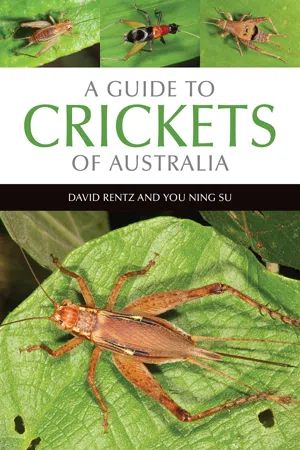
A Guide to Crickets of Australia
eBook - ePub

A Guide to Crickets of Australia

  1. 416 pages
  2. English
  3. ePUB (mobile friendly)
  4. Available on iOS & Android
eBook - ePub

A Guide to Crickets of Australia

About this book

Cricket song is a sound of the Australian bush. Even in cities, the rasping calls signify Australia's remarkable cricket biodiversity. Crickets are notable for a variety of reasons. When their population booms, some of these species become agricultural pests and destroy crop pastures. Some introduced species are of biosecurity concern. Other crickets are important food sources for native birds, reptiles and mammals, as well as domestic pets. Soon you might even put them in your cake or stir-fry, as there is a rapidly growing industry for cricket products for human consumption.

Featuring keys, distribution maps, illustrations and detailed colour photographs from CSIRO's Australian National Insect Collection, A Guide to Crickets of Australia allows readers to reliably identify all 92 described genera and many species from the Grylloidea (true crickets) and Gryllotalpoidea (mole crickets and ant crickets) superfamilies. Not included are the Raspy Crickets (Gryllacrididae), King Crickets (Anostostomatidae) or the so-called 'Pygmy Mole Crickets' (Caelifera), which despite their common names are not related to true crickets. Natural history enthusiasts and professionals will find this an essential guide.

Certificate of Commendation, The Royal Zoological Society of NSW 2020 Whitley Awards: Invertebrate Field Guide

Frequently asked questions

Yes, you can cancel anytime from the Subscription tab in your account settings on the Perlego website. Your subscription will stay active until the end of your current billing period. Learn how to cancel your subscription.
At the moment all of our mobile-responsive ePub books are available to download via the app. Most of our PDFs are also available to download and we're working on making the final remaining ones downloadable now. Learn more here.
Perlego offers two plans: Essential and Complete
  • Essential is ideal for learners and professionals who enjoy exploring a wide range of subjects. Access the Essential Library with 800,000+ trusted titles and best-sellers across business, personal growth, and the humanities. Includes unlimited reading time and Standard Read Aloud voice.
  • Complete: Perfect for advanced learners and researchers needing full, unrestricted access. Unlock 1.4M+ books across hundreds of subjects, including academic and specialized titles. The Complete Plan also includes advanced features like Premium Read Aloud and Research Assistant.
Both plans are available with monthly, semester, or annual billing cycles.
We are an online textbook subscription service, where you can get access to an entire online library for less than the price of a single book per month. With over 1 million books across 1000+ topics, we’ve got you covered! Learn more here.
Look out for the read-aloud symbol on your next book to see if you can listen to it. The read-aloud tool reads text aloud for you, highlighting the text as it is being read. You can pause it, speed it up and slow it down. Learn more here.
Yes! You can use the Perlego app on both iOS or Android devices to read anytime, anywhere β€” even offline. Perfect for commutes or when you’re on the go.
Please note we cannot support devices running on iOS 13 and Android 7 or earlier. Learn more about using the app.
Yes, you can access A Guide to Crickets of Australia by David Rentz,You Ning Su in PDF and/or ePUB format, as well as other popular books in Biological Sciences & Ecology. We have over one million books available in our catalogue for you to explore.

Information

Cricket identification

Superfamily GRYLLOIDEA

Family Gryllidae: True Crickets
This is the largest family of the Grylloidea and has been the subject of division and addition of higher taxa and generic subdivision. Presently, 6 subfamilies are represented in the Australian fauna with species found throughout the continent as well as Tasmania and Lord Howe and Norfolk islands. The appearance of many members of this family present the β€˜classical’ type of cricket. Walt Disney’s β€˜Jiminy Cricket’ was modelled after field crickets of the subfamily Gryllinae.
Gryllids are characterised by having a large globular head and laterally compressed tarsi. Many are among the largest of crickets. Males are usually winged with the forewings modified for sound production; females may be winged or not and not adapted for sound production. Some species may be very short-winged (macropterous) or wingless in 1 or both sexes.
Gryllids occupy a wide range of habitats as will be illustrated below in the various subfamilies. Some are subterranean, living in burrows or in cracks in hard soil. A few live in rotting wood and many can be found in leaf litter. Gryllids are seldom found on leaf surfaces. The great majority of species are primarily nocturnal but some activity can be noted on overcast, dark days or towards the end of summer.
Most gryllids have distinctive songs that are well known to people interested in nature. Females are attracted to singing males and males of some species provide β€˜aphrodisiacs’ from glands on thorax. This supposedly helps to achieve a successful coupling. Males of several cricket species provide the female with a β€˜nuptial gift’ of a spermatophore. Multiple spermatophores have been consumed by some females before mating.
Subfamily Gryllinae
Tribe Gryllini
The Gryllini is a poorly defined tribe with several important Australian representatives (Table 3). Since the publication of Otte and Alexander’s monograph, several genera have been transferred in and out of the Gryllini. The most important is the genus Loxoblemmus (p. 70), which has been further expanded by the synonymy of Comidogryllus and its many species. Four Australian genera are presently included in the Gryllini. The introduced House Cricket, Acheta domesticus (p. 67), used as food for birds and lizards in the pet industry, is also included in this tribe. The tribe is characterised by the head lacking dorsal bristles; the fore tibia with either both anterior and posterior tympana; and the hind tibia lacking spines above the spurs.
Genus Acheta Fabricius (House Cricket and relatives)
Known from 23 species from the Old World with 1 species cosmopolitan in distribution because it is used as food for pets, zoo animals and as live bait for fishing. It is now used as a protein source for human food. Originally the House Cricket was thought to have come from the south-west Asia where most of its relatives occur.
Table 3. Comparison of Australian members of Gryllinae.
Habitats: H. wet river banks or swampy ground: RF, rain forest; W. open, dry woodland: D. desert grassland and scrub; G. grasslands, open meadows; S. stony or rocky places (cracks); B. dry soil banks. Modified from Otte and Alexander (1983).
Tribe Genus Forewings present Mirror:divided (d)undivided (u)absent (a) Tympana:inner (i)outer (o)absent (-)(disregard size) Femur III with spines above spurs Number of harp veins Usual habitats
male female
Gryllini
Acheta + + d or u -/o - 3–4 Near humans
Gymnogryllus + + d -/o - 3 R
Teleogryllus + + d -/o - 3–4 G
Modicogryllini
Apedina + +? u -/o - 2 S, B
Aritella + + d -/o - 2 W, G
Velarifictorus + + d or uA -/o or iC/o - 2 R, G, W
Cyrtoprosopus + + a -/o - 0–1 G
Gryllodes + + d -/o - 2 S
Lepidogryllus + + u -/o or i(6)/o - 2 R, G, W
Loxoblemmus + + d or u -/o - 2 RF, R, W, G
Pictorina + + u -/o - 2 W
Rufocephalus + +? u -/o - 2 S, B
Tumpalia + + a -/o - 2 G
Eurygryllodini
Eurygryllodes + - usually d -/oD +F 3–7 D, G
Maluagryllus - - βˆ’/βˆ’ + 0 G. W?
Cephalogryllini
Apterogryllus - - βˆ’/βˆ’ + or - RF, W, D
Cephalogryllus + - UB or a -/o - 4–8G RF, W
Daintria + + d -/o - 5–9 RF, W
Landrevini
Copholandrevus + + a βˆ’/βˆ’ + 0 RF
Mjobergella + + u or a IE...

Table of contents

  1. Cover
  2. Title
  3. Copyright
  4. Contents
  5. Other
  6. Dedication
  7. Preface
  8. Acknowledgements
  9. Australian National Insect Collection
  10. Introduction
  11. Australian cricketers
  12. Biology
  13. Cricket life cycles and development
  14. Collecting techniques useful for crickets
  15. Morphology
  16. Crickets and culture
  17. Crickets as food
  18. Cricket identification
  19. Glossary
  20. Entomological supplies
  21. Websites and special interest groups
  22. Orthopteroid food mix
  23. Cricket recipes
  24. Bibliography
  25. Index