![]()
1
INTRODUCTION
‘Had Australia lacked the lyre-birds she still would have become famed among ornithologists the world over for her wonder birds: the bower-builders …’ (C. Barrett 1945).
This statement by Charles Barrett would suggest that this fascinating group of passerines (songbirds) are unique to Australia. In fact, New Guinea is home to two more species than Australia, with 10 of the 20 species found only in New Guinea and eight unique to Australia. The remaining two species are shared by both countries.
The bowerbirds (family Ptilonorhynchidae) are famed for their unique bower-building behaviour and, in some species, such as the Vogelkop Bowerbird, the bowers are such complex constructions of sticks and other vegetable matter that early zoologists could not believe that they were made by a comparatively small bird. Instead, they thought that native men and women must have constructed them for their children to play with – a sort of cubby house. These constructions can grow to two metres or so in diameter and about one-and-a-half metres high.
In all bower-building species, the male constructs, decorates and maintains the bower, which he uses to attract females for mating. The bower is wrongly referred to by most people as a nest. The nest, in most species, is a loose construction of twigs built by the female. The males in all bowerbird species, except the catbirds, mate with several females and take no part in the care of the eggs or raising of the young.
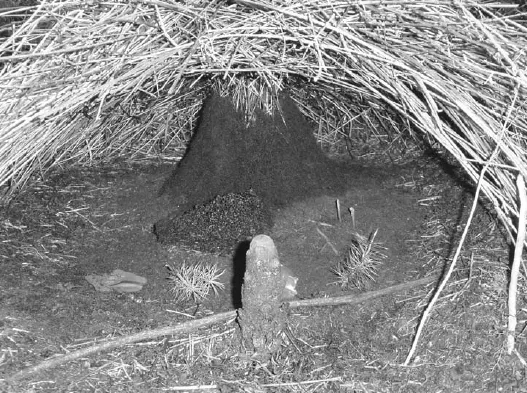
Figure 1.1 A wigwam-style maypole bower built by a male Vogelkop Bowerbird. Photo: Aniket Sardana
Four basic types of bowers have been described: the ‘court’ of the Tooth-billed Bowerbird, the ‘mat’ of the Archbold’s Bowerbird, the ‘avenue’ of the 10 species in the genera Ptilonorhynchus and Sericulus, and the ‘maypole’ of the five species in the genera Amblyornis (Figure 1.1). These maypole bower-builders are often referred to as gardener bowerbirds, because the platform areas of their bowers consist of a moss lawn, decorated with fresh leaves, flowers and berries. Currently no conclusive evidence exists to establish that male catbirds maintain a bower, although some birds have been observed laying sticks and leaves on the ground in captive situations, and some unsubstantiated historical reports talk of catbird bowers.
In most species, the bower is profusely decorated by the male. Certain types and colours of items are sought and are meticulously positioned in and around the bower in an effort to bedazzle the females. Studies have indicated that the owners of bowers with a higher number, and certain assortment of, display ornaments have more successful matings. Historically bowers were decorated with naturally occurring objects but, due to the increased spread of human habitation, a number of man-made objects are now included by some species (Figure 1.2). The male Satin Bowerbird, perhaps the most studied and widely known species, has a penchant for bright blue and violet coloured objects, which may or may not be linked to his glossy blue-black plumage and violet-blue iris. These objects include parrot feathers, flowers and berries, and pilfered objects such as blue pegs, bottle tops and straws.
Figure 1.2 Near human habitation bowerbirds use man-made objects to decorate their bowers. This Satin Bowerbird bower has over 100 blue straws. Photo: Philip Green
Other bowerbirds have a liking for different coloured objects. Males of species found in the more arid areas collect green, pale grey-brown or white objects such as berries, bones, stones and glass, while others collect snail shells, insects, seashells and snake skins. Other pilfered objects include jewellery, cutlery, coins, rifle cartridges and one bower was even found to contain a glass eye! The number of items can reach over 1000 in some bowers. Some species of bowerbird are also famed for painting their bowers. The paint consists of chewed up vegetable matter which the bird wipes onto the walls of the bower with its bill or by using a stick.
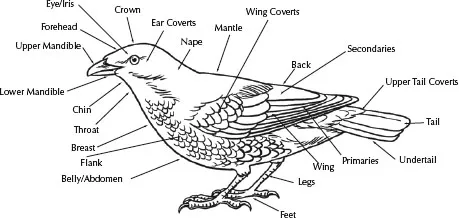
Figure 1.3 The parts of a bird most commonly referred to within this book.
In most species of bowerbirds the males have striking plumage, and the females are drab. In the catbirds, and Tooth-billed Bowerbird, however, both sexes are almost identical. The males of most species of the genus Ptilonorhynchus have a bright nuchal crest (located on the nape of the neck, see Figure 1.3), which is only erected and visible during display.
One exception is the Fawn-breasted Bowerbird, which does not have a nuchal crest, but interestingly the male still displays this part of his body during courtship. Some authors have hypothesised that the use of bower ornaments is gradually replacing the need for brightly plumaged males and evolution may lead to all male bowerbirds being uniformly coloured with highly decorated bowers.
The first species of bowerbird known to science was the Masked Bowerbird, which was described by Carolus Linnaeus (also known as Carl von Linné) in 1758. Originally the bird was depicted as a bird-of-paradise in early illustrations. The last species described was Archbold’s Bowerbird, which was named by Ernst (Walter) Mayr and Rudolf Meyer de Schauensee in 1939. Subspecies have been described as recently as 1997. On 14 July 1867 a bowerbird specimen was collected at Witton, near Brisbane, Queensland, by Henry Charles Rawnsley. The bird was described as a new species by Silvester Diggles and was named Rawnsley’s Bowerbird. The more widely accepted conclusion is that it was an adult hybrid cross between a Regent Bowerbird and a Satin Bowerbird. The specimen in question was predominantly glossy blue-back like the adult male Satin Bowerbird, with an extensive yellow wing patch, yellow tips on some tail feathers, similar to the Regent Bowerbird, and had a pale violet-blue iris. The two bowerbird genera involved are closely related and the grouping of these has been suggested (Chapter 2). Only a single specimen matching the description given for Rawnsley’s Bowerbird has been recorded since, when a bird was photographed in November 2003 in Lamington National Park near Binna Burra, Queensland, although many other wild hybrids between the Regent and Satin Bowerbirds have been recorded and photographed. Rawnsley’s Bowerbird is not accepted as a valid species.
Within species accounts measurements are given for critical body parts. These measurements cover all subspecies and populations within each species’s distributions, including New Guinea for the Spotted Catbird and Fawn-breasted Bowerbird, and thus may be quite broad in their range.
![]()
2
CLASSIFICATION AND
MORPHOLOGY
The Ptilonorhynchidae comprises 20 species, which are divided into five genera: Ailuroedus (3), Amblyornis (6), Ptilonorhynchus (6), Scenopoeetes (1), and Sericulus (4). Each of these genera are represented in Australia and four are found in New Guinea. The 20 species are also almost equally divided between the two regions with eight species endemic to Australia, 10 to New Guinea and two species, the Fawn-breasted Bowerbird and the Spotted Catbird, occurring in both regions.
The catbirds, so named because of their wailing cat-like calls, belong to the genus Ailuroedus. This group has had the most opposition to its grouping within the bowerbirds. The catbirds are monogamous (males mating with only one female in a single season), with both parents caring for the offspring, whereas all of the other 17 species are polygynous (with males mating with two or more females in a single season), with the offspring being cared for solely by the female. DNA studies indicate that the link between the monogamous catbirds and the polygynous bowerbirds dates back prior to the evolution of polygynous and bower-building characteristics. This might indicate that the catbird’s monogamous traits evolved parallel to those of the remaining bowerbirds or that the catbirds were actually once polygynous and did build bowers. This latter assumption seems unlikely, due to the results of research on cerebellum size and bower complexity (Chapter 4).
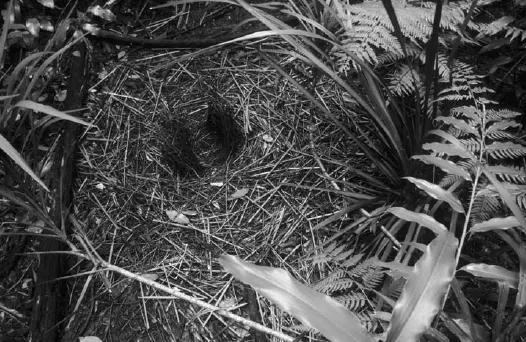
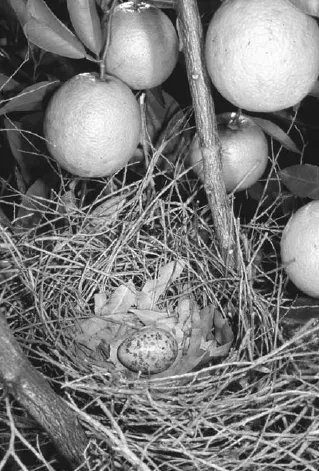
Figure 2.1 Satin Bowerbird nest and egg. The nest is constructed solely by the female. Photo: Philip Green
One of the main benefits of monogamy over polygyny is that two parent birds are able to raise and protect the young birds. Also, the eggs do not have to be left unattended and at risk if the sitting bird needs to feed, as it can be fed by its partner or swap duties with its partner while it forages. Conversely, polygyny allows the female to choose what she perceives is the best mate. The appearance of the male’s plumage is a key indicator of his health, whereas acquisition of numbers and types of display objects indicates superior foraging ability. The structure of the male’s bower is an indication of his intelligence and the ability of the male to defend his bower is an indicator of strength and dominance. The female visits several males to compare these attributes and make her choice, and thus pass these attributes on to her offspring. While both sexual systems have their benefits, it is interesting to note that over 90 per cent of bird species practice social monogamy as opposed to less than 5 per cent which are solely polygamous.
While there is a broad range in body sizes throughout the family, with smallest being the Golden Bowerbird at 230 mm, and the largest shared by the Great Bowerbird and the Archbold’s Bowerbird at 370 mm (Table 1), different sexes within the same species show little or no size difference. Different species of the same genus, however, show considerable variation across their range with the evident trend being that birds decrease in size moving south to north and at lower altitudes. This trend is referred to as Bergmann’s Rule. Developed by German biologist Karl Georg Lucas Christian Bergmann in 1847, it asserts that among closely related mammals and birds, the largest forms occur at higher altitudes and increased latitudes. The theory behind the rule is that smaller animals find it easier to keep cool, while larger animals find it easier to keep warm. While Bergmann’s Rule is most evident in northern hemisphere populations, where the increase in size correlates to the movement from north to south, the trend is still observable among southern populations.
From Table 2.1, members of the genus Ailuroedus show increased body sizes in Australia compared to those in New Guinea, with the Spotted Catbird increasing in body size due to the higher altitude occupied. Spotted Catbirds occur in both Australia and New Guinea. The birds in New Guinea are larger, even though they are at lesser latitudes, but they occupy higher altitudes. Within the genus Amblyornis there is a trend of larger species at higher altitudes, with the Archbold’s Bowerbird occupying the highest altitude and being the largest species, and the Golden Bowerbird occupying the lowest altitude and being the smallest species. This trend is less distinct but still similar in the genus Sericulus where the Australian Regent Bowerbird is the largest of all of the species and occurs at greater latitude, and the Adelbert Bowerbird, the largest of the New Guinea species, occurs at the highest altitude. The data is even less conclusive for the genus Ptilonorhynchus.
Another trend within bird populations, which is evident in the bowerbird group, is that birds occupying the more open arid areas are less colour...