![]()
Chapter 1
Energy
Summary
The primary measure of the energy value of feeds is the amount in megajoules (MJ) of metabolisable energy (ME) per kilogram of dry matter, which is designated M/D. The most generally useful methods of predicting M/D are from measurements of the digestibility of dry matter (DMD), or of the organic matter in the dry matter (DOMD), at the maintenance level of feeding.
In predicting the ME requirement for maintenance (MEm), there is an allowance for change with feeding level. Alternative equations are adopted, depending on whether the function is used in the formulation of rations at a known level of production or is used in the prediction of animal performance when ME intake is known. These two equations also include terms that allow prediction of the additional energy costs incurred by grazing compared with housed animals, and by cold stress. The net efficiency of use of ME for maintenance (km) is predicted as a function of diet quality.
The net energy requirements of gestation in sheep and cattle are estimated from functions based on those adopted by ARC (1980) and it is assumed that ME is used with an efficiency of 0.133 in meeting these requirements.
For immature animals, the energy, fat and protein contents of empty body gain are predicted with a family of equations that allow for variations in the composition of gain between species, breed, sex, stage of growth, and rate of gain. This is achieved mainly by expressing current live weight as a proportion of a Standard Reference Weight (SRW) assigned to each type of animal; with SRW defined as the animal’s live weight when skeletal development is complete and its body condition is in the middle of the condition score range. For example the SRW is higher for Charolais than Hereford cattle, for Border Leicester than medium Merino sheep, and for entire male than for castrate animals that, in turn, have higher SRW than females of the same breed. The composition of empty bodyweight change in mature animals is predicted as a function of body condition. Multiplication of the predicted values for the composition of empty body gain by 0.92 converts these to a liveweight gain basis. The efficiency of ME use for gain (kg) is not adjusted for feeding level, and is predicted with one equation for supplementary feeds and with another for grazed pasture, which accounts for a seasonal change in this efficiency.
Condition scores (CS) are defined. Relationships between change in CS and changes in live weight, body composition, production, and ME requirements are discussed. The gain or loss of body energy during lactation is related more closely to change in condition score than to change in live weight.
Tables give examples for cattle and sheep of estimates of the ME requirements for maintenance, liveweight gain and milk production but an unlimited range of estimates may be made from a spreadsheet program (ME Required) that is freely available from a website. The main equations used in making these predictions are listed in Appendix 1C. The same tables also predict performances of the animals when grazing pasture herbage of defined quality, the amounts grazed being predicted as described in Chapter 6.
Terminology
The unit of energy now used in many countries, including Australia, is the joule (J), which has superseded the calorie (cal):
1 cal = 4.184 J; 103 J = 1 kilojoule (kJ); 106 J = 1 megajoule (MJ)
The watt (W) is often used in environmental physiology to describe the rate of heat loss or gain by an animal.
1 kW = 1 kJ/s
The heat production of, for example, a 300 kg cattle beast in a thermoneutral environment and fed for maintenance is about 0.45 kW (i.e. 39 MJ/d).
Descriptions of feed energy
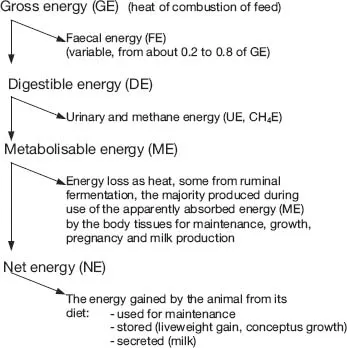
Figure 1.1 illustrates how the gross energy (GE) of feed is partitioned in the ruminant animal. The loss of energy in the faeces (FE) may be 0.65 or more of the GE of very mature, senesced material, such as grain-crop stubbles and similar materials, but with feeds of the highest quality it may be 0.2 GE or even less.
Fig. 1.1. Partition of feed energy in the animal.
The faeces contain substances of endogenous (i.e. body) as well as dietary origin so that (GE – FE)/GE describes the apparent digestibility of GE, but the terms digestibility (D) or digestible energy (DE) are generally used without qualification except when, rarely, the truly digestible coefficient is used which is: [GE – (FE – endogenous E)]/GE.
The primary description of the energy value of feeds and rations for animals is the metabolisable energy (ME) content. It is expressed in this Report, and by AFRC (1993), as MJ of ME per kg of dry matter (DM), symbolised as M/D.
ME = GE – (FE + UE + CH4E) = DE – (UE + CH4E) (1.1)
where UE and CH4E are the losses of energy in, respectively, urine and methane and on average together amount to about 0.19 DE (see p. 7). The principal source of methane is ruminal fermentation that also results in the production of heat equivalent to about 0.8 of CH4E or around 0.06–0.08 of DE (Webster et al. 1975b). This heat helps to maintain body temperature in cold-stressed animals, but otherwise it is an energy loss not accounted for in the definition of ME.
The energy of the nutrients absorbed, defined as ME, is used by the tissues with an efficiency, k, of less than 1.0, resulting in the production of heat (H) that, as a proportion of ME, is (1.0 – k). The net energy (NE) gain by the animal and its energy balance (EB) is thus (ME – H).
EB can be negative. This situation occurs when the ME intake of the animal provides less energy than it must have in order to maintain homeothermy and vital processes in, and physical activities by, its body. Energy maintenance is defined as EB = 0, when the net gain or loss of energy from the tissues, as a whole, is zero. Consequently, when EB = 0, the ME intake of the animal exactly equals its heat production (ME = H).
The NE value of a feed, as distinct from the NE gained from any particular intake, is the change (A) in the energy balance of the animal resulting from a change in the amount of that feed eaten by the animal.
NE value = EB = Δ ME – Δ H (1.2)
Its determination therefore requires the measurement of EB at two or more levels of intake, and the increment in NE gain resulting from an increment in the intake of the feed is commonly expressed as MJ per kg DM.
Utilisation of feed energy by the animal
No feed can be given a single NE value, no matter how this is expressed (e.g. NE/kg DM, NE/ME), because the value varies with the purpose for which ME is used by th...