![]()
DETAILS OF LESSER KNOWN SPECIES
Acacia anthochaera Maslin
Acacia blakelyi Maiden and
A. scirpifolia Meisner
Acacia brumalis Maslin
Acacia calamifolia Sweet ex Lindley
Acacia confluens Maiden & Blakely
Acacia hakeoides Cunn ex Benth.
Acacia hemiteles Benth.
Acacia prainii Maiden
Acacia subrigida Maslin
The following species are regarded as the next 10 best prospects, although there are no records of their seeds being consumed by Aborigines (apart from one record for A. confluens) and the palatability, nutritional value and toxicity status of their seeds are unknown. They conform exceptionally well to all other selection criteria set out under Species Selection on page 17.
Acacia anthochaera Maslin
COMMON NAME
Kimberly’s Wattle.
DISTRIBUTION
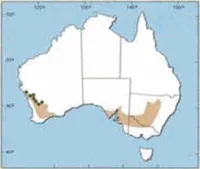
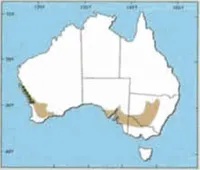
This species occurs in the central and northern wheatbelt regions of south-west Western Australia, extending from near the Murchison River south-east to near Cowcowing. In some places, A. anthochaera extends slightly east of the wheatbelt into more arid areas. It grows in flat, low-lying areas on neutral or alkaline red-brown sand or loam (sometimes with clay at depth). In the Mullewa area it is reported to grow well on saline sites (G. O’Brien, pers. comm.).
TAXONOMY
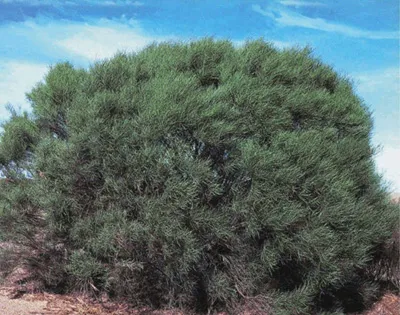
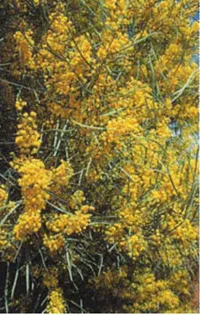
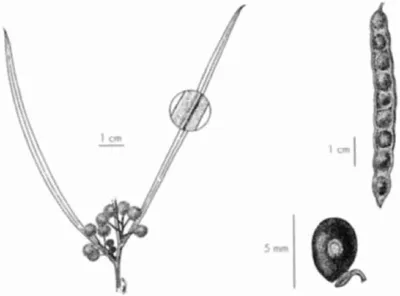
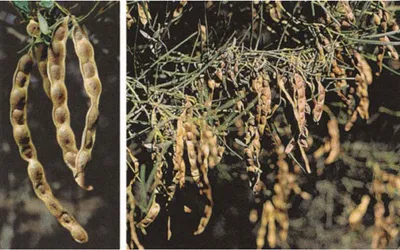
Narrow or wide-spreading, rounded, dense shrub 2–5 m tall, sometimes a tree 7–8 m tall but arborescent forms not common, branching at ground level into 2-6 (or more) straight main stems which can reach about 30 cm diam. (commonly 4–10 cm diam.). Bark fissured, persistent on main stems. Phyllodes linear, 9–15 cm long, 2–5 mm wide, straight to shallowly incurved. Inflorescences 4–9-headed racemes normally 7–15 mm long, enclosed when young by imbricate bracts; flower heads globular, bright yellow, produced in great profusion. Pods 5–8.5 cm long, 5–8 mm wide, more or less straight, pendulous, chartaceous, flat, yellow-brown. Seeds 4–5 mm long, 2.5–3.5 mm wide, funicle not expanded into an aril. A full botanical description of this species is given in Maslin (1995).
Acacia anthochaera is a member of the ‘Acacia prainii group’ (Maslin 1995). The species has limited morphological variation and, until recently was regarded as a long-phyllode form of its closest relative, A. hemiteles (see page 76). Acacia hemiteles is most readily distinguished from A. anthochaera by its smaller stature, smooth bark, generally shorter, broader phyllodes that have sticky resinous margins when young (margins not sticky-resinous in A. anthochaera) and shallowly curved to openly coiled pods. Putative hybrids between the two species occur in a few places where their distributions overlap (in the region between Beacon and Morawa.).
GENERAL USES
Acacia anthochaera is used in direct-seeding programs in the northern wheatbelt region of Western Australia (P. Ryan, pers. comm.). This species has potential as a windbreak on account of its dense porous crowns. Older plants would provide shade and shelter for stock and the stems could be a source of posts, possibly small poles and other wood products.
FLOWERING AND FRUITING
Although A. anthochaera flowers from August to October (occasionally in December) the main flush is in September.
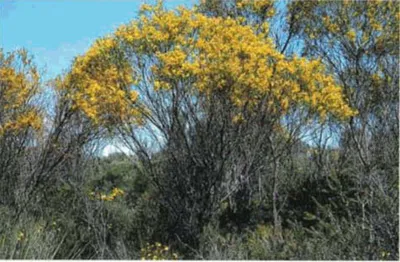
Acacia anthochaera.
Photograph: B.R. Maslin
Plants flower profusely from a young age. Pods with mature seeds have been collected from late November to January. The reliability of fruit set is largely unknown, although current evidence suggests that it is fairly regular in producing an annual crop. Sometimes, however, the plants fail to set fruit and this may be related to the timing and/or intensity of rainfall events.
SEED COLLECTION, PROCESSING AND UTILISATION FOR FOOD
The pods of A. anthochaera are produced in large quantity and are held terminally, thus they are easily accessible for collection. The seeds are medium-sized to large (about 20,000 viable seeds per kg) and although retained in the pods following dehiscence are easily separated by shaking techniques or hand stripping.
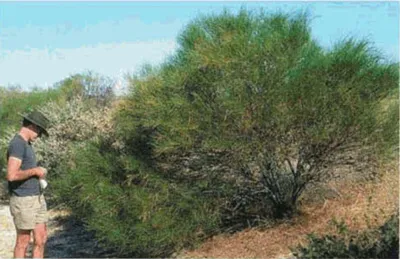
Acacia anthochaera.
Photograph: B.R. Maslin
SILVICULTURAL FEATURES
Acacia anthochaera has a moderate to moderately fast growth rate. Its coppicing ability is unknown and it has not been recorded to sucker under natural conditions.
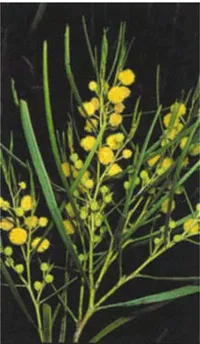
Acacia anthochaera.
Photographs: B.R. Maslin
Acacia blakelyi Maiden & A. scirpifolia Meisner
COMMON NAME
None known.
DISTRIBUTION
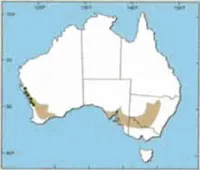
These two species have substantially overlapping, but somewhat restricted, natural distributions in south-west Western Australia, extending from near the Murchison River south to the Moora area. Acacia scirpifolia (bottom map) occurs on sand and brown sandy loam soil. Acacia blakelyi (southern form) occurs most commonly in sand or brown loam whereas the northern form of this species is normally found in yellow (gravelly) sand or sometimes in laterite.
Acacia blakelyi.
Photographs: B.R. Maslin
Acacia scripifolia.
Photographs: B.R. Maslin
TAXONOMY
Acacia blakelyi and A. scirpifolia are closely related species and the description below applies to both unless otherwise indicated. They typically grow as a dense, spreading, much branched shrub or small tree (2–4 m tall), the main trunk branching just above ground level into a few to many main stems. Phyllodes 7–20 cm long, flat and 2–5 mm wide in A. blakelyi, more or less terete and 1–1.5 mm wide in A. scirpifolia. Inflorescence an elongated 3–6-headed raceme 2–6 cm long, enclosed when young by conspicuous imbricate bracts; axis commonly growing out as a leafy shoot before flowering has ended (particularly in A. scirpifolia); flower heads globular, bright golden. Pods sub-moniliform, to 16 cm long, 4–5 mm wide, thinly coriaceous-crustaceous. Seeds 5.5–7 mm long, 2–3 mm wide.
Acacia blakelyi
Photograph: M. Fagg
Acacia blakelyi and A. scirpifolia are very closely related and future studies may show that they are best treated ...