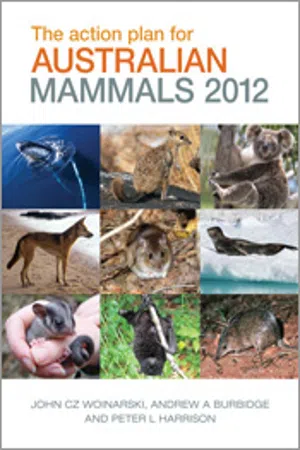
The Action Plan for Australian Mammals 2012 is the first review to assess the conservation status of all Australian mammals. It complements The Action Plan for Australian Birds 2010 (Garnett et al. 2011, CSIRO Publishing), and although the number of Australian mammal taxa is marginally fewer than for birds, the proportion of endemic, extinct and threatened mammal taxa is far greater. These authoritative reviews represent an important foundation for understanding the current status, fate and future of the nature of Australia.
This book considers all species and subspecies of Australian mammals, including those of external territories and territorial seas. For all the mammal taxa (about 300 species and subspecies) considered Extinct, Threatened, Near Threatened or Data Deficient, the size and trend of their population is presented along with information on geographic range and trend, and relevant biological and ecological data. The book also presents the current conservation status of each taxon under Australian legislation, what additional information is needed for managers, and the required management actions. Recovery plans, where they exist, are evaluated.
The voluntary participation of more than 200 mammal experts has ensured that the conservation status and information are as accurate as possible, and allowed considerable unpublished data to be included. All accounts include maps based on the latest data from Australian state and territory agencies, from published scientific literature and other sources.
The Action Plan concludes that 29 Australian mammal species have become extinct and 63 species are threatened and require urgent conservation action. However, it also shows that, where guided by sound knowledge, management capability and resourcing, and longer-term commitment, there have been some notable conservation success stories, and the conservation status of some species has greatly improved over the past few decades.
The Action Plan for Australian Mammals 2012 makes a major contribution to the conservation of a wonderful legacy that is a significant part of Australia's heritage. For such a legacy to endure, our society must be more aware of and empathetic with our distinctively Australian environment, and particularly its marvellous mammal fauna; relevant information must be readily accessible; environmental policy and law must be based on sound evidence; those with responsibility for environmental management must be aware of what priority actions they should take; the urgency for action (and consequences of inaction) must be clear; and the opportunity for hope and success must be recognised. It is in this spirit that this account is offered.
Winner of a 2015 Whitley Awards Certificate of Commendation for Zoological Resource.