![]()
CHAPTER 1
The History of Australian Butterfly Research and Collecting
M.S. MOULDS
• INTRODUCTION
Butterflies as a whole have received more attention by collectors and researchers than any other group of insects. The Australian fauna is now well documented, both systematically and biologically. Much of this research post-dates 1900 as there were few active resident workers during the early years of colonisation, and European researchers, although anxious to study New Holland butterflies, found it difficult to acquire specimens.
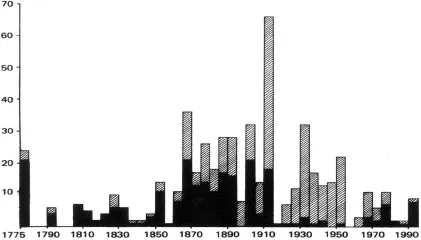
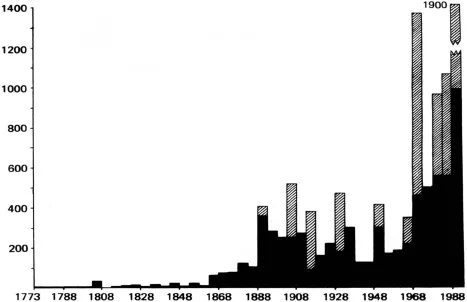
For about the first 100 years research was mostly restricted to the naming and listing of species. Although 203 species (of the 405 now known) had been recorded from Australia by 1873 (Fig. 1.1), documentation was brief. Consequently the number of pages of published text was rather limited compared with that which would be expected today, and we find the amount of printed information small until the late 1800s (Fig. 1.2). In recent years publication of Australian butterfly research has flourished. Much of this relates directly to the increased number of amateur and professional researchers and cheaper costs of printing, especially of colour plates. Since the late 1960s 11 reference books each with 16 or more colour plates have been published on Australian butterflies; during the preceding years there had been only one. Such ‘colour-filled’ publications inspire a wider community interest in Australian butterflies and, in the long term, pave the way for future research.
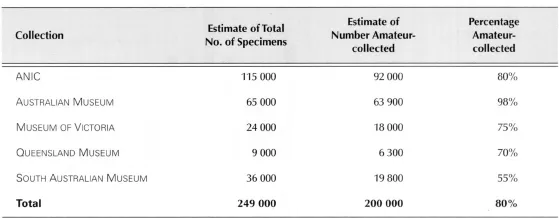
Throughout the years much of the research and collecting of Australian butterflies has been carried out by amateur workers. This situation continues today as few professional entomologists have opportunities to undertake basic research on the natural history of butterflies and even less opportunity to collect them. A survey of the literature published since 1970 indicates that some 450 publications containing original data have appeared on Australian butterflies. Of these, an estimated 280 involved about 95 different amateur authors; the remaining 170 contributions, although tending to be longer than those by amateurs, were the responsibility of some 80 professional authors. The amateur contribution to collecting, both past and present, is even greater. The majority of specimens in institutional collections have been donated by amateurs. A 1986 survey I conducted of the five largest butterfly collections in Australian museums showed that some 80% of their combined holdings were amateur-collected (Table 1.1). Much of this material has been donated in recent years following the introduction of the ‘Tax Incentives for the Arts Scheme’ which provides taxation relief for donors. Table 1.2 lists the principal museum collections of Australian butterflies held throughout the world; the total number of specimens held in these collections approximates 325 000 but it is interesting to note that all but some 48 000 are housed in Australian museums.
Figure 1.1 Rate of description of currently recognised species (black) and subspecies (shaded) with an Australian type locality. Annual totals combined into 5-yearly increments.
Figure 1.2 Approximate number of published pages* directly relevant to Australian butterflies (periodicals black, books shaded). Annual totals combined into 5-yearly increments.
*Part pages combined to the nearest number of full pages. The Australian content of broad-based publications estimated, combined, and converted to full pages. Variations in page and print sizes have been taken into consideration only in extreme cases. Only the increased size of revised editions of books included. Commissioned reports for government and conservation instrumentalities excluded. Data based on literature listings in Australian Entomological Magazine, The Australian Entomologist Moulds (1977) and Moulds unpublished data.
TABLE 1.1 Estimated holdings of butterflies (Hesperioidea and Papilionoidea) collected by amateurs in the principal butterfly collections in Australian museums
In all, more than 700 authors and collectors have been responsible for our present knowledge of Australian butterflies. Obviously I have been able to mention only those whose contributions have been the most significant in the following history. Literature references to many of their obituaries have been listed by Gilbert (1977) and Gaedike (1985).
• HISTORY OF RESEARCH AND COLLECTING
Before European Colonisation, pre-1788
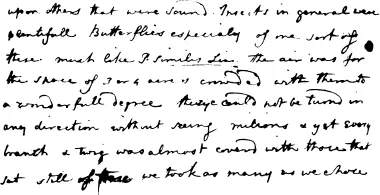
On 16th April, 1770 the Endeavour, under the command of Captain James Cook, had reached the mid Tasman Sea en route to explore the east coast of what was then known as New Holland. Here Joseph Banks, a wealthy naturalist accompanying Cook, wrote in his journal “At noon Our second Lieutenant observed a small Butterfly as he thought...”. This entry can be regarded (in the absence of any known aboriginal record) as the first recorded account of an Australian butterfly. Banks mentions Australian butterflies once more in his journal, but on this occasion numerous specimens were encountered.
Figure 1.3 Part of Banks’ journal where he begins his notes on the butterflies at Thirsty Sound. From the original manuscript housed in the Mitchell Library, State Library of N.S.W. Sydney.
Banks’s description of the butterflies swarming at Thirsty Sound was first published by John Hawkesworth in 1773 in his account of Cook’s voyage drawn from the journals of Cook,3 Banks and others and forms the first published record of Australian butterflies. However, publication of Banks’s complete journal took almost another 200 years, eventually being produced by Angus and Robertson in 1962 from the original manuscript held in the Mitchell Library, Sydney.
During the Endeavour’s voyage along the Australian coast, butterflies were collected at three locations: at Botany Bay (Kurnell) (29 April-7 May, 1770), Thirsty Sound (30 May-1 June, 1770), and at the Endeavour River (Cooktown) (18 June-5 August 1770).4 Most were taken at the Endeavour River where the Endeavour was forced to make repairs after running aground on a coral reef. Banks and his paid assistants collected nearly all the butterflies (and most of the other natural history material) but it appears that a few others also collected some butterflies, notably Bailey the astronomer.
Twenty-seven new species and subspecies collected during the Endeavour voyage were described by J.C. Fabricius in 1775 in his Systema Entomologiae. These descriptions are the first of Australian butterflies and this book was only the second publication to mention Australian butterflies. Specimens of nine other new species and subspecies were also collected but these were described at later dates by Fabricius (1792–98). An English artist, William Jones, made many fine paintings of butterflies (including some from the Endeavour voyage) and Fabricius used these paintings in describing at least four of these additional species (Waterhouse 1938).
Early Colonial Years, 1788–1860
By the time European colonisation reached New Holland in 1788, butterflies had become a popular subject for entomological collectors and researchers. The 10th edition of Linnaeus’s Systema Naturae, the work providing the foundation for modern systematic nomenclature, had appeared 30 years earlier (1758) and much of the European fauna and flora had been catalogued. Thus, Cook’s voyage of discovery in 1770 had sparked considerable interest in the many natural wonders of New Holland and this interest remained strong throughout the early years of Australian colonisation despite the difficulties for the European naturalists in obtaining specimens. In fact barely two years of settlement had ela...