![]()
1
INTRODUCTION
This book aims to provide a comprehensive presentation of the main pest and beneficial species of insects and allied forms in the main field crops and pastures presently grown in Australia. ‘Allied forms’ are other arthropods and molluscs: invertebrates that are normally managed by similar methods as those of insects. ‘Beneficial species’ included are those predators and parasitoids which are known, or thought, to provide a level of control of pest species in crops and pastures. Also included are insects introduced to Australia for the biological control of weeds, and dung beetles introduced for the dual purposes of reducing bovine dung and the bush flies that breed in it.
Each of the main crops and pasture regions in Australia is presented as a separate chapter in which the identification, biology and management of pest and beneficial species are detailed. ‘Field crops’ are those grown under extensive cultivation, as distinct from horticultural crops that require more intensive cultivation methods. To keep this book to a reasonable size, it has been necessary to arbitrarily exclude crops such as potatoes, tomatoes and other vegetable crops which, although often grown in extensive field plantings, are usually regarded as horticultural crops.
Included are pests from areas where production of some crops has recently ceased. These crops include tropical rice and tobacco, and summer cotton grown in the Ord irrigation area of WA. Inclusion is justified on the basis that the considerable pest management information developed for these crops may be useful if these crops are again produced in tropical areas.
This book aims to present the best available knowledge on the identification, biology and management of crop and pasture pest and beneficial species. The authors are field biologists with experience in particular field crops and pastures. Some of the information presented in this book has been published in mainstream scientific books and journals, but most can be found in industry or regional publications such as ute guides, fact sheets and newsletters, or in the filing cabinets of government entomologists. As such, the basis of the information presented ranges from well-founded laboratory experiments and field trials to field observations and informed guesses by experienced field biologists. In practice, there may be little basis for preferring one over the other, especially in estimating ‘action levels’, choice of monitoring techniques or pest management techniques. The criterion for inclusion is what works best in the field.
Crop, pasture and rainfall regions
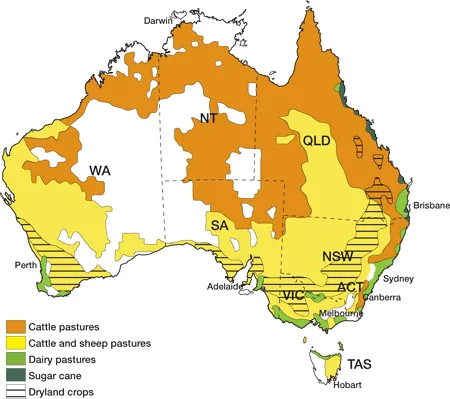
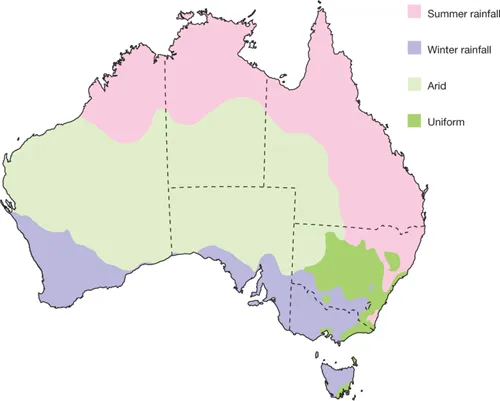
The main cropping and pastoral areas of Australia are shown in Figure 1.1 and the main rainfall divisions referred to in this book are shown in Figure 1.2.
Indicative crop areas quoted in this book are 5-year averages to 2002/2003 (Australian Bureau of Agricultural and Resource Economics 2005).
Layout of the book
In the chapters on insects of annual crops, the order of presentation of the insects is firstly related to the phenological stage of the crop in which they are first likely to cause damage (or in the case of beneficials, to exert control). Secondly, within each growth stage, insects are presented by taxonomic groups (all aphid species, for example, are presented together) in the order that they are presented in The Insects of Australia (CSIRO 1991). In the chapters on stored products insects and pasture insects, order of presentation is by taxonomic group alone.
For major pests and those with a widespread distribution, sufficient biological background is provided to enable rational decisions on their management. For insects that occur in a number of crops, a full biological background is given under the crop in which the insect causes most economic impact, while crop-specific information is provided in other crops in which it occurs. The format for a full entry is:
Fig. 1.1. Summer and winter rainfall areas of Australia. (Australian Bureau of Statistics)
Names of insects are generally consistent with those of the CSIRO Australian Insect Common Names website.
Distribution: Origin, present world distribution (by continent) and distribution in Australia.
Pest (or beneficial) status: (1) Major/moderate/minor; (2) widespread/restricted; or (3) regular/irregular.
Major: Failure to manage likely to result in significant economic loss.
Moderate: Failure to manage likely to result in some economic loss.
Minor: Damage may result in some economic loss.
Widespread: Occurs as a pest (or beneficial) over most of the range where crop is grown.
Restricted: Pest (or beneficial) in only part of the area where crop is grown.
Regular: Likely to be a pest (or beneficial) in most years.
Irregular: Not likely to be a pest (or beneficial) every year.
Identification: Size of insect. Distinctive colouration.
May be confused with: Any other organism or damage symptom with which the subject may be confused on the particular commodity.
Host range: Plants or insects (in the case of beneficials) eaten.
Fig. 1.2. Major Australian rainfall divisions. (Bureau of Meteorology, redrawn)
Life cycle on commodity: Number of generations each year, and number spent on the commodity.
Risk period: Stage of the crop and/or month(s) when the insect causes damage. (Beneficials: when they are effective.)
Damage: Symptoms and economic impact. (Beneficials: impact on pest.)
Monitoring: An indicative guide on techniques to detect significant populations of the species.
Action level: An estimate of the numbers, density, etc., at which it is cost-effective to apply control. Precision of estimates is likely to vary considerably between pest species and crops. The action level also depends on costs and the economic benefits of treatment. Action levels are provided as a guide only.
Chemical control*: Availability (including registration status) of chemicals is indicated, and whether application is cost-effective at the action level indicated.
‘Cost-effectiveness’ is an estimate based on:
• value of the crop
• cost of the chemical, including application cost
• effectiveness of the treatment
• ability of the crop to tolerate pest damage and still yield well
• prevalence and effectiveness of natural enemies.
No specific chemicals or chemical groups are mentioned other than to indicate chemicals to which resistance is recorded.
Cultural control: Includes cultural techniques, resistant varieties, and other techniques to avoid damage. May be omitted if no cultural control methods are in general use.
Conservation of natural enemies: An attempt has been made to include only those natural enemies that are effective in control on the particular commodity and whose conservation is likely to be of economic benefit. Since there is often a paucity of information to aid this judgement, natural enemies have generally been included where possible. This category may be omitted if little is known of the natural enemies of a particular pest.
*A note on registration and usage of agricultural chemicals in Australia
Registration of agricultural chemicals in Australia is the responsibility of the Commonwealth Government, presently through the agency of the Australian Pesticides and Veterinary Medicines Authority (APVMA). To be registered, an agricultural chemical must satisfy public health, food safety, occupational health and safety, environmental, trade and efficacy criteria.
Regulation of usage of agricultural chemicals is the responsibility of State and Territory Governments who, through various acts, regulate the use, storage, disposal and compliance with label instructions, including withholding periods. Pesticides acts between various states and territories are generally similar in objectives and content, but there are some differences. States may place additional restrictions on pesticide usage that further limit their registered use.
Pesticide usage may be further regulated by non-statutory means, such as area-wide resistance management agreements between farmers. Residue requirements more restrictive than those allowed for registration may be required by national and international commodity buyers. Farmers producing for organic and integrated pest management (IPM) markets may have restrictive contractual requirements for pesticide usage.
Sources of information used throughout this book
Australian Bureau of Agricultural and Resource Economics (2005). Crop Report No. 133, February 2005.
Australian Bureau of Statistics (1996). Australian Agriculture and the Environment. Catalogue no. 4606.0. Figure 2.31. p. 40
CSIRO. Australian Insect Common Names. <http://www.ento.csiro.au/aicn>.
CSIRO (1991). The Insects of Australia. Melbourne University Press, Melbourne
![]()
2
CEREALS
CEREALS—PESTS AND BENEFICIALS IN THE FIELD
D.C. Hopkins and G. McDonald
Barley,
Hordeum vulgare Poaceae. Origin: Asia, Europe
Oats,
Avena sativa Poaceae. Origin: Europe
Rye,
Secale cereale Poaceae. Origin: Europe
Triticale,
Triticosecale rimpaui Poaceae. Hybrid
Wheat,
Triticum
aestivum, and
durum wheat,
T. durum Poaceae. Origin: West Asia
(a) Tillering
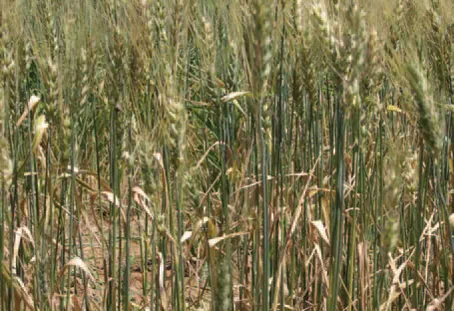
(b) Wheat
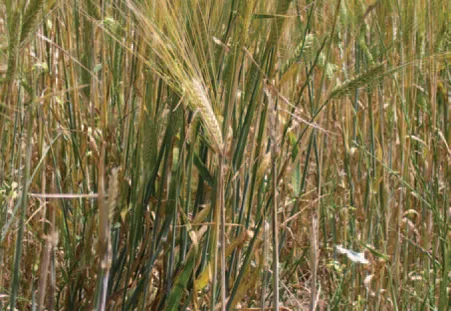
(c) Barley
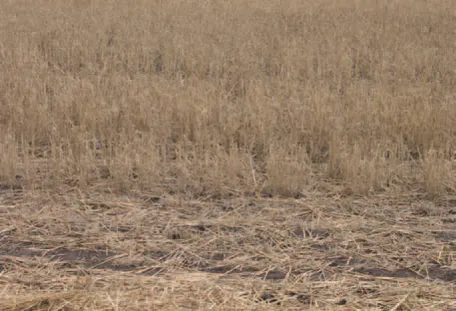
(d) Stubble
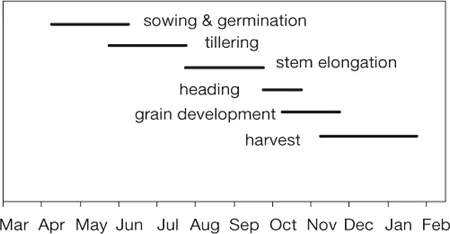
Phenology of a cereal crop in the south-eastern and south...