![]()
1
INTRODUCTION
Cockatoos belong to an order of birds known as the Psittaciformes (parrots). Parrots are widely distributed across the southern hemisphere, reaching their greatest diversity in the tropical forests of South America. They range in size from the tiny Buff-faced Pygmy Parrot (weighing only 10–15 g) to the large Hyacinth Macaw (weighing 1400–1700 g). The basic plumage colour is green, with varying amounts of red, blue and yellow. Parrots have a powerful downward-curving bill and a relatively large head. Their short legs give them a characteristic waddle, while the arrangement of toes on their feet (two forward, two backward) provides strength and dexterity. Their colourful plumage and capacity to mimic human speech have made parrots a popular cage, pet or companion bird around the world. The Psittaciformes have been divided into two families – the Cacatuidae (cockatoos) and the Psittacidae (lories and true parrots).
Twenty-one cockatoo species are currently recognised; most are large stocky birds (length 30–60 cm, weight 300–1000 g). The exception is the Cockatiel, which resembles a medium-sized parrot (length 32 cm, weight 80–100 g). Cockatoos are distinguished by the presence of an erectile crest. Most have black, white or grey plumage and, unlike other parrots, lack violet, blue, green or purple feathers. The pinks in the plumage of a number of species puts them among the most beautiful of the world’s birds. They typically have a large robust bill and muscular tongue, which combine to efficiently process the seeds and nuts on which they feed. Cockatoo skulls are reinforced around the eye, to support muscles associated with their bill’s sideways movements.
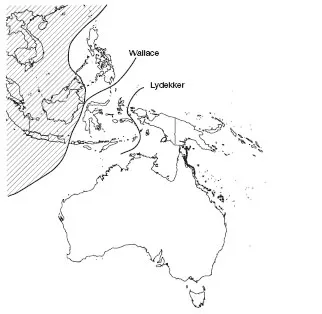
Cockatoos have an essentially Australasian distribution, suggesting that modern species arose after the break-up of Gondwana. Like many other elements of Australasian fauna, cockatoos have not reached the south-east Asian mainland or adjoining islands such as Borneo, Sumatra and Java. Similarly, many typically Asian animals have not penetrated into Australasia. The 19th-century naturalist Alfred Russel Wallace was among the first to note this break in faunal distributions. The line separating Australasian and Asian faunas is known as the Wallace Line. This line runs between the islands of Bali and Lombok, Borneo and Sulawesi, and south of the Philippines. Cockatoos are present on Lombok and Sulawesi, but not on Bali and Borneo. The Wallace Line represents the western edge of a zone of overlap between Australasian and Asian faunas. The zone is known as Wallacea and its eastern edge is defined by the Australian continental shelf or Lydekker’s Line.
Fourteen cockatoo species occur in Australia. These are widely distributed and at least one or two species can be found in most areas. The most widespread species are the Galah and Cockatiel, which occupy Australia’s vast interior. The next most widespread is the Little Corella, essentially a northern species but also found in inland regions. The Sulphur-crested Cockatoo is common in the tropical north and temperate south-east. The Red-tailed Cockatoo is widespread throughout northern and north-eastern Australia, and occurs as a number of isolated populations through central and southern Australia. Pink Cockatoos occur at low densities throughout the arid and semi-arid regions. The Glossy Cockatoo and Yellow-tailed Cockatoo are broadly distributed across the south-east. The Gang-gang and Long-billed Corella have restricted distributions in the south-east. Baudin’s Cockatoo, Carnaby’s Cockatoo and the Western Corella all have limited distributions, confined to the south-west corner of Western Australia. The Palm Cockatoo has the most restricted distribution of the mainland cockatoos – it is found only on Cape York Peninsula in northern Queensland.
Figure 1.1 The distribution of cockatoos is restricted to south-east Asian islands, New Guinea and Australia.
Three Australian species also live in New Guinea. The Sulphur-crested Cockatoo and Palm Cockatoo are broadly distributed there, while the Little Corella is confined to a small area in the south.
The remaining seven cockatoo species are distributed across the islands of South-East Asia. The Philippine Cockatoo and Yellow-crested Cockatoo have the largest natural ranges, the former throughout the Philippine archipelago and the latter across the central archipelagos of Indonesia and on East Timor. The Umbrella Cockatoo and Salmon-crested Cockatoo are restricted to the Moluccas; further to the south the Tanimbar Islands are home to the Tanimbar Corella. To the east of New Guinea, the Blue-eyed Cockatoo and Solomon Corella occupy the Bismarck Archipelago and Solomon Archipelago respectively.
Table 1.1 Cockatoo species
Scientific name | Common name |
Probosciger aterrimus | Palm Cockatoo |
Calyptorhynchus banksii | Red-tailed Cockatoo |
Calyptorhynchus lathami | Glossy Cockatoo |
Calyptorhynchus funereus | Yellow-tailed Cockatoo |
Calyptorhynchus latirostris | Carnaby’s Cockatoo |
Calyptorhynchus baudinii | Baudin’s Cockatoo |
Callocephalon fimbriatum | Gang-gang Cockatoo |
Eolophus roseicapillus | Galah |
Lophochroa leadbeateri | Pink Cockatoo |
Cacatua tenuirostris | Long-billed Corella |
Cacatua pastinator | Western Corella |
Cacatua sanguinea | Little Corella |
Cacatua goffini | Tanimbar Corella |
Cacatua ducorpsii | Solomon Corella |
Cacatua haematuropygia | Philippine Cockatoo |
Cacatua galerita | Sulphur-crested Cockatoo |
Cacatua sulphurea | Yellow-crested Cockatoo |
Cacatua ophthalmica | Blue-eyed Cockatoo |
Cacatua alba | Umbrella Cockatoo |
Cacatua moluccensis | Salmon-crested Cockatoo |
Nymphicus hollandicus | Cockatiel |
On the Australian mainland, the most commonly encountered cockatoos are those occupying open habitats. The Galah, Little Corella and Cockatiel are the archetypical open-country species. The long-billed corellas and some populations of Black-cockatoos also fall into this category. Open-country species typically feed on the ground on a wide range of grasses and herbaceous plants. Seeds dominate their diet, but they also eat other plant parts. The widespread availability of suitable habitats and a generalised diet mean that even prior to European settlement many open-country species were widespread and abundant. Their natural ecology has allowed most to take advantage of changes in the Australian environment. Open-country species typically form large flocks, especially where food is concentrated. They are often considered agricultural pests, and their destructive chewing habits and noisy antics mean they can be a nuisance in urban areas.
Australian cockatoos occupying woodland or forest habitats are less readily observed. They are most commonly encountered in family groups or small flocks. This group is dominated by the Black-cockatoos, but also includes the Gang-gang Cockatoo. Woodland-forest species feed mostly in the canopy on the seeds of trees (e.g. Eucalyptus, bloodwoods) and shrubs (e.g. banksias, hakeas, sheoaks). Many have a relatively specialised diet and their bills have evolved to help access and process their favourite food. Invertebrates feature more prominently in the diet of this group of cockatoos, and may be especially important to some species. With some exceptions, woodland and forest...