![]()
1 Introduction
The Australian cockroach fauna is remarkable in its extent, colour and biology. Cockroaches occur in every habitat on the continent except in seas and lakes. The diversity of species is only just being appreciated. At my home in the Kuranda rainforest, I have recorded nearly 90 species ranging in size from 4 mm to 35 mm in virtually all habitats from the treetops to on, and in, the ground. They are major components of leaf-litter fauna. Their numbers suggest that they must be important in the return of the litter to soil, as well as food for other organisms. They occur along watercourses and there is at least one Australian aquatic cockroach whose water-loving habits has been observed but is not yet recorded in the literature.
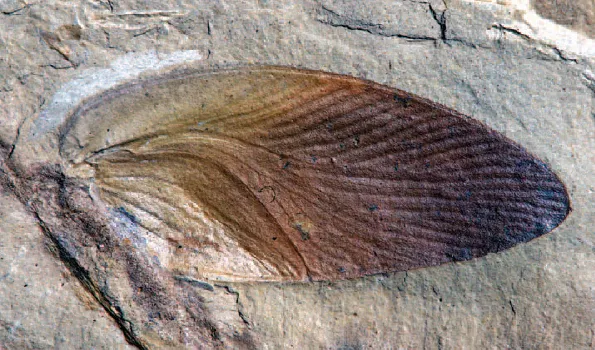
A fossilised cockroach wing from Molteno Formation, South Africa, Triassic Age, 200 mya. Photo: L Smith
Cockroaches are blattodeans that are orthopteroids – most closely related to termites and mantids. They are well known in the fossil record and seem to have been especially abundant in the late Palaeozoic, some 300 million years ago. There is a very well-preserved fossilised blattodean wing from the Molteno Formation, which is situated in the heart of the semi-desert Karoo Basin of South Africa. This site has the richest known flora and insect fauna at about the time of origin of the mammals, dinosaurs and possibly the flowering plants in the Late Triassic. It is thought that blattodeans split from the common ancestor they shared with the mantids during the Lower Cretaceous about 140 million years ago. The early blattodean-like species have been dubbed ‘roachoids’. They had external ovipositors but the flattened body characteristic of cockroaches today.
This specimen of Polyzosteria fulgens from the Perth region is hardly a disgusting creature.It is attractive, sedate and moves about in its habitat by day. Photo: J & F Hort
A large native Australian cockroach, Anamesia serrata, a common inhabitant of the arid northern and central portion of Australia, p. 127. Photo: D Marshall
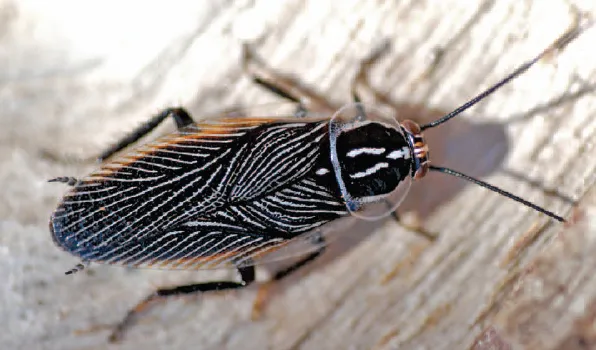
This colourful cockroach may represent an undescribed species. It is related to Balta hebardi (p. 264) but has very different pronotal markings. Usually these marks are diagnostic for species. This cockroach was photographed in a Perth suburb suggesting that you do not have to go far to find beautiful and interesting blattodeans. Photo: J & F Hort
Recent research, using DNA, biology and other characteristics indicates that termites are actually in a lineage of cockroaches and should not be allocated a separate order in the world of insects. They are merely modified Blattodea that are most closely related to the wood-feeding cockroaches of the genus Cryptocercus! It has been suggested that the initial oötheca-like packet of eggs in cockroaches were cemented together as is found in the Australian termite, Mastotermes darwiniensis. This termite extrudes eggs in packets of two and covers them with a tanned outer layer that is similar to the cockroach oötheca. It is believed that the mantids diverged first and the cockroaches and termites are nested within the Blattodea. The North American cockroach genus, Cryptocercus, represents the sister group to the termites.
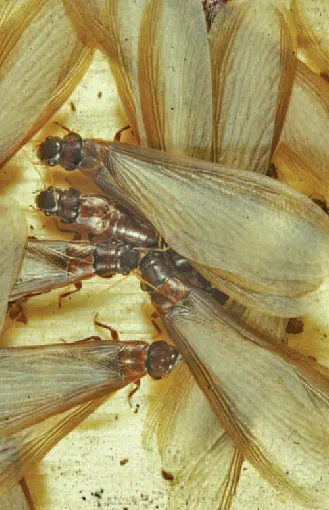
The winged form of the Australian termite Mastotermes darwiniensis has had an important role in the discovery of the relationship between termites and cockroaches. Photo: M Lenz
Although termites are technically blattodeans, this book is only concerned with the families of ‘true’ cockroaches: Nocticolidae, Corydiidae, Blattidae, Ectobiidae, Tryonicidae and Blaberidae that occur in Australia.
Cockroach diversity in Australia
The cockroach component of the order Blattodea is of moderate size with approximately 4500 species in 460 genera worldwide. It is expected that the number of blattodean species will increase dramatically because some of the diverse families, such as the Ectobiidae (previously known in most studies of the Australian fauna as the Blattellidae) are, as yet, very poorly studied. More than 530 species are now recognised from Australia and in excess of 90% of these are considered endemic. At least twice that number of Australian species are yet to be described.
Cockroach taxonomy and biology can be a rewarding pursuit in Australia because many groups have been little studied.
Some of the world’s smallest and largest cockroaches are found in Australia. Adults of Nocticola can measure as little as 3 mm in length, while those of Macropanesthia rhinoceros are up to 80 mm in length and rank among the heaviest of insects, sometimes weighing 33 grams.
Intensive collecting and trapping at my home at Kuranda in the tropical rainforest of north Queensland has revealed a rich diversity of species not seen elsewhere. An array of families is present and 88 species have been identified to date. Most have been determined on the basis of several characters with the most distinguishing being the minute details of the male genitalia.
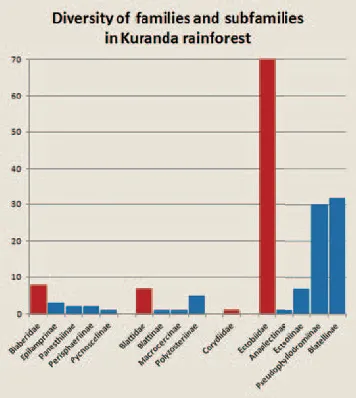
Of the 88 species, 70 (79%) are in the Ectobiidae, the most diverse family in Australia. The Blaberidae follow well behind with only 8 species (9%). Others are illustrated in the graphs. This further suggests the importance of cockroaches in the environment since almost all of the ectobiids occur in leaf litter. They must be very important in the decomposition process. Virtually every handful of leaf litter contains cockroaches, often several species in various stages of development. It would be educational to perform detailed census of cockroaches in other habitats around Australia. A similar result may be obtained, although the total number of species may not be so great. Collections in coastal mixed closed forests in coastal New South Wales (including Bawley Point) during the 1990s revealed about two dozen species. Cockroaches may be the most abundant of orthopteroids, both in numbers and diversity in all habitats in Australia.
Origins and affinities
The Australian cockroach fauna contains endemic elements as well as those derived from other regions of the world. There are many endemic genera, mostly in the Blattidae, in the subfamily Polyzosteriinae (p. 121) and many Blaberidae (p. 72), especially the Epilamprinae, Panesthiinae. Genera in several subfamilies of the Ectobiidae (p. 196) are endemic to Australia.
The red columns illustrate the families found in the kuranda rainforest. The blue columns represent the subfamily against the number of species on the vertical axis.
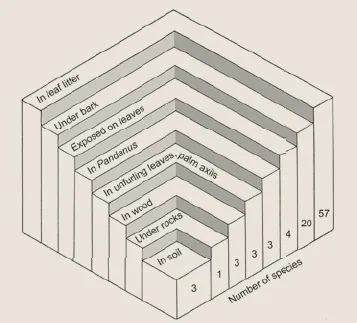
Habitat preferences of species in kuranda rainforest. Some species overlap, at least during part of their lifetime. Most of the standing trees in the rainforest have bark that does not flake or dehisce. As a result it is generally a habitat not used by cockroaches as it is in eucalypt woodlands. This suppresses the number of species that may be found under bark in the rainforest. The great majority of species live in leaf litter and are probably very important in its decomposition.
There are many genera in all of the families that are shared with other regions of the world, especially the tropical regions to the north. Genera such as Shelfordina and Balta in the Ectobiidae occur in New Guinea, Indonesia, Malaysia and other parts of south Asia. Methana, here placed in the Blattidae (p. 112), occurs in the Oriental Region as well as Australia and Norfolk Island. Blattids like Polyzosteria, occur in New Zealand as well as the Oriental Region and New Caledonia. Celatoblatta (and its synonym Austrostylopyga) occurs in both Australia and New Zealand. The genus Tryonicus occurs at high elevations in northern Australia and New Caledonia. It is a relict that requires cool temperatures and could be threatened by the warming of climate change as are other organisms living on mountaintops in the northern tropics.
The introduced cosmopolitan species are generally not found in nature. Some exceptions are the Australasian Cockroach, Periplaneta australasiae, and the Dusky Cockroach, P. fuliginosa, which can be found short distances away from human habitation. The Surinam Cockroach, Pycnoscelus surinamensis (p. 104), seldom enters homes but can be found outside in tropical and subtropical regions in compost or in roof gutters. Oddly enough it is not found far from human habitation. An Australian species, The Coulon, Paratemnopteryx (formerly Shawella) couloniana, has been introduced from Australia to New Zealand where it can be a pest. It can also enter dwellings in Australia.
Cave-dwelling cockroaches
Australia has an abundance of cave systems. Some have been studied more than others, but in general the biota of these systems is considerable but largely undescribed. The cockroaches are a notable exception, in that several species have been described. Cockroaches can be found in all of the cave systems.
Australian caves can be found in the tropics, subtropics, subtropical dry zones and transitional zones with winter rain. Both karst limestone caves and tunnels and lava (lava tubes) occur in Australia. Examples include the Cape Range of north-western Western Australia which is an extensive karst system and the Undara and Chillagoe Caves of tropical north Queensland which are lava tubes.
Cave systems in Australia harbour some of the world’s most interesting dark-adapted cockroaches. The arid Cape Range supports one of the world’s richest cave biota. The Cape Range attains an altitude of only 330 m but there are more than 600 limestone caves to 100 m depth. The fauna there is entirely endemic and is derived from rainforest species that used to occupy the area. One of the most spectacular is Nocticola flabella (p. 107), the most cave-adapted cockroach in the world. It is extraordinarily long-legged and lacks pigmentation and eyes. Its exoskeleton is so thin that only the mandibles and genitalia are normally sclerotised.
Blattelline ectobiids (p. 203) contribute the majority of species found in Australian caves. They can be large and well sclerotised, like Trogloblattella nullarborensis or small and delicate like Paratemnopteryx stonei. This species exhibits considerable morphological variation and occurs in caves some 150 km apart. Approximately half of the known species of Neotemnopteryx are cave dwellers, while the terrestrial species are presently found along the east coast of the continent.
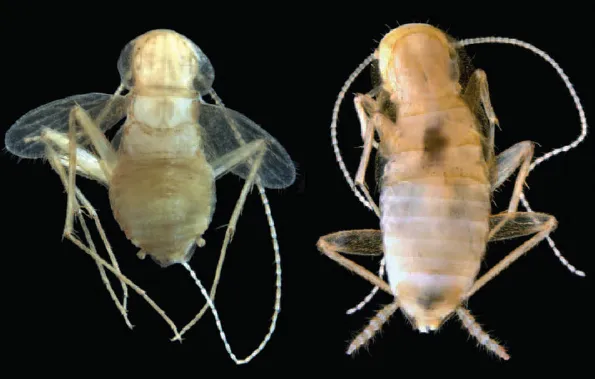
The spectacular Nocticola flabella is the most cave-adapted species in the world. Male (left) and female (right). Photos: J McRae
The family Nocticolidae (p. 105) has an Old World distribution but Nocticola species can be found in the Philippines, Vietnam, Ethiopia, South Africa and Madagascar as well as Australia. Christmas Island harbours the only known species of Metanocticola, the only species from that locality covered in this book.
Cave cockroaches feed on a variety of material depending on how far they are found from the entrance of their caves. The Nullarbor Cave Cockroach, Trogloblattella nullarborensis, is known to feed on tree roots. Other species found in the presence of bats feed on dead bats or guano from bats or swiftlet birds.
What is a cockroach?
Cockroaches have a dorso-ventrally flattened body with the head directed downwards, and bearing chewing mouthparts. Cockroaches undergo gradual metamorphosis and usually have short lifecycles. Males and females of many species are dissimilar. Many have highly specific ecological preferences and elaborate biological lifestyles. They involve activities as diverse as parental care, Müllerian mimicry, host preferences and chemical defence.
Interest in blattodean classification has been very popular over the years partly because there is a rich fossil history of the group, a considerable diversity of extant species a...