![]()
Chapter 1
Australia’s woodland heritage
It was once possible to walk from Melbourne to Sydney through almost continuous woodland. A traveller in the early nineteenth century passing through this part of south-eastern Australia would have encountered an astonishing diversity of woodland types including: grey box woodlands, black box woodlands, white box woodlands, and woodlands with mixtures of tree species such as yellow box and Blakely’s red gum. In the wetter areas along creeks and streams, our traveller would have encountered magnificent stands of river red gum.
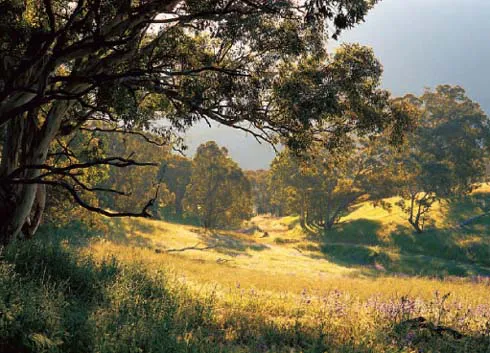
Grassy woodlands – a once typical scene in temperate Australia. The large, relatively open spaces between trees are one of the classic features that helps distinguish woodlands from forests.
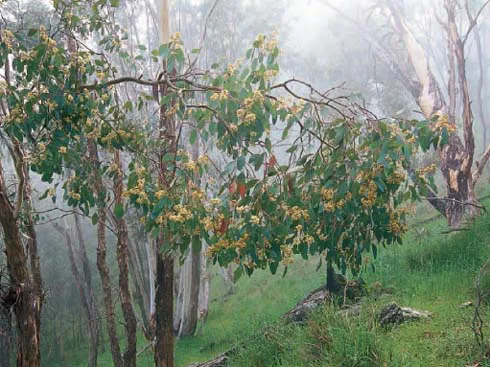
Blakely’s red gum typically flowers between August and December and, like most eucalypts, larger older trees flower more intensively and for longer than smaller regrowth stems and saplings. Different species of woodland eucalypts flower at different times – enabling wildlife that feed on pollen and nectar to harvest food resources across much of the year.
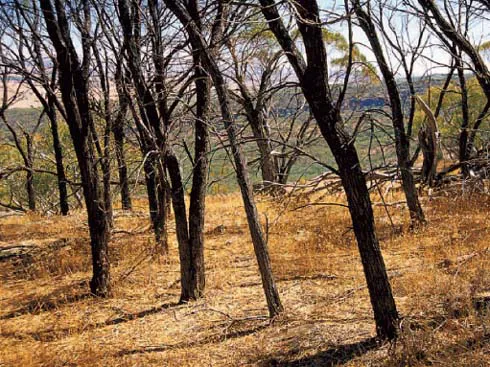
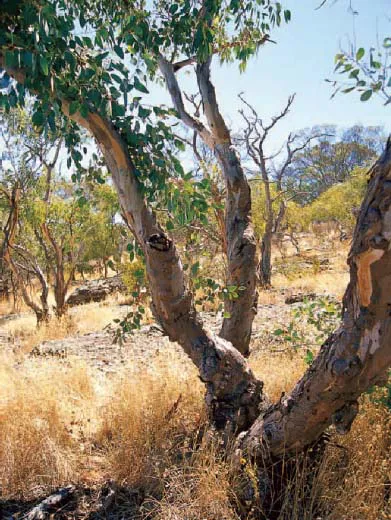
Not all woodlands are dominated by eucalypts. Dominating this woodland is currawang, a species of wattle that often occurs on welldrained rocky ridges and hillslopes.
Today most of these woodlands have gone. Of those that remain, most have been extensively altered by land use practices adopted since European settlement. As an example, 85 per cent of the original cover of native vegetation – much of it woodland – has been removed from the South West Slopes of New South Wales, making the area the most disturbed of the 13 botanical regions of that State. Huge tracts of woodland also have been lost from the Australian Capital Territory and northern Victoria and the remaining temperate woodlands in these regions are often highly degraded.
What are woodlands?
Woodlands are a broad category of vegetation in which stands of dominant trees are distinguished from those in forest and rainforest by their height, spacing and crown cover. Perhaps the most workable definition of woodland is that of Richard Hobbs: ‘ecosystems that contain widely spaced trees with their crowns not touching’.
Mallee red gum typically occurs on ridges and stony rises. This stand is at the foothills of Table Top Mountain, near Albury in southern New South Wales.
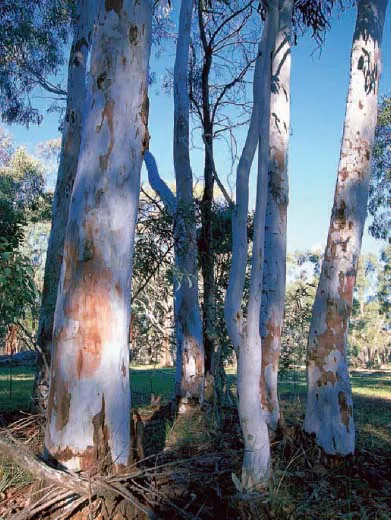
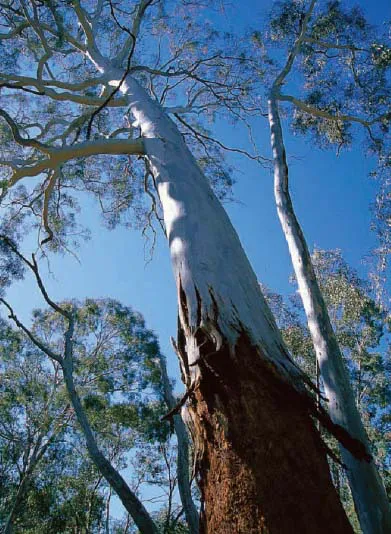
Brittle gum is a distinctive fine-leaved, white-barked woodland tree that grows in association with other eucalypts such as scribbly gum, red stringy-bark, Blakely’s red gum and red box.
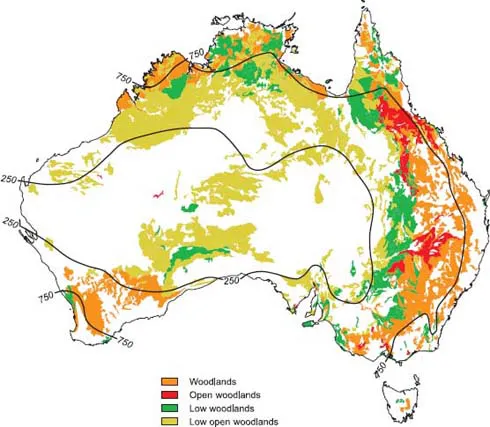
The distribution of broad woodland types in Australia
Source: redrawn from Johnson, 2003.
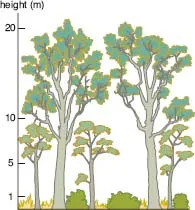
Many kinds of typical woodland have a canopy layer, an understorey and a ground cover.
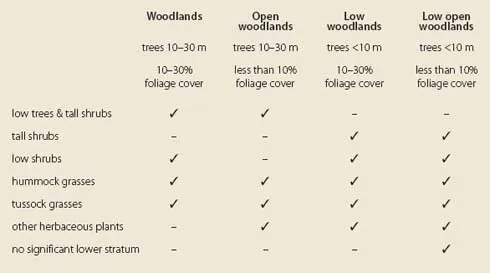
The four broad types of woodland in Australia are distinguished by the height of the trees and their foliage cover. Within these categories there may be a range of understorey and ground cover types.
Source: Hobbs, 2002 using information from Specht, 1970 and AUSLIG, 1990.
Scribbly gum is a woodland tree found widely throughout southeastern Australia, and is typical of places with poor soil. As a result, its growth is sometimes quite stunted – adult trees may be as little as 10–15 m tall. The smooth white bark with ‘scribbles’ – made by the burrowing of insect larvae – is one of the characteristic features.
This makes it clear that it is not only the tree spacing (which often gives woodlands a park-like appearance) that is important, but also the attributes of the tree crowns which help broadly define woodlands. The crowns of trees are often characterised by a measure called ‘projected foliage cover’, or the proportion of the ground covered by the vertical projection of the vegetation. In woodlands this is typically between 10 and 30 per cent (except in dense regenerating stands comprised of many small saplings). That is, the crowns of the trees shade less than 30 per cent of the ground.
Projected foliage cover can be a useful general way to distinguish woodlands from other broad types of vegetation. For example, tropical rainforests are tall and have very high cover values with more than 90 per cent of the surface of a site covered by the tree crowns which are often 30 m or more above the ground. Temperate eucalypt forests may be just as tall, or taller, but the crown cover of the tallest trees is usually around a third of that of their tropical counterparts.
The height of the trees is another important feature defining a woodland. Woodland trees rarely exceed 30 m tall, but they may be shorter than 10 m – depending on the productivity of the environment and, in particular, the rainfall. In contrast, open forests and rainforest trees can attain heights of 40 m or more and sometimes exceed 80 m (as in the majestic wet eucalypt forests of Tasmania, Victoria and south-western Western Australia). Another characteristic of mature woodland trees is that the depth of the crown is often the same or greater than the length of the trunk. Put another way, the stem (or bole) never exceeds half the tree height.
Many woodlands are dominated by eucalypts – a group of trees that has diversified enormously across Australia. This is only paralleled by wattles (Acacia spp.) – the largest genus of flowering plants in Australia with over 1000 species – and by the oaks (Quercus spp.) in the Northern Hemisphere. More than 80 per cent of Australia’s 650 or so species of eucalypts are found in woodlands. However, there are also substantial areas of woodland dominated by other tree species such as she-oaks (Casuarina spp.), native cypress pines (Callitris spp.), paperbarks (Melaleuca spp.) and banksias (Banksia spp.).
Our definition of woodlands encompasses a huge variety of native vegetation types across large parts of Australia. At the time of European settlement, they covered nearly 30 per cent of the continent from the tropical north, the semi-arid interior of the continent, to south-western and south-eastern Australia (including Tasmania).
Types of woodlands
Within our broad definition of woodlands, it is possible to further recognise four broad sub-categories based on tree height and crown cover. These are woodland, open woodland, low woodland, and low open woodland. The table opposite details the features used to distinguish these sub-categories. As with almost all classification systems, the boundaries between the various sub-categories of woodland are artificial, and on the ground there are many cases where one type grades slowly into another.
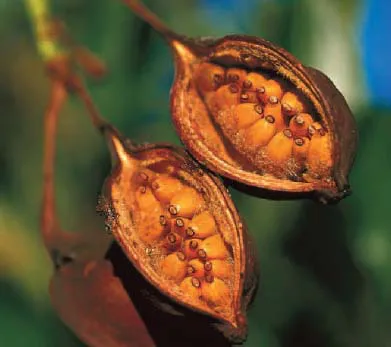
Kurrajong trees are a familiar part of woodland landscapes in many parts of south-eastern Australia. The name comes from an indigenous word meaning ‘fibre-yielding plant’. Aboriginal people used the inner bark fibres for making nets; they ate the seeds as an excellent source of fat and protein (after burning the pods to remove the sharp hairs). The tap roots of young saplings also were a valuable source of food.
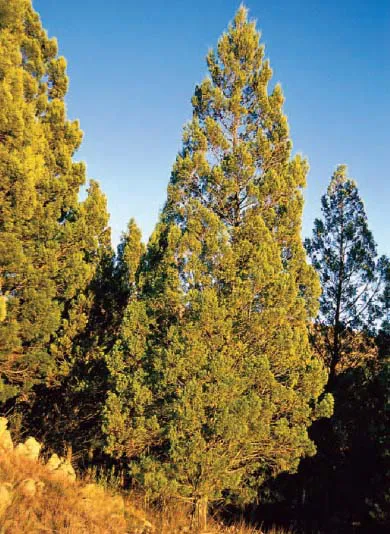
Black cypress pines are sometimes found in temperate woodlands – particularly on rocky ridges. They also may be a dominant tree species, forming extensive single species stands. The wood of the black cypress pine is highly prized because it is termite resistant. Aboriginal people also had many uses for cypress pine; they used its wood for canoe poles and woomeras, and its resin as a glue.
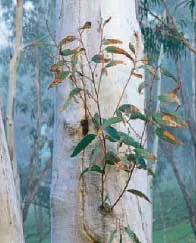
Candlebark has distinctive whorled strips or ‘candles’ of bark on the trunk. It occurs widely from forests in high elevation montane areas and tablelands through to woodlands. Its scientific name, Eucalyptus rubida, refers to the fact that it seasonally develops beautiful patches of red bark on the trunk. Like many species of gum-barked eucalypts, candlebark often has scars on the trunk caused by burrowing insects.
Long-leaved box is a widely distributed woodland and open forest eucalypt. It has rough, persistent and deeply-fissured box-bark on the trunk, helping to distinguish it from the many other trees species that occur in temperate woodlands.
A full study of all woodland types is impossible in a book this size, so we will focus on temperate woodland – the tallest and least open of the sub-categories of woodland – found in temperate areas of Australia.
Australia’s temperate woodlands
Temperate woodlands are found primarily to the west of the Great Dividing Range from southern Queensland, through New South Wales and the Australian Capital Territory, into Victoria, Tasmania and the south-east of South Australia (see page 4). These woodlands support scattered or widely spaced trees, 10–30 m tall, with a projected foliage cover of 10–30 per cent. Such woodlands are generally interfaced between taller, wetter forested areas on the coast and the drier, hotter grasslands and shrublands of the interior (see page 4). This area coincides strongly with the nation’s major wheat–sheep belt and much of the original vegetation cover has been ...