![]()
Chapter 1
Introduction
Contact
‘Have you got any ideas on how to make a better banknote?’ asked Dr J.R. (Jerry) Price as he walked into the office of Dr Dave Solomon in the CSIRO research laboratories at Fishermens Bend on 25 March 1968.1 Dr Price was the Chairman of CSIRO and Dr Solomon a polymer scientist in the CSIRO Division of Applied Mineralogy, recently recruited from BALM Paints Pty Ltd (now Dulux Pty Ltd).
‘The budget can’t be that bad’ would have been the smart reply. What Solomon actually said was ‘What about plastic paper?’ to which Price replied, ‘That sounds all right. Why don’t you get some samples?’ The occasion was the defining moment in Solomon’s career, the careers of many CSIRO scientists, the history of banknote technology and the commercialisation practices of CSIRO.
Professor Ken McCracken reports a more dramatic incident.2
The phone rang.
‘Professor McCracken?’
‘Yes.’
‘Professor Ken McCracken?’
‘Yes, that’s right.’
‘You are in the Physics Department of the University of Adelaide, and have worked for NASA in the USA?’
McCracken began to wonder what the man was up to. It didn’t get any clearer.
‘Could I come and discuss something with you?’
‘What will it be about?’
‘Oh, I’m sorry, I can’t tell you that.’
‘Well, whom do you represent?’
‘I can’t tell you that either.’
Professor McCracken eventually agreed to the meeting.
Price and McCracken’s visitor explained that the Reserve Bank of Australia (‘the Bank’), in particular its Governor, Dr H.C. (Nugget) Coombs, was very concerned about the quality of the recent $10 forgeries and was seeking ideas from some of Australia’s leading scientists on how to produce a more secure banknote. This book is the story of the project that emerged from those discussions, that eventually led to the introduction of plastic banknotes in Australia and subsequently many other countries. We refer to this as the ‘Bank project’.
The introduction of decimal currency
The 1966 decimal currency, both banknotes and coins, was important in the development of a more independent Australia. In his policy speech for the December 1958 election Prime Minister Robert Menzies announced on behalf of the government that ‘We accept the principle of decimal coinage. We will set up an independent committee to advise how and when and on what terms to effect this reform.’3 The committee was formed in February 1959 and reported in August 1960, recommending firmly in favour of decimal currency. The government took until April 1963 to announce that it had accepted the committee’s recommendations in full and February 1966 was tentatively set as the date for the introduction of the new currency. The government set up a public competition to find a name ‘with an Australian flavour’ for the new currency. Nearly 1000 names were suggested including ‘austral’, ‘boomer’, ‘kwid’ and ‘ming’ (the nickname of the Prime Minister). No consensus emerged and in June 1963 the government announced that it had decided to name the new currency the ‘royal’. This proved most unpopular. In July 1963 the Treasurer, Harold Holt, stated to Cabinet:
There can be no doubt that we made a very unpopular choice of name ... We selected ‘royal’ because it was distinctive, euphonious, met the technical considerations and had an interesting historical association with the British currency ... Of the choices open to us the least unsatisfactory – uncomfortable and embarrassing though it might be – is to admit that we have misjudged the public acceptability of ‘royal’, that we recognise the controversy surrounding it has greatly strengthened public support for ‘dollar’, and that in a matter where members of the public are so directly and personally involved, we should meet what we have gathered to be a wish for a change to ‘dollar’.4
Cabinet agreed and on 19 September 1963 the government announced that ‘dollar’ would be the name of the new currency.5
The Bank decided to attempt the ambitious task of designing a new series of banknotes and producing and distributing them by Decimal-Day, 14 February 1966. It acted quickly and decisively. It appointed Russell Drysdale as artistic adviser and commissioned four artists (Gordon Andrews, Richard Beck, Max Forbes and George Hamori) to prepare preliminary designs. The designs by Gordon Andrews were accepted and in April 1964 detailed designs were commenced in Milan by the specialist banknote printing firm Organisation Giori. New banknote printing machinery was obtained from Thomas De La Rue of the UK and the first banknotes were produced in June 1965.6 The changeover to the new currency was well planned and executed, including a very effective public education campaign. By April 1966 most of the imperial banknotes had been withdrawn from circulation. The public acceptance of the change from pounds, shillings and pence to dollars and cents, the bold new banknotes, was better than the Bank had expected.
The new banknotes were state of the art in terms of security and resistance to forgery attempts. The $10 banknote of 1966 is shown in Plate 1. It was made with quality paper (a so-called rag paper made out of cotton and linen fibres). Security features included a watermark ~25 mm square and a metallised plastic thread which ran through the banknote, both introduced during manufacture of the paper, and quality printing called intaglio, which gives a raised print profile and contributes to the characteristic feel of a quality entity such as a banknote. Intaglio printing requires expensive equipment not readily available to small forgery groups.
Forgeries!
It took less than a year for forgers to pass a fake $10 banknote. Forgers don’t have to reproduce a banknote accurately; they only need to produce a simulation that is good enough for at least one transaction. The 1966 forgery involved ordinary paper purchased at a regular office supply outlet, and no intaglio printing. The forged notes had no watermark and no metal thread, although both were simulated during the printing process, the latter via a printing ink that contained aluminium flakes. The forgers used simple office equipment which they had modified in quite an ingenious manner, but nevertheless they had been able to forge the banknotes with readily available raw materials and equipment.
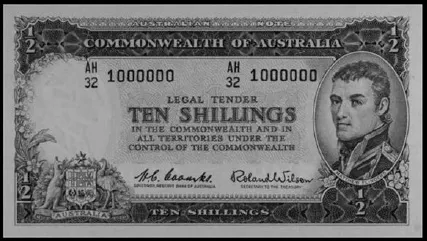
The forged banknotes resulted from a plan conceived in the south-east suburbs of Melbourne.7 Francis Papworth, an artist from Bentleigh, got to know Jeffrey Mutton when Mutton owned a milk bar in Moorabbin and Papworth worked at a printing plant nearby. They met occasionally at the Boundary Hotel in East Bentleigh. On one of these occasions in January 1966 they discussed whether Papworth and his friends in the printing business could forge a 10 shilling banknote if Mutton could provide some finance.8 The choice of the 10 shilling note (Fig. 1.1) was curious as forgers generally choose a higher-denomination note. They decided that it was feasible; Mutton agreed to be in the scheme and enlisted Dale Code, described in newspaper reports as either a sales representative or a tailor, with whom Mutton had business dealings. On 14 February 1966 decimal currency was introduced into Australia and they agreed that it would be easier to forge the new $10 note. They weren’t daunted by the state of the art security. One of Papworth’s friends, Ronald Adam, a photographer from Ferntree Gully, needed about $800 to buy a lens to photograph the genuine notes in order to make the printing plates. Neither Mutton nor Code had that amount of cash so, without informing Papworth, they approached a ‘safe-breaker’ known to Mutton to finance the scheme. Mutton gave evidence to a court hearing in 1969 that the person was Robert ‘Bert’ Kidd.9 The safe-breaker agreed on the condition that he had complete control of the distribution of the forged notes. Mutton and Code agreed to that condition but never intended to honour the agreement. However, if they had followed the professional criminal’s plan the outcome could well have been much more successful for the forgers. Kidd’s plan was to buy opals from the opal fields with the forged notes and then sell the opals for cash. The rest of the forged notes would be sent to moneychangers in Hong Kong, who would not be familiar with the new Australian notes.
Fig. 1.1: A 10 shilling banknote.
When Papworth’s printer pulled out of the scheme Code decided that he could learn enough about printing to do it himself. With the underworld figure’s cash, Code and Mutton purchased a Gestetner 201 four-colour offset printer and had it installed in Code’s sister’s garage in Beaumaris.10 Code had one week’s training from Gestetner and spent some time in the State Library studying books about printing. During this time Adam was preparing the printing plates. Papworth’s only contributions were drawing the watermark on paper for Adam to photograph and touching up the printing plates. Adam was aghast when he discovered that Mutton and Code were going to do the printing themselves but gave them some advice on colours and on the technical limitations of the Gestetner machine. Mutton and Code devised ingenious modifications which reduced the number of passes needed to produce a multi-coloured banknote. They tried various types of papers before settling on Original Charter Mill paper, burning their failures in an incinerator in the backyard of Code’s sister’s house. By early December 1966 they had worked out how to produce a passable banknote; they classified the quality as ‘A’, ‘B’ and ‘C’. It is difficult to know exactly how many banknotes they produced. There were probably about $200 000 worth of A notes, about $400 000 worth of B notes and possibly about $200 000 worth of C notes (see Plate 2). Mutton and Code thought that the notes did not ‘feel’ right, so at the last minute coated them with wax. Mutton and Code dismantled the printing machine after they finished the production runs. Kidd collected the dismantled parts and disposed of them.
After the notes had been printed, instead of giving them all to Kidd, the notes were divided five ways between Papworth, Mutton, Code, Adam and Kidd. Mutton buried two containers with about $170 000 in his back yard. Mutton went with the underworld figure for a drink after the distribution of the notes and saw him hand a paper bag containing six bundles of notes to three men in a car outside the hotel where they were drinking. Mutton claimed that the three men were detectives from the Malvern police. Mutton distributed his share of the notes to his friends and relations, including his brother Desmond, on Thursday 22 December. He gave his brother strict instructions not to use the notes until Friday night after the banks had closed. Desmond gave two of the notes to his wife Moira to pay for Christmas shopping but forgot to tell her not to use them until late on Friday. Moira Mutton purchased some items from a milk bar in Ashburton on the Friday afternoon. The owner thought that the notes felt different, noted Mrs Mutton’s car number and notified the police. Mutton and his collaborators were charged on 30 December. If the distribution had been carried out in the more professional manner planned by Kidd the forgeries may not have been discovered so quickly.
Adam, Code and Mutton were tried and found guilty of forgery but Papworth, who had been a source of information to the police, was found not guilty. Kidd was not arrested in 1967 but was arrested in 1969 after Mutton, who was in gaol at the time, gave evidence against Kidd. In the subsequent trial Kidd was found not guilty.
There was some debate at the time as to the quality of the forged notes. On 26 December 1966 Inspector Cox of the Malvern CID declared them to be the ‘best forgeries that I have ever seen’ and the General Manager of the Note Issue Department (W.H. Wilcock) said ‘These are pretty good forgeries by comparison with any’.11 On 30 December an article in The Age commented ‘The approach to Interpol seems to indicate that the expertly produced forgeries found in the past few days were produce...