![]()
Skinks
Family Scincidae
(Skinks)
Scinidae is the most widespread family of lizards, occurring on all continents except Antarctica. With well over 400 species in the 41 genera currently recognised in Australia, it has by far the greatest diversity.
Typically, skinks are small, four-limbed, pentadactyl lizards with hard, shiny, overlapping scales. There are many variations on this theme, however, with species ranging in size from the tiny Menetia species with a snout–vent length of only 25 mm, to the ‘giant’ Blue-tongued Lizards (Tiliqua species), with a snout–vent length over 320 mm. Similarly, limb configuration varies across species, from the well-developed pentadactyl limbs of arboreal and most terrestrial species, to some of the elongate litter-dwelling or burrowing species which may have reduced numbers of fingers and toes, entirely lack forelimbs, retain hindlimbs as mere buds, or are completely limbless. However, all Victorian species have limbs.
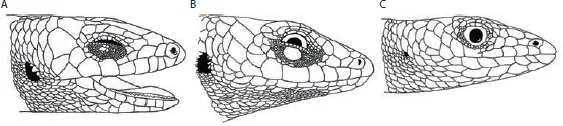
The lower eyelid of skinks is also variable. Some species have a movable scaly eyelid, while others have the lower eyelid transformed into a fixed transparent spectacle (the ablepharine eye), similar to that of snakes, geckos and legless lizards. Others have retained a movable eyelid, but have developed a transparent window (the palpebral disc) in the eyelid, such that the skink can still see when the eye is closed. In small skinks, the exposed surface of the eye is thought to be a significant source of water loss – evolution of the window or fixed spectacle may have been important in reducing this loss in dry habitats. Most skinks have the ability to autotomise the tail as a predator-avoidance mechanism, hence the often-applied common name of ‘drop-tails’. The brightly coloured tail of juveniles of some species, and the behavioural tail-wriggling of others, is thought to distract predators away from the vulnerable body.
Australian skinks eat a wide range of other animals, usually invertebrates that are small enough to swallow whole. Larger species are omnivorous or even mainly herbivorous, including plants and fungi in their diet. Skink species may lay eggs or produce live young, with a few species having a relatively complex placenta allowing some nutrient transfer from the mother to the developing embryos. Only one species, Bougainville’s Skink (Lerista bougainvillii), both lays eggs or gives birth to live young in different parts of its range, with the more southerly Victorian populations laying eggs that contain well-developed young that hatch after a few days.
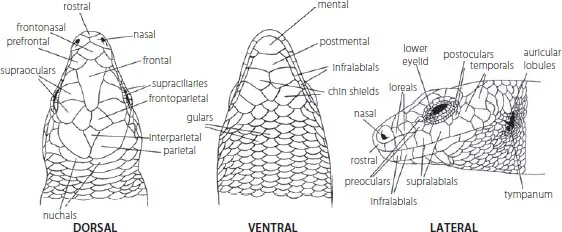
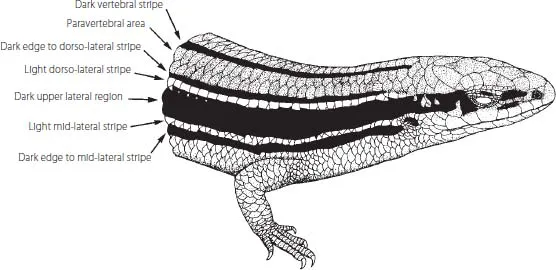
The body scales of skinks all have underlying bony elements (osteoderms), which tend to make the skin hard and relatively impervious. Many species have smooth shiny scales but some have developed keels or spines, which help to provide purchase in narrow crevices. The greatly enlarged and rugose scales of the Stumpy-tailed Lizard (Tiliqua rugosa) afford considerable protection against predators. The characteristic large and symmetrical head scales (Fig. 22) are an important tool in the identification of skinks; they are usually consistent within a species. Similarly, the patterns of lines along the body are useful when identifying some species; the nomenclature of these is shown in Fig. 23.
Skinks are found in all terrestrial habitats of Australia, including its islands. Of the 41 genera reported from Australia, 19 have been recorded in Victoria, represented by 52 species.
Fig. 22. Nomenclature of the head scales of a skink.
Fig. 23. Generalised nomenclature of colour pattern in skinks (Acritoscincus duperreyi illustrated).
Key 4.3 The genera of Victorian skinks
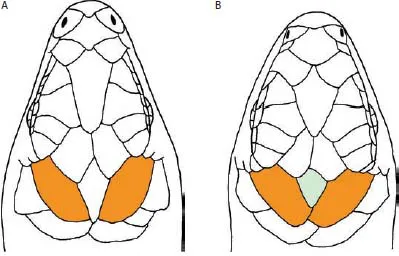
1. Parietal scales not in contact (Fig. 24A)........................................... 2
Parietal scales in contact behind interparietal (Fig. 24B)............................................ 6
2. Hind feet with third and fourth digits of similar length, or third slightly longer 3
Hind feet with fourth digit much longer than others........................................... 4
3. Original tail more than two-thirds the length of head and body, labial scales in contact with granular scales below eye.................................... Cyclodomorphus (see Key 4.3.4, page 123)
Tail less than two-thirds the length of head and body; labial scales separated from granular scales below eye by subocular scales.................................... Tiliqua (see Key 4.3.13, page 183)
4. Proximal upper tail scales not enlarged or spinose.................................... 5
Proximal upper tail scales enlarged or spinose.......................... Egernia (see Key 4.3.5, page 127)
5. Thirty or more mid-body scale rows.................................... Liopholis (see Key 4.3.10, page 154)
Fewer than 30 mid-body scale rows.................................... Lissolepis (page 163)
6. Lower eyelid movable, may be scaly or have a transparent disc (Fig. 25A,B)............... 7
Lower eyelid immovable, forming a fixed spectacle over eye, as in snakes (Fig. 25C).................................... 15
7. Lower eyelid with a transparent disc (Fig. 25A)................................................. 8
Lower eyelid scaly, without a transparent disc (Fig. 25B)........................................... 14
8. Limbs well developed, hindlimbs and forelimbs meet or overlap
when adpressed (Fig. 26A).......................................................... 9
Limbs short or rudimentary, failing to meet when adpressed (Fig. 26B).................................... 18
9. Five digits on forelimbs (pentadactyl)........................................... 10
Four digits on forelimbs (tetradactyl).................................... Carlia (page 110)
10. Nasal scales widely separated, the rostral-frontonasal suture about
as wide as frontal (Fig. 27A)........................................... 11
Nasal scales narrowly separated, the rostral-frontonasal suture about
half as wide as frontal (Fig. 27B)........................................... 13
11. Frontoparietal scale single (Fig. 28A)........................................... 12
Frontoparietal scale divided (Fig. 28B)........................................... Saproscincus (page 181)
12. Dorsal pattern not boldly striped (may have a vertebral line),
but usually with a fine speckling of lighter or darker colouring,
at least on tail.................................... Lampropholis (see Key 4.3.8, page 146)
Dorsal pattern either boldly striped or immaculate,
without speckling.................................... Acritoscincus (see Key 4.3.1, page 101)
13. Transparent disc in lower eyelid almost as
large as eye.................................... Pseudemoia (see Key 4.3.12, page 172)
Transparent disc in lower eyelid about half as large as eye, about the same
width as ear opening.................................... Carinascincus (see Key 4.3.2, page 107)
14. Ear lobules absent (Fig. 29A).................................... Eulamprus (see Key 4.3.6, page 133)
Ear lobules present (Fig. 29B).................................... Ctenotus (see Key 4.3.3, page 113)
15. Fingers fewer than five........................................... 16
Fingers and toes five........................................... 17
16. Toes less than five.................................... Lerista (part) (see Key 4.3.9, page 149)
Fingers four, toes five........................................... Menetia (page 165)
17. Eye surrounded with uniform sized granules............. Morethia (see Key 4.3.11, page 167)
Three or four scales larger than surrounding granules
on top of eye........................................... Cryptoblepharus (page 111)
18. Nasal scales normally in contact.................................... Lerista (part) (see Key 4.3.9, page 149)
Nasal scales normally not in contact........................................... 19
19. External ear opening present, fingers five, toes five (5 + 5), or
rarely 4 + 5.................................... Anepischetosia (page 104)
External ear opening absent, digits 3 + 3, 4 + 4, or
5 + 5........................................... Hemiergis (see Key 4.3.7, page 140)
Fig. 24. Skink head scalation, dorsal view. A: parietal scales (shaded) not in contact; B: parietal scales (shaded orange) in contact behind interparietal (shaded green).
Fig. 25. Skink heads, lateral views showing state of lower eyelids. A: movable, scaly; B: movable, with transparent palpebral disc; C: immovable, with fixed transparent spectacle (ablepharine eye).
Fig. 26. Skink limbs. A: adpressed limbs meet or overlap; B: adpressed limbs do not meet.
Fig. 27. Separation of nasal scales of skinks. A: widely separated, suture between rostral and frontonasal scales (shaded orange) about as wide as frontal scale (shaded green); B: narrowly separated, suture between rostral and frontonasal scales (shaded o...