Plants of Central Queensland
eBook - ePub

Plants of Central Queensland

Identification and Uses of Native and Introduced Species

  1. 576 pages
  2. English
  3. ePUB (mobile friendly)
  4. Available on iOS & Android
eBook - ePub

Plants of Central Queensland

Identification and Uses of Native and Introduced Species

About this book

Conservation and sustainable productivity are vital issues for Australia. In order to manage vegetation well from an agricultural, recreational or conservation point of view, an understanding of individual plant species is important. Plants of Central Queensland provides a guide for identifying and understanding the plants of the region so that pastoralists and others can be better equipped to manage the vegetation resource of our grazing lands.

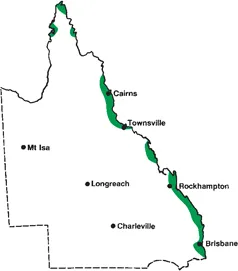
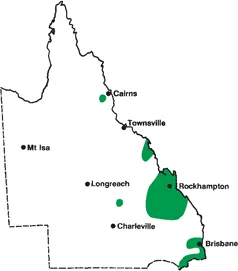
Central Queensland straddles the Tropic of Capricorn, although many of the plants in the book will also be found outside this area, as shown by their distribution maps. The book provides information on the habit, distribution, foliage and fruits of 525 plant species. Informative notes highlighting declared, poisonous, weed and medicinal plants are included, and plants useful for bees and bush tucker are also noted. These are the most important plants you might see if you live in or travel through central Queensland.

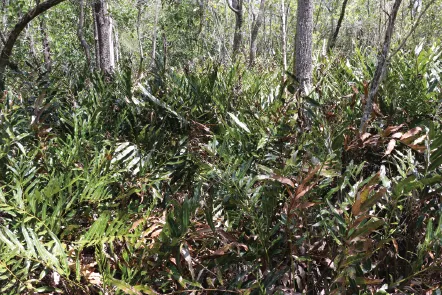
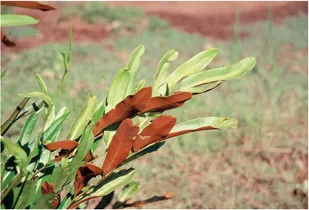
This book has an easy-to-read, non-botanical format, with helpful photographs and distribution maps that greatly aid anyone interested in the vegetation of central Queensland. It is based on a previous work of the same title but is greatly expanded, incorporating information on an additional 285 plant species.

Frequently asked questions

Yes, you can cancel anytime from the Subscription tab in your account settings on the Perlego website. Your subscription will stay active until the end of your current billing period. Learn how to cancel your subscription.
At the moment all of our mobile-responsive ePub books are available to download via the app. Most of our PDFs are also available to download and we're working on making the final remaining ones downloadable now. Learn more here.
Perlego offers two plans: Essential and Complete
  • Essential is ideal for learners and professionals who enjoy exploring a wide range of subjects. Access the Essential Library with 800,000+ trusted titles and best-sellers across business, personal growth, and the humanities. Includes unlimited reading time and Standard Read Aloud voice.
  • Complete: Perfect for advanced learners and researchers needing full, unrestricted access. Unlock 1.4M+ books across hundreds of subjects, including academic and specialized titles. The Complete Plan also includes advanced features like Premium Read Aloud and Research Assistant.
Both plans are available with monthly, semester, or annual billing cycles.
We are an online textbook subscription service, where you can get access to an entire online library for less than the price of a single book per month. With over 1 million books across 1000+ topics, we’ve got you covered! Learn more here.
Look out for the read-aloud symbol on your next book to see if you can listen to it. The read-aloud tool reads text aloud for you, highlighting the text as it is being read. You can pause it, speed it up and slow it down. Learn more here.
Yes! You can use the Perlego app on both iOS or Android devices to read anytime, anywhere β€” even offline. Perfect for commutes or when you’re on the go.
Please note we cannot support devices running on iOS 13 and Android 7 or earlier. Learn more about using the app.
Yes, you can access Plants of Central Queensland by Eric Anderson in PDF and/or ePUB format, as well as other popular books in Biological Sciences & Biology. We have over one million books available in our catalogue for you to explore.

Information

1. Ferns
Mangrove fern (Acrostichum speciosum)
Common maidenhair fern (Adiantum aethiopicum)
Rock fern (Cheilanthes sieberi)
Basket fern (Drynaria rigidula)
Short-fruit nardoo (Marsilea hirsuta)
Ox tongue (Microsorum punctatum)
Bracken fern (Pteridium esculentum)
Mangrove fern
Acrostichum speciosum (Pteridaceae)
Description
Habit: tall, coarse fern forming large spreading clumps from creeping rhizomes, 1–1.5 m tall.
Fronds: dark or dull green, thick, leathery, up to 2 m long, made up of smaller leaflets (up to 15 cm long); spores produced on the backs of fertile fronds as a dark brown mass throughout the year.
Habitat
In mangroves and along coastal estuaries, tolerating partial immersion by salt water; usually on the landward edges of mangrove forests, high in the intertidal zone where there is a large freshwater input.
Distribution
Northern New South Wales around the tropical coast to north-western Western Australia; also in tropical Asia.
Notes
image
The mangrove fern is not strictly a mangrove as a mangrove is commonly accepted as a woody intertidal plant. The only fern to inhabit the mangrove forest floor. Other ferns in mangrove forests are epiphytic (growing attached to the trunks and branches of trees).
image
The mangrove fern often dominates in areas that have been cleared or disturbed.
Stems were used as food, after roasting, by Aborigines. In some islands of the South Pacific the fronds have been woven to make thatch. The presence of plentiful insects make it a perfect habitat for birds such as scrubwrens and fantails.
image
Mangrove fern: Large spreading clumps 1–1.5 m tall
image
Dark brown spore mass on back of frond
Common maidenhair fern
Adiantum aethiopicum (Adiantaceae)
Other common names: small maidenhair fern, bush maidenhair fern
Description
Habit: small, delicate, soft fronded terrestrial fern, 20–60 cm tall; forms spreading patches by wiry branched rhizomes creeping near the soil surface or spreading extensively underground; stems very slender, dark brown, shiny.
Fronds: bright green, prostrate or erect, up to 40 cm long and 30 cm wide, two or three times divided; segments thin, pale green, heart or fan-shaped, outer margins lobed and finely toothed.
Habitat
River and creek banks and in damp, often semi-shady situations.
Distribution
Tropical and temperate regions in all Australian states; also New Zealand and South Africa.
Notes
image
This is an adaptable fern that will tolerate a wide range of conditions, although strong sunlight, low temperatures and frost will damage the fronds.
image
Aborigines made from the fronds a syrup that was used as a soothing medicine for coughs and colds.
A closely related and not dissimilar terrestrial fern is the rough maidenhair fern (Adiantum hispidulum). Its dull dark green fronds are harsh textured, two or three times divided, up to 35 cm long with fan shaped segments 1–2 cm long and toothed on the upper margins. New fronds are a delicate pink colour. It is found in eastern Queensland, New South Wales, Victoria and Northern Territory; also New Zealand, Pacific Islands, tropical Asia and Africa. It grows in a variety of situations ranging from shaded rainforest to open rocky areas.
image
Rough maidenhair fern: Dull dark green fronds
image
Common maidenhair fern: Delicate pale green fronds with fan-shaped segments
Rock fern
Cheilanthes sieberi (Sinopteridaceae)
Other common name: mulga fern
Description
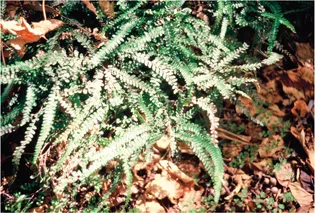
Habit: small fern 20–40 cm tall, forming spreading clumps; stalks dark brown to almost black.
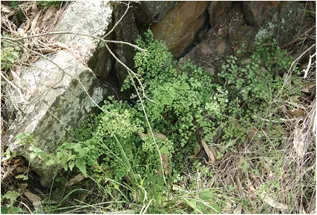
Fronds: 15–40 cm long, narrowly triangular in outline, dark green on the upper surface, somewhat paler underneath. Under dry conditions, the fronds curl up and may look dead, but they usually expand again when it rains.
Habitat
Rocky situations in coastal and mountainous areas; also alluvial flats of fine sandy loam in the western areas of Queensland, where the plant frequently grows abundantly.
Distribution
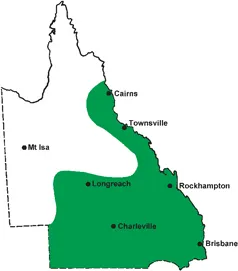
Widespread in eastern Australia, extending from coastal areas to far inland.
image
Notes
image
Fronds of rock fern are poisonous to cattle and sheep. Most cases of poisoning occur during late winter and spring. Generally, poiso...
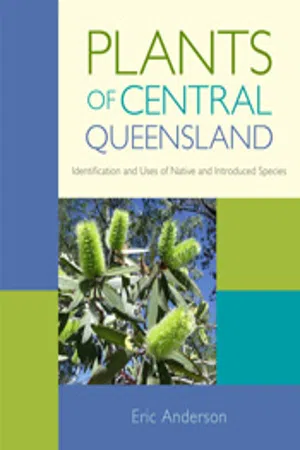
Table of contents

  1. Cover
  2. Title
  3. Copyright
  4. Contents
  5. Foreword
  6. Acknowledgements
  7. Introduction
  8. 1. Ferns
  9. 2. Palms and cycads
  10. 3. Aerial plants
  11. 4. Trees and shrubs
  12. 5. Vines and creepers
  13. 6. Cacti
  14. 7. Herbaceous plants
  15. 8. Water plants
  16. 9. Sedges and matrush
  17. 10. Grasses
  18. Further reading
  19. Index of common names
  20. Index of scientific names