- English
- ePUB (mobile friendly)
- Available on iOS & Android
eBook - ePub
About this book
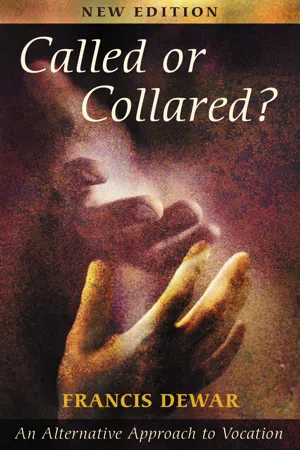
Our notion of calling or vocation has become very narrow, and is often taken only to mean the calling to be an ordained minister. I want to rescue the idea from all those assumptions because I believe that God calls every human being to some particular self-giving task at each stage of their life'. Francis Dewar. Written for all lay people, including those considering ordination, this new edition, which takes into account changes since the ordination of women to the priesthood, is itself a call for everyone to discover their unique journey.
Trusted by 375,005 students
Access to over 1 million titles for a fair monthly price.
Study more efficiently using our study tools.
Information
1
On Call
There is an old Christian tradition
that God sends each person into this
world
that God sends each person into this
world
with a special message to deliver,
with a special song to sing for others,
with a special act of love to bestow.
No one else can speak my message,
or sing my song,
with a special song to sing for others,
with a special act of love to bestow.
No one else can speak my message,
or sing my song,
or offer my act of love.
These are entrusted only to me.
So writes John Powell (Through Seasons of the Heart, Collins 1988). This is your calling, your personal vocation from God at each stage of your life. Expressing that message, singing that song, offering that act of love will not only bring you the most profound fulfilment: it will also be for the freeing or for the enrichment of others. This is God’s calling to each of us, to unearth and to give our innermost treasure.
And there is always something about it that is peculiar to each individual. Whatever you do in response to this calling it will have about it something that is unique to you; it will not just be some recognized role or some task that you do simply to fulfil other people’s expectations. It is something that is entrusted to you personally. Until you discover it and offer it, it will be unknown and unexpected. If you do not offer it, it will remain for ever unoffered. But if you do respond, whatever the problems or difficulties, you discover that you are doing what you were born for, and find in it a profound sense of rightness. You find that peace of God which passes all understanding.
I wonder if you thought I was speaking of ordination! It is amazing how often these deep and universal human longings for fulfilment in life and in action get focused on the ordained ministry. It will be my first task in this first chapter to try to unravel why this happens; because when it does it can have quite destructive consequences.
It will help if at the outset we try and disentangle three different senses in which the words calling and vocation are used. First there is the general sense, the calling to be a Christian, to be a follower of Christ, and to become a member of his body, the Church. This is the sense in which, for example, St Paul normally uses it. God’s call in this sense is addressed to everyone.
A second sense of the word refers to the call to a role. A role is essentially something defined by others. Most secular jobs are roles in this sense. There is a job description which tells you what you have to do and, often, how you are to set about it. Being a priest or minister is also a role. There is not usually anything as formal as a job description, at least not in parish work. That does not alter the fact that there are strong role expectations, as you quickly find if you as the incumbent see the task differently from the way your parish sees it. But the majority of people, apart from the clergy, would not think of themselves as called by God to the job they are paid for. The call to a role is not for everyone.
A third sense of the word refers to a person’s unique or personal vocation, and this is the one I was talking about at the beginning of this chapter. Potentially this again is for everyone. By it I mean a task or activity engaged in for the love of it by which others may be enriched or released: something you do as a freely-chosen expression of your nature and energy, something that expresses the unique essence of yourself which God calls out from you to be a gift to others. This can, of course, be an aspect of the job you are paid for; or it might be something you do as a sideline. But, whatever its context, it will essentially be a voluntary initiative of your own, and not usually something required of you by others. It is something that you will feel as it were from within, as an inner urge or prompting.
I hope the first sense is clear enough. I don’t propose to say anything more about that here. But more needs to be said about the other two. It is very important to understand the difference between them, even if there are sometimes circumstances when they overlap. Lack of clarity about the difference can cause a lot of pain and heartache, as I will explain later.
The second sense in which the word vocation is used is in connection with the calling to a role. It is vital to grasp that in this sense of the word the call comes through other people and is to a job or task that is defined by other people. In this sense, for example, there is the call, made to an individual by representatives of the Christian community, to accept appointment to a specific office required by the community for its well-being and its proper functioning. Ordination is a calling in this sense, where the calling of God is mediated through the community, the Church. To become a parson you don’t just decide one day to put up a brass plate outside your door saying VICAR, however much you may be convinced in your own mind that that is what God wants you to be. There is a careful selection process by the official representatives of the Church to determine whether or not you have the right qualities for the job. (I will go into what these qualities are in chapter 6). A broadly similar process is involved in being appointed to any job. The firm or organization who wants a particular task doing interviews applicants and appoints the person most able to do what is required. Where this is a secular organization most people would be hesitant about claiming that God had called them to this job, least of all the organization itself. But where a person’s individual gifts are very fully engaged and stretched by such a job, that person might well privately feel that it was something they were called by God to do. In this case it would be an example of something more akin to the third sense of the word calling. But most people do not feel identified to that extent with the work by which they earn their bread and butter.
It is about the third sense that there is the least awareness. It tends not to be recognized at all, either by the individual concerned, or by the Church, or by society in general. It is not recognized by individuals, at least with their minds, because it is usually pretty hidden and non-standard and difficult to discover. But our hearts know about it all right, if we give them half an ear. It is this that gives rise to all those nameless longings that often surface in people in their thirties or forties. In a slightly more explicit form it appears in the vague sense that ‘God has something special for me to do’ or ‘God has something more for me to do’ that so easily gets focused on ordination. It is not recognized by the Church because vocations are still largely thought of as what clergy or monks or nuns or missionaries have: and by implication the rest of us do not, whatever high-minded things may sometimes be proclaimed from pulpits. It is not acknowledged by society in general because to the public ‘vocation’ means certain kinds of professions, like doctor or nurse or teacher. Nowadays the phrase ‘vocational training’ obscures the issue even further. It usually means little more than ‘teaching them what they need to fit them into what the job market requires’. It is more and more a case of producing persons for pigeonholes, and less and less about developing young people’s creativity or originality. So to redress this lack of recognition and to do justice to this third sense we will need to give it a good deal of emphasis. We will come back to it in a moment.
I hope this helps to make the notion of calling or vocation a little clearer. The third sense is the one I intended at the beginning of this chapter, and is the one that will probably be least familiar. In fact it is probably so unfamiliar to make a distinction between the second and third senses that later on (in chapters 2 and 3) I shall explain more fully what I mean by personal vocation. For now I will explain the idea briefly, but I hope enough for you to begin to see why it is relevant in understanding the call to ordination. It is, of course, important for every Christian, and not just those who are ordained. So even if you personally are not considering ordination, I hope you will find that the notion of personal vocation illuminates your own living of the Christian life.
PERSONAL CALLING
I believe that potentially every human being has something of value to offer to the world’s life. Many people would be surprised if you told them that. They would not think they had anything of value to offer at all. What society communicates to many is that they are of no worth except as cogs in a (sometimes) inhuman machine, the world of work, which requires slaves in order to function, but has no real regard for their development as persons with latent creative possibilities. Not everyone feels like this about work, of course, and the more middle-class you are probably the less you will see it this way. But it is true for a very large number of people, and if you are eventually ordained and perhaps work in a housing estate or an inner city district you will maybe understand more clearly what I mean. I myself believe that within every human being, at all levels of society, lie all kinds of undeveloped creative potential. That does not mean that everyone has a symphony up their sleeve or a novel in their back-pocket. We usually think of gifts and creativity in much too purple terms. I am thinking of much more ordinary capacities like the ability to listen, or to be playful, or to organize. God calls out from us all kinds of very ‘ordinary’ capacities like that so that in exercising them in a particular way among particular people they become gifts to others – or, perhaps more accurately, in the exercise of them we ourselves become a gift to others: because essentially it is ourselves that we give in what we do in this way. It is as in response to the inner nudgings of God we take the risk of doing things we are not required to do and taking initiatives unasked that it may become appropriate to use the language of personal calling. It does not have to be some lifelong, heroic step like Albert Schweitzer going to Lambaréné. It might just be something like offering to re-decorate an elderly couple’s living room because actually you love messing about with wallpaper and paint, and risking the possibility that your offer may be rebuffed.
But most of our potential creativity and love remains hidden because we do not expect it. We do not expect it of ourselves, and we do not expect it of others. We fit ourselves comfortably within the safety of others’ or society’s expectations. We do not believe in ourselves enough for God to call out our treasures from us: and we do not believe in God enough to expect and to receive the Kingdom promised to us. Most of the time we dutifully and conscientiously do what is expected or demanded of us in accordance with our perceived place within the scheme of things. In short our expectations of God and of ourselves fall short of God’s glory. We perish in our dullness and others perish because of it.
Let me sum up this brief preliminary outline with a rough and ready list of some typical features of personal calling:
It will be some activity that connects deeply with your nature, character and history.
It will always be prompted by God.
There will be something new, creative and non-standard about it – perhaps never done before, or not in that particular way.
It often (perhaps usually) stems from some ‘thorn in the flesh’ that you have come to some sort of terms with, something you think of as a problem, trauma or disaster, some wound, disability or handicap.
It will be something that in some way enriches the impoverished,
or gives sight to the blind,
or release to prisoners,
or freedom for the oppressed.
(I use these categories, from Luke 4.18–19, in a very wide sense indeed.)
You will be doing what in your heart of hearts you love to do (even if it brings you hassle and trouble, even suffering).
It will be an initiative that you take, probably unasked, one that will not be taken unless you do it.
It will feel risky, something you would only do because you feel God has called you to (and you have checked with one or two wise and spiritually mature Christians that it is God, and not just your ego!).
It will always be a generous self-giving of what you truly are and could be.
It will, in some way or other, somewhere along the line, prove personally costly for you.
It is more likely, statistically speaking, to be in the secular sphere than in the Church, simply because there is more of it!
It is unlikely to be lifelong, or full time, or paid – it is more likely to be something you do from time to time, or for short periods, in your own time. But, if you respond, it will become a thread that runs through more and more of your life.
If it is at work, it will be something you do beyond the requirements of the job description (and it may get you into hot water). Or it may be expressed in the way in which you fulfil some part of the job description.
I hope I have managed to explain, if only in outline at this stage, that God’s personal calling is to an infinite variety of activities. Not only will the activities themselves be varied, but also the amount of time and energy they require: so also will the context vary, e.g. it may be something you do at work or in your spare time, in the Church or in the world, in the public sphere or privately and unseen, individually or with others, and so on. This variety is to be expected when you reflect on the fact that it is God who calls and that there is always something new and unexpected about what God calls us to.
I want to say a little more now about how and why it is that an inner sense of being called by God so easily gets attached to ordination; in other words how the second and third senses of the word calling so easily get confused. There are basically two reasons: one is because of the nature of work in our society and the effects it has had on all of us in the past two centuries; the other is because of the Church’s own muddled ideas about vocation.
THE NATURE OF WORK IN OUR SOCIETY AND ITS EFFECTS
We live in a society where work is almost entirely defined by others. One of the effects of the industrial revolution was to increase this alienation between what we are and what we do. Jobs for most people are defined by the requirements of a process, whether that be making cars or cakes, selling insurance or package holidays. Scope for genuinely creative activity is either non-existent or severely constrained by the requirement that the company you work for must produce goods or services that are saleable at a profit or it will go to the wall. This feature about the nature of work in the modern world has sunk deep into our consciousness, so deep that it affects our activities outside the sphere of paid work. Many of us can hardly conceive what our daily activity would be if it were not demanded of us, expected of us, or at least asked of us by someone else. In other words, a very great deal of our life is lived in response to outside stimuli, instead of from within outwards.
I believe this factor is one of the reasons why, when prompted by an inner sense of call, we go for a ready-made niche, as it were. The ordained ministry is there as a handy receptacle which feels as though it will accommodate our vague longings and give some shape to them. If you ask people, as I have done, why they want to be ordained, their ideas are often very vague and quite unfocused. ‘I want to learn more of my faith so that I can share it.’ ‘I feel God is calling me to something more.’ ‘I want to enter into a deeper commitment to people.’ Or simply ‘I want to grow closer to God.’ Looking at these reasons it is not at all clear that ordination is the only or the obvious course of action. Sometimes people recognize this; one person wrote, ‘For me the call to serve was crystal clear; but the question of ordination specifically was not spelled out.’
It is not that these people do not have a call of some kind. They clearly do, and are beginning to hear echoes of it. But what they are hearing is, I believe, usually the echo of a personal call from God that, so to speak, gets reflected from the bulwarks of the ordained ministry. There, after all, is the most obvious public model and pattern of a committed and dedicated Christian life. A dedicated and committed Christian life is potentially what God calls every one of us to. But, as I said at the beginning of this chapter, it is much more personal and idiosyncratic than a predetermined role like ordination. You are called by him to deliver your message, to sing your song, to offer your act of love: and that is not a predetermined path. As you respond, God calls you on. As you respond, God calls you ever further and further into being the gift you could be. That is, after all, how we are to follow Christ; we are to be generous with what we are and could be, just as he was generous with what he was. We are called to total self-giving as he was, but each of us in our own way and not in some predetermined standardized path. (I have explained this in relation to Jesus more fully in chapter 6 of my book Live for a Change.)
THE CHURCH´S MUDDLED IDEAS ABOUT VOCATION
These have certainly contributed in the minds of most church people to a fundamental confusion between the calling to a role (the second sense) and personal calling (the third sense). If it is not yet clear to you that there is any confusion, let me put it like this. Suppose you feel called to be ordained; and you go to a selection conference and you are not recommended. That happens quite often: and when it does, who has got it wrong? The selectors? Or you? Or God?
It could be that the selectors got it wrong; but they do take a great deal of care and trouble at selection conferences. No one is infallible, of course, but I find it difficult to believe that they get it wrong every time someone is ‘not recommended’.
Did you get it wrong? Were you simply mistaken in thinking that God is calling you? I think it is both unfair and cruel to load all responsibility for error o...
Table of contents
- Cover
- Title
- Copyright
- Contents
- Preface
- Preface to the Second Edition
- 1. On Call
- 2. A double invitation: 1
- 3. A double invitation: 2
- 4. RSVP
- 5. Call in the Bible
- 6. To the Church, with love
- Appendix: Where do you go from here?
Frequently asked questions
Yes, you can cancel anytime from the Subscription tab in your account settings on the Perlego website. Your subscription will stay active until the end of your current billing period. Learn how to cancel your subscription
No, books cannot be downloaded as external files, such as PDFs, for use outside of Perlego. However, you can download books within the Perlego app for offline reading on mobile or tablet. Learn how to download books offline
Perlego offers two plans: Essential and Complete
- Essential is ideal for learners and professionals who enjoy exploring a wide range of subjects. Access the Essential Library with 800,000+ trusted titles and best-sellers across business, personal growth, and the humanities. Includes unlimited reading time and Standard Read Aloud voice.
- Complete: Perfect for advanced learners and researchers needing full, unrestricted access. Unlock 1.4M+ books across hundreds of subjects, including academic and specialized titles. The Complete Plan also includes advanced features like Premium Read Aloud and Research Assistant.
We are an online textbook subscription service, where you can get access to an entire online library for less than the price of a single book per month. With over 1 million books across 990+ topics, we’ve got you covered! Learn about our mission
Look out for the read-aloud symbol on your next book to see if you can listen to it. The read-aloud tool reads text aloud for you, highlighting the text as it is being read. You can pause it, speed it up and slow it down. Learn more about Read Aloud
Yes! You can use the Perlego app on both iOS and Android devices to read anytime, anywhere — even offline. Perfect for commutes or when you’re on the go.
Please note we cannot support devices running on iOS 13 and Android 7 or earlier. Learn more about using the app
Please note we cannot support devices running on iOS 13 and Android 7 or earlier. Learn more about using the app
Yes, you can access Called or Collared? by Francis Dewar in PDF and/or ePUB format, as well as other popular books in Theology & Religion & Christian Rituals & Practice. We have over one million books available in our catalogue for you to explore.