Sheppard first came to prominence as a cricketer in the 1950s. An opening batsman, he was selected for England while still at Cambridge, and later captained his country. In the 1960s Sheppard was a leading figure in the campaign to sever sporting links with South Africa, a crucial factor in the ending of apartheid.
Converted in his first year at Cambridge, Sheppard was ordained into the Church of England in 1955. His curacy in Islington gave him a passion to serve the church in the inner city, a calling he fulfilled as warden for twelve years of the Mayflower Centre in Canning Town. Following his appointment as Bishop of Woolwich in 1969, he published a major text about his work in urban areas, Built as a City.
David Sheppard made his biggest mark as Bishop of Liverpool from 1975-97, forging a pioneering partnership with Archbishop Derek Worlock, his Roman Catholic counterpart. For twenty years the two worked tirelessly to revive the fortunes of the city, helping to break down its many internal divisions. In 1991 Sheppard was seriously considered for Archbishop of Canterbury following Robert Runcie' retirement.
In 1997 Sheppard was awarded a life peerage, and played an active role in the Lords, and as a writer, speaker and preacher, until his death in 2005.
This biography draws on the papers left by Sheppard in Liverpool Central Library, other archival material, and more than 150 interviews conducted by the author.
- English
- ePUB (mobile friendly)
- Available on iOS & Android
eBook - ePub
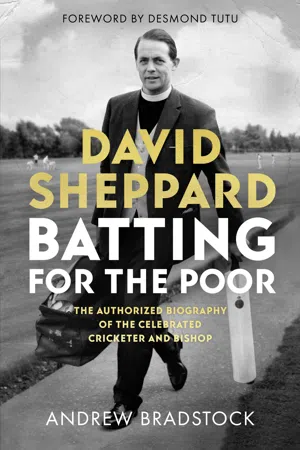
David Sheppard: Batting for the Poor
About this book
Information
1
Early life
(1929–1942)
(1929–1942)
The author of Bias to the Poor1 and The Other Britain2 never sought to hide his privileged origins. Born just months before the Wall Street Crash, and brought up during the resulting Great Depression of the 1930s, David Sheppard acknowledged that he was born ‘on the right side of the tracks’.3 He grew up comfortably far from the other side, the family home being in one of the nation’s more affluent neighbourhoods.
*
Entries for David Stuart Sheppard in most works of reference begin ‘born Reigate, 6 March 1929’, suggesting a childhood spent in that delightful market town in Surrey. In fact, his family had no connection with the town. He was born there because his mother chose one of its nursing homes for her confinement as it was near to her parents’ home in Charlwood. The delivery of her first child in the Charlwood house six years earlier had been long and uncomfortable. Barbara Sheppard wanted to minimize the pain this time by ensuring professional care would be on hand. It was to be another 40 years, when he was bishop of Woolwich, before David became properly acquainted with the part of Surrey in which he was born.
Married in December 1922, Barbara and her husband Stuart had made their first home in a rented flat in Beaufort Street, Chelsea. At that time Chelsea was known as the ‘borough of artists’. Beaufort Street is still one of its main thoroughfares, linking Fulham Road and the King’s Road with Battersea Bridge. With a child on the way the following year, they had sought larger accommodation nearby, moving around the corner to a house in Mallord Street. Here, at number 10, the young family was able to spread out over three floors. Mary, who was born in September 1923, enjoyed the benefits of a nursery on the top floor and a garden with a playhouse. It was a fashionable and much sought-after street. A few doors down was a house built for the painter Augustus John, while directly opposite the Sheppards lived Mr and Mrs A. A. Milne. Their son, Christopher Robin, was three years older than Mary.
Stuart was building a career with Messrs Boyce and Evans, a firm of solicitors in Stratford Place off Oxford Street. Aged 27 at the time of his marriage, he had a promising future at the firm, which numbered several large departmental stores among its clients. He had become a partner in the firm, suitably renamed Boyce, Evans and Sheppard, by the time David was born. He had had a terrible war, enduring long periods of misery in the trenches and a cocktail of illnesses. These were severe enough to see him invalided out and shipped back to Blighty, only to be sent back to France once he was deemed to have sufficiently recovered. Though he returned home again when hostilities ceased in 1918, his health remained impaired for the rest of his life, exacerbated by his addiction to cigarettes.
*
As David would enjoy pointing out, his mother was a Shepherd who married a Sheppard. Three years younger than her husband, Barbara was the daughter of William James Affleck Shepherd, the artist better known as J. A. Shepherd (JAS). Shepherd’s work regularly appeared in popular children’s books and bestselling journals of the day including Punch, for whom he drew on a weekly basis for many years, London Illustrated News and Strand Magazine. A man of great warmth and humour, JAS had a talent for caricaturing animals and birds in delightfully comical ways. He also illustrated more serious books devoted to natural history. Such was his reputation, he was once invited by the young Walt Disney to work for him in California, an offer he declined. While Shepherd would have brought in a steady income, it was his wife Nellie who ensured the family’s financial security, courtesy of the fortune made by her father, George Lewis Turner. Turner was born in the Old Kent Road, the son of a brush-maker. In a classic rags to riches saga, he loaned a friend the money to start a boot-blacking business in the early days of the industry, enjoying a generous return on his investment as the Nugget Polish Company became one of the biggest manufacturers of boot and floor polishes in the world. In the 1920s Nugget merged with its rival business, Chiswick Polish Company, to create a global brand which included the famous Cherry Blossom label.
In 1926, Barbara’s parents moved from their cottage in Charlwood to the much grander Tintinhull House near Yeovil in Somerset. Built around 1630, Tintinhull had a distinguished history, and was let to the Pitt family during the eighteenth century. It had a magnificent garden created by the eminent botanist Dr S. J. M. Price around 1900. As children, Mary and David often stayed at Tintinhull, where their grandmother delighted in tending the garden and their uncle Jack, their mother’s youngest brother, managed the adjacent farm. Here the London-based children could enjoy the wild outdoors. Jack, an accomplished horseman, taught them to ride, and when they were not tending the farm animals or roaming the countryside, they had pets with which to play. The family entertained a tame raven who called regularly at the back door. Milking the cows and taking the churn around the village to fill up residents’ jugs was popular, as was watching carthorses pulling the plough. In cold winters they would thaw out lambs in the bottom oven of the stove and complete their revival by feeding them from bottles. A further treat was watching their grandfather, whom they affectionately called ‘Pa’, draw sketches of animals for them.
*
David’s birth led Barbara and Stuart to look for a larger house. They took the lease on 34 Carlyle Square, almost literally in view of their existing home in Mallord Street. Here the children had a day and a night nursery, and there was accommodation for the family’s cook and house parlour maid, Hannah and Lettice. The garden had a plane tree, giving anyone who touched it sooty fingers. As well as playing there, Mary and David would join with other children in the square’s private gardens. They used these as an improvised cricket pitch and racetrack for their bikes. At home, a more daredevil sport involved hoisting each other up in the dumb waiter lift used to bring meals from the kitchen in the basement to the ground floor dining room.
The five and a half years between David and Mary, known affectionately in the family as ‘Bill’, meant they were not always close. Their relationship was not without its fights, including one over a swing which ended with David losing a tooth. As in Mallord Street, the Sheppards had their share of celebrity neighbours, among them the writer Osbert Sitwell, and the actor Dame Sybil Thorndike and her husband Lewis Casson and their family. David made friends with a girl of the same age from a titled family who, because she would break his toys, he referred to as ‘my difficulty’.
The children were enrolled at the Francis Holland School. Mary was in the main school and David in the preparatory or kindergarten. Barbara and Stuart developed a culture of learning, being keen to foster a love of books in their offspring, and encouraged them to read themselves as well as reading stories to them aloud. They devoured children’s books illustrated by their maternal grandfather, including the Uncle Remus tales featuring Brer Rabbit, Brer Fox and others. They also read other staples popular with their contemporaries, such as The Wind in the Willows, The Just So Stories, Dimsie Goes to School, The Story of Little Black Sambo and the books of Arthur Ransome. They enjoyed the Winnie the Pooh stories created by their former neighbour in Mallord Street, and the Babar the Elephant tales which Milne had helped make accessible to English readers.
In addition to vacations at Tintinhull, there were family holidays each summer at Woolacombe Bay in Devon, where the Sheppards would rent rooms. The children would play on the beach by day, and in the evenings the family would walk the coastal paths or take the car out to the moors. Mary had her own surfboard, which she was allowed to take out to the rollers under strict supervision, while David and his father would use every opportunity to play beach cricket. A high point of the day was the appearance at the kitchen door of local fishermen, bringing freshly caught crab for the cook to prepare for supper.
Less eagerly anticipated visits were those to the house of two great aunts, Grace and May, in Tunbridge Wells in Kent. Elder sisters of Stuart’s father, Henry Winter Sheppard, both were in their seventies when David was small. The thought of going to see them filled both children with dread because of the exacting standard of behaviour required. For a boy still in short trousers, it was hard to be expected to sit up straight at table for the duration of a meal, then remain in that position for a further 20 minutes to let his food digest before being allowed to play in the garden. Grace was the most formidable of the two. In later life David said she reminded him of pictures of the elderly Queen Victoria, while May he remembered as ‘lovely and gentle’. Grace hardly endeared herself to David by reminding him that he had a squint.
Stuart’s connections meant that life for the children had its exciting moments. As a member of the Carlton Club, he ensured the family had a grandstand view of the procession to mark the Silver Jubilee of King George V and Queen Mary in May 1935. For the coronation of George VI two years later, a friend inside the Palace of Westminster got the Sheppards seats in a stand in the building’s courtyard. This afforded them an outstanding view of the state procession as it snaked its way from Westminster Abbey to Buckingham Palace.
*
The extent to which David’s family and upbringing helped to shape his direction in life is an open question, but an interest in cricket and practical Christianity characterized members of both the Sheppard and Shepherd clans.
Both of David’s parents encouraged him to develop an interest in cricket. When he was just six or seven his father took him to Lord’s and Hove to watch first-class games, experiences which sparked an early appetite for the game and its traditions. Stuart was a paid-up member of Sussex County Cricket Club. For the princely sum of 15s 6d (77½p) per year he could watch all home county games from the Members’ Pavilion and take Barbara as a ‘lady’ guest. He also took out a ‘Member’s Son’ membership for David, who clearly got his money’s worth from his ticket. ‘Watching’ for David was never a passive occupation. He would start each match, in the days before shirts were printed with numbers and names, by identifying each member of the fielding side as soon as possible. He learned the names and styles of each batsman who came in and absorbed the conversation of the older and wiser spectators around him.
Sheppard said his father ‘turned me into a fanatical cricket fan from a very early age’.4 Between attending matches he eagerly read reports of county and Test matches in the daily newspaper. Another source of information and enjoyment was the cricket enthusiast’s bible, Wisden. Published annually, this contains a wealth of statistics, biographies, scorecards and match summaries.5 Even the winter months were not barren for the cricket aficionados of Carlyle Square. Not only would reports of England’s quests for the Ashes in Australia appear in the papers, updates on the state of play could usually be heard each morning, through the crackle, on the wireless. Stuart made a table cricket game which the two played regularly. This comprised a roulette-style wheel with a pointer to spin to indicate the number of runs scored and how the batsman was out.
Stuart encouraged his son to play cricket from an early age. Photos in the family collection show David, aged about four, padded up and taking guard in the back garden. By the time he was eight he was in the Colts team organized by his father in the Sussex village of Slinfold, where the family had a weekend cottage. In one match against a Veterans XI, David made a creditable 23. Batting at number five, he determined this would be his preferred place in the order as his career developed.6
Relatives on both sides of the family encouraged the boy in his passion for the game. His maternal grandfather once gave him a drawing entitled ‘Animal Spirits’, depicting the Lions of England playing cricket against the Kangaroos of Australia, with two wombats as umpires. J. A. Shepherd had originally produced this for Punch magazine in March 1895 during a tense Ashes series in Australia. Stuart gave his son a cricket-themed gift in childhood, a bib with picture of a teddy bear batting.
To the delight of the aspiring young batsman, there was some cricketing blood in the family, his great uncle Tom having played two first-class games in the early 1900s. This was Major Thomas Winter Sheppard, half-brother of Stuart’...
Table of contents
- 1 Early life (1929–1942)
- 2 Sherborne (1942–1947)
- 3 National service and conversion (1947–1950)
- 4 Trinity Hall and Sussex (1950–1953)
- 5 Ridley Hall (1953–1955)
- 6 Islington (1955–1957)
- 7 Mayflower (1958–1969)
- 8 Woolwich (1969–1975)
- 9 Liverpool (1975–1980)
- 10 Liverpool (1981–1985)
- 11 Liverpool (1985–1990)
- 12 Liverpool, retirement and death (1991–2005)
- 13 Conclusion
- Appendix 1: Chronology
- Appendix 2: The cricket career of David Sheppard
- Sources
- Select bibliography
- Photograph acknowledgements
- Search terms
Trusted by 375,005 students
Access to over 1.5 million titles for a fair monthly price.
Study more efficiently using our study tools.
Frequently asked questions
Yes, you can cancel anytime from the Subscription tab in your account settings on the Perlego website. Your subscription will stay active until the end of your current billing period. Learn how to cancel your subscription
No, books cannot be downloaded as external files, such as PDFs, for use outside of Perlego. However, you can download books within the Perlego app for offline reading on mobile or tablet. Learn how to download books offline
Perlego offers two plans: Essential and Complete
- Essential is ideal for learners and professionals who enjoy exploring a wide range of subjects. Access the Essential Library with 800,000+ trusted titles and best-sellers across business, personal growth, and the humanities. Includes unlimited reading time and Standard Read Aloud voice.
- Complete: Perfect for advanced learners and researchers needing full, unrestricted access. Unlock 1.5M+ books across hundreds of subjects, including academic and specialized titles. The Complete Plan also includes advanced features like Premium Read Aloud and Research Assistant.
We are an online textbook subscription service, where you can get access to an entire online library for less than the price of a single book per month. With over 1.5 million books across 990+ topics, we’ve got you covered! Learn about our mission
Look out for the read-aloud symbol on your next book to see if you can listen to it. The read-aloud tool reads text aloud for you, highlighting the text as it is being read. You can pause it, speed it up and slow it down. Learn more about Read Aloud
Yes! You can use the Perlego app on both iOS and Android devices to read anytime, anywhere — even offline. Perfect for commutes or when you’re on the go.
Please note we cannot support devices running on iOS 13 and Android 7 or earlier. Learn more about using the app
Please note we cannot support devices running on iOS 13 and Android 7 or earlier. Learn more about using the app
Yes, you can access David Sheppard: Batting for the Poor by Andrew Bradstock in PDF and/or ePUB format, as well as other popular books in Theology & Religion & Religious Biographies. We have over 1.5 million books available in our catalogue for you to explore.