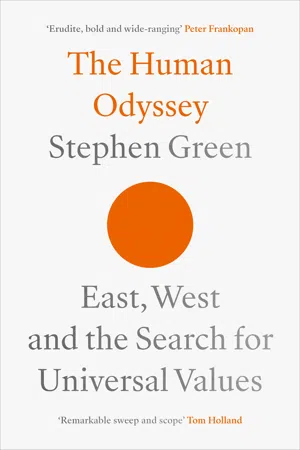
'Erudite, bold and wide-ranging – a book that makes you think about knowledge, wisdom and what the future has in store.' PETER FRANKOPAN
'A book of remarkable sweep and scope - not just learned, but deeply humane.' TOM HOLLAND
The long human odyssey of self-discovery has reached a crucial stage: everything we do affects everyone and everything else - and we know it. The next hundred years will bring more change than we can easily imagine: more opportunities for more people to achieve the fulfilment of a good life, and more risks that could result in catastrophic harm to the entire planet.
Viewed geopolitically, the main question is whether the world-views of the world's most important and influential powers – China and America (the one fundamentally Confucian, the other essentially individualist) – can be made to work together constructively.
At the same time, on a deeper level, the even greater question is how the irreversible fact of urbanisation may nurture healthy and mature human individuality, such that the accumulated wisdom of the world's great cultures becomes mutually transforming and enriching.
This bold and wide-ranging book explores those questions, with all the risks and opportunities they hold for generations still to come.
- English
- ePUB (mobile friendly)
- Available on iOS & Android
eBook - ePub
About this book
Information
1
Eurasia: the next hundred years
Eurasia, and its continental shelf, stretches from Ireland in the west to the Bering Strait in the east, and from Franz Josef Land in the north to Sri Lanka in the south. It includes the South East Asian archipelago. It is a third of the world’s total land mass. Both the Arctic Circle and the Equator run through it. It includes virtually every kind of climate and geographical environment known to humanity. It has the highest mountains, the largest steppe, the largest area of tundra, the largest inland sea, the largest body of fresh water, some of the longest rivers, one of the three largest tropical rainforests, and the largest known reserves of hydrocarbons anywhere in the world. It is also home to two-thirds of humanity.
There is no single all-purpose definition of Eurasia: geologists and natural historians may well, for example, have a different perspective from social historians or from political scientists. For the purpose of history, geopolitics and culture, Eurasia clearly includes the Indonesian archipelago. Australasia is effectively part of the story too, although it plays a relatively marginal role and would not normally be thought of as being geographically a part of Eurasia. At the other end of the land mass, what about Iceland? Geologically, it straddles the great Atlantic divide, but in human terms, it is very obviously part of the European story rather than America’s. Like Australasia, only even more so, it plays a marginal role, though its importance in the history of north European culture is out of all proportion to the small size of its population.
The big question is about Africa. In deep geological time, it was part of the same great land mass as Eurasia. And from the earliest beginnings of Homo sapiens, there has always been interaction between the two great continents. For much of recorded history, that interaction was limited by the almost impenetrable barrier of the Sahara Desert: had it not prevented any significant southward movement of people, Africa might well have become the demographic centre of one of Eurasia’s greatest cultures – Islam. As it is, Africa’s interaction with Eurasia was largely confined, through most of recorded history, to its northern regions and some trading links down its eastern coast. Five hundred years ago, that began to change, and with the huge growth of shipping, air links and digital connectivity, Africa has been reconnected ever more intensively with Eurasia. Africa’s impact on Eurasia will grow enormously throughout the coming decades. If present demographic trends continue, Africa’s population may be almost as large as that of Asia by 2100. In the longer-term future – but perhaps not until the next century – Africa may be home to some of the world’s most powerful states. But not yet. The truth is that, for the rest of this century, the world’s agenda – whether political, cultural or spiritual – is going to be determined, for better or worse, mostly by Eurasia.
The world’s centre of gravity has shifted back from an American-led West to the Eurasian East, where it was for most of human history. Increasingly, Eurasia will be dominated by its two great behemoths, China and India. All the world’s biggest risks and opportunities lie now in Eurasia. It produces around two-thirds of the world’s economic output. It is also the origin of all the world’s great cultures and spiritual traditions, and so it will be the testing ground of all the great challenges facing humanity for the next century. In Eurasian history – past, present and future – what we see is nothing less than the evolution of the human spirit. Looking backwards, we can see the tracks of a journey with many detours; looking forwards, the most important question facing us all is if and how that human odyssey will continue. The answer will lie, to a large extent, in how humans relate to one another and deal with one another on the Eurasian land mass. The impact will be felt globally, not only in Eurasia’s near neighbour Africa but also in the Americas, already deeply influenced not only by Europeans but also through Asian immigration, and now increasingly by Asian investment too.
Some argue that this is the wrong question – that it is outdated due to the digital revolution. They have foreseen a different future, one in which all the great human opportunities and challenges will present themselves, not in a geographically determined form, but in a digital realm of consciousness, in which physical limitations and geographically based conceptions of identity will become increasingly irrelevant. With the predicted emergence of such a new ‘noosphere’ – to borrow the ingenious terminology of Teilhard de Chardin, who (writing long before the digital era) saw shared thought and reflection as part of the essence of a new humanity1 – goes a loss of interest in the past as a source of identity and meaning. Geopolitics takes on radically new forms: the old order is passing away and, depending on the visionary’s penchant for optimism or for pessimism, either our grandchildren will enjoy a new and freer world or a new beast is slouching towards Bethlehem to be born.2
But reports of the death of the old world of geographically based identities, geopolitics and cultural histories are – to use Mark Twain’s famous words – an exaggeration, as we shall see in Chapter 4. Yes, the digital realm brings significant new, non-national actors into geopolitics (as did capitalism in the last three centuries, by bringing into being international businesses that seemed to have no national home or loyalties). And, yes, digital connectivity makes it much harder to put barriers round people’s thought worlds. Yes, too, artificial intelligence will surely transform our life experience in the coming decades, as well as posing a whole new series of questions about values and ethics (how long will it be before we determine that an artificial intelligence has moral or legal rights?). But, no, we are a long way from shaking off our materiality. Even in the next century, we will not have reached the questionable utopia of pure digital existence (because we never can; even the cloud depends on hardware). In the meantime – and probably for much, much longer – we will live with all the joys, pains, stresses and stimulations that come from being what such diverse figures as Confucius, the Buddha, Aristotle, the apostle Paul and countless others down the ages have always known: a mysterious mixture of the material and the spiritual.
The empires of Eurasia
Humans have done well in Eurasia. From very early on, they made their presence felt. They hunted the mammoths and may have contributed to their extinction. From the ice ages onwards, they left their stencilled handprints and their figurative and abstract art on the walls of caves from one end of the land mass to the other. They built monuments, the purposes of which we can in some cases only guess at, and these have dotted the land mass for at least the last six thousand years. They learned how to produce workable metal. They domesticated animals, namely dogs, sheep, goats, cattle, poultry, camels and the all-important horses. They domesticated wheat and rice. They moved gradually from hunting to pasturing their flocks, to growing their crops and to founding cities. From a very early stage, contact over large distances increased, helped by their camels and by their horse-drawn chariots, which first appeared over four thousand years ago.3 In this way, small hunting groups evolved into nomadic pastoralists, into settled farmers and into urban trading societies, with each of these shifts enabling a dramatically increased population density. All these ways of existence overlapped, even into modern times.
By the turn of the Common Era, Eurasia was home to the vast majority of all the world’s human beings. No one had travelled from one end of the land mass to the other, but many of them knew at least something about other Eurasian societies that they never saw. The Romans and the Chinese knew of one another’s existence and the insatiable Roman appetite for silk was a major impetus for an emerging East–West trade over very long distances – a trade that was named for the silk but also came to include precious gems, copper, spices, chemicals, glass, saddles and horses, plus weapons.
Close encounters were all too often violent: witness, above all, the centuries of wars between Greeks and Persians, both before and well into the Christian era (a contest that, in a sense, mutated later on into the great struggle between Christendom and Islam). It is one of the oldest cultural fault lines in all of human history. The epic stories – told to us mainly from the Greek side, from Aeschylus and Herodotus onwards – are, however, only part of a broader pattern recurring throughout Eurasia. One clan, or tribe, or nation, would move or expand, at the expense of less-energetic, less well-endowed, less well-organized neighbours. Over the millennia, empires and civilizations have waxed and waned, most leaving traces visible only to archaeologists and philologists, but with a few leaving deep imprints even on modern cultures, as we shall see.
Some reached degrees of sophistication that are extraordinary given their antiquity. Thus, for example, the Harappans of the Indus Valley left not only their remarkable city outlines (as well as treasures such as an exquisite bronze statuette of a dancing girl from four thousand years ago) but also an indecipherable script and tantalizingly little evidence of how they developed and why they went into decline. Over the centuries, others – some nomadic, some settled – came and went, rose and fell, were decimated or just absorbed by the next group of people whose star was rising: the Scythians in the area north of the Black Sea; the Kushans to the west of Tibet; various Indian kingdoms; the Huns; the Alans; the Khwarezmians; the Kharakhanids; the Ghaznavids; the Seljuk Turks; the Vikings; the Xiongnu; the Xixia. It can all seem like a continuous swirl. Cities and states sometimes lived and let live, and sometimes went to war. Nomads sometimes traded with and sometimes raided the settled communities (they were an age-old scourge of China, Iran, Russia and Europe). Above all, there were the Mongols, whose incredible and terrifying explosion across the land mass brought them nearer than anyone else before (or since) to ruling Eurasia from sea to shining sea.
For much of history, all this turmoil had very little to do with ideas. Great powers expanded because they were good at it, because they had leaders with vaulting ambition, because economic pressures pushed them and/or because there was wealth to be had – the Greeks under Alexander, for example, as well as the Mongols – and perhaps also because of a Darwinian sense that they had to conquer or succumb (this was surely the main impetus behind the growth of Republican Rome through its existential struggle with Carthage). There is something elemental about all this: the drive to feed and reproduce, to dominate territory and to control the group is widespread in the animal kingdom too.
But there were some movements of history that were impelled by ideas, beliefs and aspirations that went beyond such primal drives. The first empire with any sort of idea or programme underlying its expansion was arguably Persia. The new idea that conquest could be a civilizing duty – or at least that it would confer civilizing benefits on the conquered – might be said to be the legacy of Cyrus and Darius (the former being famously accoladed as the Lord’s anointed by a tiny people with their own rather special sense of calling, as recorded in the Jewish Bible4). At its height, the Persian empire was at least three times larger than present-day Iran; its rulers described themselves as ‘Kings of Kings’; and they constructed the world’s first bureaucracy and communications system to run their empire.
Others would follow. Ashoka took his Indian philosophy of just rule deep into Central Asia. His edicts, carved in rock and scattered all over his empire, proclaim a Buddhist-inspired code for living (the tone of which also sounds surprisingly like the voice of Confucius). The apogee of the Roman idea came, ironically, after the death of republicanism: it was the moment when the Emperor Caracalla granted full Roman citizenship to all free men of the Roman Empire in 212 ce. Although he intended it as a tax-raising measure, this Roman idea is effectively a harbinger of what became the concept of Christendom and provided the potential basis for a European identity. Then came Islam – the most spectacular explosion created by a new idea in all of history, not only up to that point but also for over a thousand years thereafter (until a very different explosion at one end of the Eurasian land mass triggered by the French Revolution in 1789). Islam reached the Pyrenees and the gates of China within its first century. Its control and transformation of the lands central to Eurasian communications ensured the emergence of the most sophisticated, cosmopolitan and creative culture the world had yet known. The cross-fertilization of ideas – Chinese, Indian, European, Iranian – that took place under this Islamic aegis made it one of the greatest times for the human spirit in all history. Then there is China itself. Though not the world’s oldest continuous civilization, China is certainly the world’s oldest continuous identity, founded on the bedrock of an holistic cosmological and terrestrial philosophy that saw its emperors as having ‘the Mandate of Heaven to rule all under heaven’. Then, when Europe was in the ascendant, the Habsburg Emperor Charles V ruled over domains that covered much of Europe as well as huge swathes of a new world and stretched all the way round to Manila. His empire was the first in human history on which the sun literally never set. His motto was plus ultra – ‘there is more beyond’. His faith and commitment to his role as Holy Roman Emperor was deep and personal.
But in all these cases, what was potentially a universalizing vision ran out of steam, either because they ran into adversaries who brought them to a halt or just because sheer extension became unmanageable. Ashoka’s domain didn’t long survive him. Islam found its high-water mark in Europe at Poitiers in the eighth century and soon thereafter began to break up into separate polities. China had sought to extend its tributary relationships around the Indian Ocean in the early fifteenth century, but then retreated to the mainland. And Charles V retired to his monastery, exhausted by the burden of his mission.
Even the fearsome Mongols also reached a high-water mark: they were stopped in the end from totally overwhelming Islam by the Egyptian Mamluks (who also finally defeated the Crusaders) at Ain Jalut in 1260. Soon after defeating a Polish-led army at the battle of Liegnitz and a Hungarian army at the Battle of Mohi in the same week in 1241, they turned back from moving further westwards (scholars have debated the reason: the death of the Great Khan back home may have been the decisive factor; but they may also have been daunted by the unfamiliar and uncongenial forests that blocked their progress westwards towards the Atlantic). A generation later, a ‘divine wind’ or kamikaze protected Japan from Kublai Khan’s invasion force in 1281 (an intriguing parallel with the storms that saved England from the Spanish Armada in 1588).
Since then, others have sought dominant positions in various regions of Eurasia: the Ottoman Turks, who built an empire on the ruins of Byzantium and established a new caliphate in Constantinople; the British, whose trade drew them into empire in India; the Russians, who moved into Siberia and into the vacuum left by the Mongols in the centre; the Japanese, who emerged from more than two centuries of isolation to erupt into Eastern Asia just at the time when the Qing Dynasty of China was losing the Mandate of Heaven; and lastly the Americans – the first non-Eurasian power to play a role (and a decisive one) in the land mass, at both ends of it, in the wake of the Second World War. In all cases, the motives were mixed: the drive for geopolitical supremacy, economic advantage and cultural assertion all played their part.
Connections and tensions
Over the millennia since Homo sapiens first came to Eurasia, the human spirit has developed immeasurably. All the great cultures of the world originate from there. Connections have been established and broadened, knowledge of our context and of one another has deepened, the life experience of people everywhere has become enormously more complex and sophisticated. Apart from a small number of epic journeys by medieval travellers such as Xuanzang, Marco Polo and Ibn Battuta, few saw much of the land mass before modern times. Now we can cross it by air in fifteen hours. Railway maps of Eurasia over the past hundred years and projected over the next few decades show extraordinarily rapid proliferation. Only two hundred years after the first railway opened in northern England, there are now thousands of rail freight journeys between east and west in Eurasia every year, with much more growth to come.5 Rivers are being bridged, tunnels bored through mountains and islands connected to their mainlands. China’s so-called Belt and Road Initiative (of which more later) will see massive amounts of capital being mobilized for investment in new infrastructure, which will further enhance the connectivity of the whole land mass. On top of all this, shipping lanes round the continent are becoming ever more crowded, while millions of flights criss-cross it every year.
The upheavals of the nineteenth and twentieth centuries have produced a geopolitical map of the land mass that has over eighty different sovereign nations, all jostling to make their way in this increasingly connected twenty-first century Eurasia. Inevitably, though, the geopolitical balance on the Eurasian stage is dominated by a handful of great powers, each of which has an identity rooted in its own history and self-understanding. By the dawn of the new millennium it was becoming clear which these dominant powers were: China and India – the one soon to be the largest economy in the world, the other the largest by population; Russia, geographically the largest country in the world and the only major power that straddles the traditional divide between Asia and Europe; the Europeans, prosperous and finally at peace after centuries, but struggling to achieve cohesion; Japan, the largest island society in the world, with its uniquely impenetrable social dynamics; and America – the only non-Eurasian power to be engaged in and around the Eurasian land mass, both to the west and to the east. Others too have aspirations for cultural or regional influence: Turkey, Iran and Saudi Arabia.
All of these occupants of the Eurasian stage are uncomfortable with their position, sometimes more than they will admit (even to themselves). China exudes confidence internationally, but knows it is riding a tiger, because its authorities fear a domestic pluralism that could so easily turn into debilitating instability. America fears China, as an established leader always fears a new and assertive rival; it fears its economic strength and the military power thereby made possible; and it is unsure how to respond to China’s ideological challenge on the world stage. India is obsessed with China’s success and strength, and it has nightmares about encirclement. Russia seethes with resentment at the humiliation of the collapse of the Soviet Union; it is ill at ease with all its neighbours. Europe is deeply unsure of what it stands for, and the European Union is struggling to find a new vision and impetus for its seventy-year-old project of integration. Japan chafes more than America appreciates under its post-war tutelage; and it becomes increasingly nervous about Chinese resurgence with every passing year. Finally, there is an unanswered question about the Muslim world, always conscious of the ummah, the comm...
Table of contents
- The Human Odyssey
- Title
- Copyright
- Dedication
- Contents
- Preface
- Introduction
- 1 Eurasia: the next hundred years
- 2 Cities: immediacy, connectivity, freedom, alienation – and identity?
- 3 So who do we think we are now?
- 4 ‘What is a nation?’
- 5 The past that is never dead
- 6 Westphalian Eurasia?
- 7 Not lost in translation
- 8 First person singular
- 9 The end of history?
- Notes
- Select bibliography
- Index
Trusted by 375,005 students
Access to over 1.5 million titles for a fair monthly price.
Study more efficiently using our study tools.
Frequently asked questions
Yes, you can cancel anytime from the Subscription tab in your account settings on the Perlego website. Your subscription will stay active until the end of your current billing period. Learn how to cancel your subscription
No, books cannot be downloaded as external files, such as PDFs, for use outside of Perlego. However, you can download books within the Perlego app for offline reading on mobile or tablet. Learn how to download books offline
Perlego offers two plans: Essential and Complete
- Essential is ideal for learners and professionals who enjoy exploring a wide range of subjects. Access the Essential Library with 800,000+ trusted titles and best-sellers across business, personal growth, and the humanities. Includes unlimited reading time and Standard Read Aloud voice.
- Complete: Perfect for advanced learners and researchers needing full, unrestricted access. Unlock 1.5M+ books across hundreds of subjects, including academic and specialized titles. The Complete Plan also includes advanced features like Premium Read Aloud and Research Assistant.
We are an online textbook subscription service, where you can get access to an entire online library for less than the price of a single book per month. With over 1.5 million books across 990+ topics, we’ve got you covered! Learn about our mission
Look out for the read-aloud symbol on your next book to see if you can listen to it. The read-aloud tool reads text aloud for you, highlighting the text as it is being read. You can pause it, speed it up and slow it down. Learn more about Read Aloud
Yes! You can use the Perlego app on both iOS and Android devices to read anytime, anywhere — even offline. Perfect for commutes or when you’re on the go.
Please note we cannot support devices running on iOS 13 and Android 7 or earlier. Learn more about using the app
Please note we cannot support devices running on iOS 13 and Android 7 or earlier. Learn more about using the app
Yes, you can access The Human Odyssey by Stephen Green in PDF and/or ePUB format, as well as other popular books in History & World History. We have over 1.5 million books available in our catalogue for you to explore.