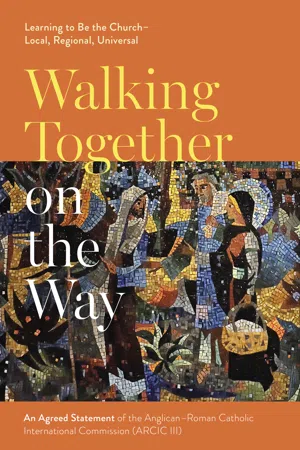
Walking Together on the Way is the first agreed statement of the third phase of the Anglican-Roman Catholic International Commission, and the first ARCIC agreed statement since 2005.
The language of 'walking together' is used by both Archbishop Justin Welby and Pope Francis to describe our ecclesial life and the ecumenical journey. Both have also, in different ways, endorsed the approach of receptive ecumenism: that we have much to learn and much to receive from each other.
In Walking Together on the Way the Commission asks what Anglicans and Catholics can learn from one another to make us better able to walk together in the way of communion. Both our communions have an understanding that all the baptized share in the threefold office of Christ as prophet, priest and king. The document considers how this common understanding is lived out in our processes of governance and discernment at the local, regional and global levels.
The Commission not only examines our respective ecclesial processes of discernment, but also seeks to identify the tensions and difficulties we experience; it asks where Angicans and Catholics can look to one another for wisdom. In this way, the Commission proposes, we can grow together through a journey of mutual enrichment. As the text affirms, 'We are pilgrims together walking on the way of penitence and renewal towards full communion.'
- English
- ePUB (mobile friendly)
- Available on iOS & Android
eBook - ePub
About this book
Information
VI. Instruments of Communion at the Worldwide/Universal Level of Anglican and Roman Catholic Life
As explained in the Co-Chairs’ Preface and in §79, this section has three main subsections: VI.A describes what currently is the case for each of our traditions concerning the respective instruments of communion which operate at this level; V.IB identifies what respective tensions and difficulties are experienced in relation to these instruments of communion at this level; VI.C asks what possibilities there might be for transformative receptive learning from the other tradition in relation to these tensions and difficulties. The Commission has chosen to present our structures, our challenges, and our learnings in parallel columns. At times, in order to avoid appearing to equate quite different processes, we use a sequential format, but with those paragraphs on the left-hand side of the page in an Anglican voice, and those on the right-hand side in a Roman Catholic voice.
The shared inheritance of universal instruments of communion
123. | The ‘ancient common traditions’ that Anglicans and Catholics share include a common recognition of the service rendered by instruments of communion at the worldwide level. These instruments include both the great ecumenical councils of the first millennium and the ways in which the Petrine ministry was exercised to support the unity of the Church. Such structures have evolved from New Testament times and continue to be subject to renewal and development under the providence of God (see Auth I Elucidation §8; also Gift §§45–47). The common tradition was formed and developed with a sense of worldwide mission that necessitated coordination of efforts. Now, however, there are significant differences. The Anglican stress on the significance of provinces has led to the development of regional structures in the service of communion. Anglicans are concerned to ensure that the provinces remain doctrinally cohesive despite great diversity of ecclesial life. In order to promote such cohesion, Anglican provinces have developed instruments of communion at the worldwide level. These tend to rely on bonds of affection and self-discipline rather than on binding norms for their implementation. Catholics, especially since regional gatherings of bishops became infrequent in the early modern period, have stressed the universal instruments of communion, arguably to the detriment of regional ones. |
Respective self-understanding relative to the one, holy, catholic, and apostolic Church of Christ
124. | Anglicans identify the ‘one, holy, catholic, and apostolic church’ as genuinely visible, realized, and instantiated, albeit imperfectly, in current churches, with ongoing dialogue and ecumenical partnerships drawing the churches towards the full visible manifestation of the Church.43 The Lambeth Conference since 1888 has endorsed the Lambeth Quadrilateral as expressing a fundamental Anglican principle. Its intention is to formulate the necessary elements for unity between Anglican and other churches: the Holy Scriptures as containing all things necessary for salvation; the Apostles’ Creed and the Nicene Creed as sufficient statements of faith; the dominical sacraments of baptism and the eucharist; and the ‘historic episcopate’. While the Quadrilateral has been nuanced and reinterpreted over the years, its four elements have become fundamental for Anglican ecclesiological identity. | At the Second Vatican Council the Roman Catholic Church moved from articulating its relationship with the one, holy, catholic, apostolic Church of Christ in terms of strict and exclusive identity to stating that the Church of Christ ‘subsists in’ (subsistit in) the Roman Catholic Church (LG §8). Read within the canon of Second Vatican Council texts, four significant claims can be found here: a)nothing essential to the Church of Christ (in terms of unity, holiness, catholicity, and apostolicity) is lacking in the Roman Catholic Church (UR §3); b)the Church of Christ is not to be found in perfect, eschatologically completed form in the Roman Catholic Church, which is itself in need of continual reformation (UR §6) and purification (LG §8); c)nor is the Church of Christ coextensive with the boundaries of the Roman Catholic Church: key elements are to be found within the other traditions (see LG §8 and UR §3; see UUS §11), sometimes even in more developed form—in fuller flower, as it were—than has been the case within the Roman Catholic Church as it currently exists;44 d)current ecclesial divisions also diminish the Roman Catholic Church (see UR §4): consequently, each tradition has much to learn and receive as we journey towards a reconciled Church that can at once be a more effective sacrament of and witness to the communion of the Trinity (see UR §4). |
VI.A The nature and instruments of communion at the worldwide levels of Anglican and Roman Catholic life
125. | The Anglican Communion continues to discern how best to support its unity with the aid of appropriate structures. Over the last 150 years, four instruments of communion have emerged to give shape to that communion as the autonomous churches emerged through a process of historical, political, and ecclesial devolution. These instruments are: the Lambeth Conference, the Archbishop of Canterbury, the Anglican Consultative Council, and the Primates’ Meeting. Although the roles of the various Instruments of Communion have evolved in response to historical developments, they do embody essential principles of ecclesiastical polity.45 At the heart of the role of each instrument are relationships, with each other and the whole Communion, rooted first and foremost in a relationship with God in Christ.46 Consequently, a willingness to meet together for prayer, worship, and dialogue in the context of all being called to share in the mission of God in the world is essential to each. | The universal communion of the local churches is primarily expressed in the communion of the bishops of these churches: ‘Just as in the Gospel, the Lord so disposing, St Peter and the other apostles constitute one apostolic college, so in a similar way the Roman Pontiff, the successor of Peter, and the bishops, the successors of the apostles, are joined together’ (LG §22; also §8). A Church council is the fullest manifestation of the episcopal college. The Bishop of Rome is head of the college and can act on behalf of the whole. The Roman Curia assists him in service of the universal communion of the Church. Synods of bishops are occasional and partial manifestations of the college. Although Roman Catholic documents do not enumerate only four instruments of communion, the Commission identifies these four recognized instruments because they can be examined in a manner comparable to Anglican structures. It should be remembered that many of the particular structures that facilitate the collegial ministry of the bishops have not been given to the Church by dominical command and are therefore mutable and reformable. |
The character of decisions made at the universal level
126. | Decisions made by the instruments of communion at the worldwide level are non-binding on the provinces and have authority only when they are received and implemented. | Two of the instruments of communion that operate at the universal level—ecumenical councils and the Bishop of Rome as head of the episcopal college—can definitively declare a revealed truth to be an article of faith, a dogma. Thus, for Catholics, these two universal instruments hold the possibility of definitively resolving theological qu... |
Table of contents
- I. Introduction
- II. The Church Local and Universal in the Apostolic and Post-Apostolic Periods
- III. Ecclesial Communion in Christ: The Need for Effective Instruments of Communion
- IV. Instruments of Communion at the Local Levels of Anglican and Roman Catholic Life
- V. Instruments of Communion at the Regional Levels of Anglican and Roman Catholic Life
- VI. Instruments of Communion at the Worldwide/Universal Level of Anglican and Roman Catholic Life
- Conclusion: Growing Together into the Fullness of Christ
- Bibliography
- Members of the Commission
Trusted by 375,005 students
Access to over 1.5 million titles for a fair monthly price.
Study more efficiently using our study tools.
Frequently asked questions
Yes, you can cancel anytime from the Subscription tab in your account settings on the Perlego website. Your subscription will stay active until the end of your current billing period. Learn how to cancel your subscription
No, books cannot be downloaded as external files, such as PDFs, for use outside of Perlego. However, you can download books within the Perlego app for offline reading on mobile or tablet. Learn how to download books offline
Perlego offers two plans: Essential and Complete
- Essential is ideal for learners and professionals who enjoy exploring a wide range of subjects. Access the Essential Library with 800,000+ trusted titles and best-sellers across business, personal growth, and the humanities. Includes unlimited reading time and Standard Read Aloud voice.
- Complete: Perfect for advanced learners and researchers needing full, unrestricted access. Unlock 1.5M+ books across hundreds of subjects, including academic and specialized titles. The Complete Plan also includes advanced features like Premium Read Aloud and Research Assistant.
We are an online textbook subscription service, where you can get access to an entire online library for less than the price of a single book per month. With over 1.5 million books across 990+ topics, we’ve got you covered! Learn about our mission
Look out for the read-aloud symbol on your next book to see if you can listen to it. The read-aloud tool reads text aloud for you, highlighting the text as it is being read. You can pause it, speed it up and slow it down. Learn more about Read Aloud
Yes! You can use the Perlego app on both iOS and Android devices to read anytime, anywhere — even offline. Perfect for commutes or when you’re on the go.
Please note we cannot support devices running on iOS 13 and Android 7 or earlier. Learn more about using the app
Please note we cannot support devices running on iOS 13 and Android 7 or earlier. Learn more about using the app
Yes, you can access Walking Together on the Way: Learning to Be the Church - Local, Regional, Universal by in PDF and/or ePUB format, as well as other popular books in Theology & Religion & Christianity. We have over 1.5 million books available in our catalogue for you to explore.