Your life tells a story.
From beginning to end, your life creates a unique narrative, shaped by the wider stories you find yourself in. For many in the West, the stories that dominate our experience are those of happiness ('just do what makes you happy'), safety ('it's not worth the risk') and significance ('I want to be remembered').
But what if these stories are too small to really matter?
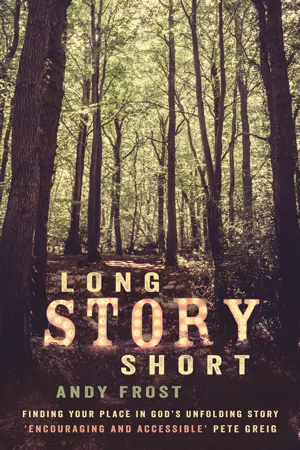
Exploring the importance such stories play in our lives, Andy Frost, Director of Share Jesus International, presents an alternative narrative – the God Story. Long Story Short invites readers to find their place in the only story big enough to live for.
'This book is invaluable for discovering, or finding again, your story.'
Tim Hughes
'Andy encourages us to discover a greater narrative that ultimately helps us to find the real meaning for our existence.'
Lou Fellingham
About the author:
Andy Frost is Director of Share Jesus International and is responsible for kick-starting a variety of projects that help the Church to communicate the story of Jesus. He is a popular speaker and the author of a number of books, and has presented Jesus. The Series.
He is married to Jo and they have two daughters. Currently living in London, Andy loves travelling the world, surfing good waves, pushing himself in physical challenges and eating Mexican food.
Follow him on Twitter @andythefrosty
- English
- ePUB (mobile friendly)
- Available on iOS & Android
eBook - ePub
About this book
Information
Chapter one
ONCE UPON A TIME . . .
Man is always a teller of tales. He lives surrounded by his stories . . . he sees everything that happens to him through them and he tries to live his own life as if he were telling a story.
Jean-Paul Sartre
The way I see it, life is short. At the time of writing, the average life expectancy in the UK is a meagre 81.5 years. Broken down, that’s 978 months, 4,250 weeks or 29,747 days. Given the brevity of life and the enormity of all the world has to offer, each of us will only ever experience a tiny fraction of all that can be experienced. And the cruel part is, we never know just how long we have left. Death could come a-knocking at any moment. None of us knows when our end credits will roll.
We measure age in the number of years that we have lived, but I wonder what the impact on our thinking would be if we were able to measure it in the number of days, weeks, months and years that we have left. How might that change the story we are telling? Would it move things up a gear, having that fresh perspective?
There can be something beautiful about funerals. Now, don’t get me wrong, funerals are often the hardest of events, brimming with grief, loss and a sense of questioning. But funerals can also meddle with our perspective for the better. Funerals can be a healthy reminder that death is on its way. Just like a JCB digger forcing away the topsoil of pleasantries and superficiality, they can brutally and beautifully create space for each of us to look into our souls.
As the eulogy is given, we are made to remember our own mortality. Often with a mix of tears and laughter, we reminisce over someone’s life story, we celebrate the good they did and the adventures they lived. And sometimes we are left wondering, how will we be remembered? We wonder what story will be told about our lives.
There is now an app for your phone that, taking into account your vital statistics, gives you a predicted countdown on how many days, hours and minutes you have left before you die. This may sound scary, but the intention behind it is to encourage you to embrace a healthier lifestyle and thereby extend your life. The app might help us focus on living well – but it really is just a ‘guesstimate’; without a definite countdown it is impossible to know when our time may be up.
Ultimately, the future is a mystery. We live in the uncertainty of not knowing just how long we have left. What we do have is the power to choose, in the here and now of today, how our life story will play out. Today, as another of our possible 29,747 days gets invested in the slot machine of life, we may not be able to choose exactly what we live, but we can choose how we live.
*
There is a famous scene in the 1970s zombie film Dawn of the Dead where two of the lead characters, Francine and Stephen, look down from the rooftop of a shopping mall to see zombies roaming around trying to get into the shops. With a sense of disbelief, Francine asks, ‘What are they doing? Why do they come here?’ Stephen responds, ‘Some kind of instinct. Memory of what they used to do. This was an important place in their lives.’ It became a classic scene in movie history because it prophetically depicts the living dead – people who have many of the attributes of being alive but no sense of meaning or purpose. People existing rather than living.
Though we wouldn’t like to admit it, this sentiment can be seen in many aspects of our own lives. We may post on social media so that people can ‘like’ us without even thinking of whether it really matters. Or we might operate on autopilot, switching on the TV as soon as we arrive home because we’d rather busy our minds with stories of others than fully engage with our own. We look to the sleight of hand again and again, even when we know deep down that the true magic isn’t to be found there.
I wonder, sometimes, if the sleight of hand has left us focusing on the wrong things and missing out on what life is all about. But how do we avoid focusing on the wrong things? How do we make sure that we don’t live life on autopilot? Ultimately, how do we find a story worth living?
JOURNEY
This book is a journey into the world of stories. We’re going to begin by looking at why stories are so important, then we’re going to explore the three main stories we tell ourselves over and over again in the Western world.
First, there is the story of happiness: that life is about enjoying what is on offer. Like squeezing the last bit of toothpaste out of a tube, life is for squeezing every bit of pleasure out of our short time here on earth. The second is about safety. The world is a scary, messed-up place and the aim of the game is to try to make ourselves as safe as we can. The third story that I believe we live for in the West is the narrative about significance. We want our life story to have mattered. And if our existence is just some great accident, then we have to create meaning and purpose so that we can find some kind of significance in the story we live.
The next three chapters are an exploration of these commonly held stories. They present an opportunity to think about the story your life is telling and what you really want it to say. We’ll then move on to the whole idea of meta-narratives – the idea that there are bigger stories that frame the smaller stories we tell ourselves every day.
And then I will pitch you the God story – the story we find in the pages of the Bible. This is the story I have chosen to frame my own life and I will offer you my reasoning as to why I think it makes sense. From this point, I want to explore what the God story means for our lives. I will explore God as the central character. I will explain why I don’t think we are meant to be the centre of our story, and how there is something beautiful about discovering what it means for us to be a character in his story. We’ll then get really practical in the last couple of chapters, looking at our unique role in history, and how we can discover our subplot in God’s unfolding narrative.
THE POWER OF STORY
Before digging deeper into the God story, or even our personal stories, it helps to see just how important stories are. Whether or not you are ‘a reader’ doesn’t matter, because it’s impossible to deny that stories are everywhere. We often think of stories being entombed in books and films, but the truth is, stories are all around us.
Every day we receive dozens of stories from the adverts that adorn street hoardings, our TV screens and our social media channels. It’s fascinating how advertisers frequently don’t even feature the product in the commercial; instead they tell us a story rich in emotion that somehow connects with our very being. As McDonald’s celebrated its fortieth anniversary, there were no perfect photographs of a Big Mac positioned next to a cold Coke, condensation running down the side of the cup. Instead, there were a series of images that depicted milestone moments.
The ‘brave little soldier treat’ photograph showed a young boy in the back of the car with his arm in plaster, a Happy Meal just in view. The ‘just passed your driving test drive-thru’ depicted a young driver with a perfectly positioned green ‘P’ plate driving past a McDonald’s serving window. The campaign was not directly selling us burgers but telling us stories that would engage with our emotions, reminding us of deep memories. They were helping us associate the golden arches brand with key life moments, in turn writing McDonald’s into our own memories.
Our news media pump us with stories whenever we glance at a screen or wade through a paper. Whichever incident is being reported, the coverage we choose to follow dictates the story that is being told. The reporters tell us who are the good guys and who are the bad guys. These stories saturate our lives.
Most days we pass by without thinking about the monuments and graveyards that punctuate our cities, towns and villages. Interestingly, commemorative monuments are nearly always built by the victors, reinforcing a story that might not be wholly true. These monuments remind us of our past, the cost of freedom, the heroes of history. And graveyards remind us of our future, our mortality, our 81.5 years. Our life story might one day just become a short epitaph on a moss-covered gravestone hiding in the shadows of an overgrown cemetery.
The songs we sing, the box sets we watch, the clothes we wear, the shopping centres we frequent, the people we live with, the coffee we drink – all these tell a story. Stories are the glue that shape our conversations, our interactions and our very thoughts. The poet Muriel Rukeyser famously unpacked the idea that the universe is not really made of atoms but of stories. For Rukeyser, they are the heartbeat of our very existence, but what makes stories so powerful?
STORIES GIVE CONTEXT
First, stories give context. They help us make order out of chaos. Whenever we see something unusual or unexpected, like a broken-down car, we say, ‘I wonder what’s happened there?’ We yearn for a story to help us make sense of what we have witnessed. Stories help us understand what’s going on.
I was gripped when I first started reading Dean Karnazes’ book Ultramarathon Man. He begins with the description of a random conversation he has with a pizza delivery man. It’s nearing midnight and Dean is ordering pizza for himself; but he doesn’t order a pizza for one but a family-sized pizza. Then he goes on to order not just one piece of cheesecake but an entire cheesecake. And on top of that he asks for a flask of coffee.
The already confused pizzeria man now asks for the delivery address, and Dean says that he wants it to be delivered to the edge of a highway, miles from the nearest houses. The scene, as it unfolds, leaves the reader confused too, until you discover that Dean is an ultra-marathon runner, running 170 miles straight through the night. He is desperate for calories to keep himself going. As the pizza is delivered, he rolls it up in one hand like a taco and carries on running off into the night, munching away. The story gives context. It helps us understand what’s going on.
Somewhere between Babygros and mastering the alphabet in nursery, children embark on a stage of life where they want to question everything. My daughter was no exception. When she was two, she would often ask, ‘Can you tell me a story about that?’ Even as a toddler she understood that within the context of a story, complex things could begin to make more sense.
As we search for our life story, we become aware that we find ourselves in a bigger story that gives our life context. We have all been brought up with some kind of understanding of family that has shaped our worldview. The values of our parents, the things we experienced, the religious systems we grew up with, the very fact that our families were present or distant, all frame our life’s story. Whenever life stories are retold in books, documentaries or films, they often pinpoint a key moment in childhood – when a wrong was witnessed, a passion was birthed or a skill noticed – that changed the trajectory of the individual’s life, either for good or for evil.
But more than just family, the community that surrounds us in our formative years, with both its generosity and its prejudice, will give us a backdrop to understanding our life story. And more than family and local community, we are born into a much bigger story – one that is being played out among nations and multinationals framed by human history. Now as never before we live in a time period when technology is king and the world’s issues are available online for all to see in HD quality.
Part of discerning our story is discerning the bigger story in which we find ourselves. It’s about understanding our context and the story that has been spoken over our lives.
STORIES GET BENEATH OUR SKIN
But stories do more than give us context. They have the ability to move us to tears and to laughter. Stories get beneath our skin.
In the world of child psychology, the power of story is being realized. Children with behavioural problems, for example, often find it hard to express themselves with words. When talking through issues they can feel pressurized, almost as if they are being interrogated, and so there is a growing trend towards ‘play therapy’. Through role play and storytelling, children are given a freedom to explore emotions and express feelings. Creating stories with figurines or painting or acting out scenarios can give children the chance to operate at their own pace and process emotions they would otherwise find difficult to articulate. Stories have the power to open that vault of emotions we sometimes want to keep firmly closed.
Stories also have the potential to be emotive enough to challenge our very core; we get transported into an experience of life in somebody else’s shoes. Many stories that have been told brilliantly in books and on cinema screens have changed perceptions on issues such as gender, race and culture. As readers and audiences emotionally experience the reality of other people’s existence, mindsets can be transformed.
The power of story in changing belief systems was particularly well executed in a number of British university cities in 1984, a time when apartheid still existed in South Africa. Barclays was involv...
Table of contents
- Introduction
- Chapter one – Once upon a time . . .
- Chapter two – Be happy
- Chapter three – Safety first
- Chapter four – Becoming somebody
- Chapter five – A bigger story
- Chapter six – The God story
- Chapter seven – My story
- Chapter eight – Characters
- Chapter nine – What God wants
- Chapter ten – Your unique subplot
- Conclusion
- Your story
- Notes
Trusted by 375,005 students
Access to over 1.5 million titles for a fair monthly price.
Study more efficiently using our study tools.
Frequently asked questions
Yes, you can cancel anytime from the Subscription tab in your account settings on the Perlego website. Your subscription will stay active until the end of your current billing period. Learn how to cancel your subscription
No, books cannot be downloaded as external files, such as PDFs, for use outside of Perlego. However, you can download books within the Perlego app for offline reading on mobile or tablet. Learn how to download books offline
Perlego offers two plans: Essential and Complete
- Essential is ideal for learners and professionals who enjoy exploring a wide range of subjects. Access the Essential Library with 800,000+ trusted titles and best-sellers across business, personal growth, and the humanities. Includes unlimited reading time and Standard Read Aloud voice.
- Complete: Perfect for advanced learners and researchers needing full, unrestricted access. Unlock 1.5M+ books across hundreds of subjects, including academic and specialized titles. The Complete Plan also includes advanced features like Premium Read Aloud and Research Assistant.
We are an online textbook subscription service, where you can get access to an entire online library for less than the price of a single book per month. With over 1.5 million books across 990+ topics, we’ve got you covered! Learn about our mission
Look out for the read-aloud symbol on your next book to see if you can listen to it. The read-aloud tool reads text aloud for you, highlighting the text as it is being read. You can pause it, speed it up and slow it down. Learn more about Read Aloud
Yes! You can use the Perlego app on both iOS and Android devices to read anytime, anywhere — even offline. Perfect for commutes or when you’re on the go.
Please note we cannot support devices running on iOS 13 and Android 7 or earlier. Learn more about using the app
Please note we cannot support devices running on iOS 13 and Android 7 or earlier. Learn more about using the app
Yes, you can access Long Story Short by Andy Frost in PDF and/or ePUB format, as well as other popular books in Theology & Religion & Christian Theology. We have over 1.5 million books available in our catalogue for you to explore.