This introductory guide to philosophy of religion opens with an engaging history of the discipline, mapping the important landmarks and introducing the main areas of debate.
The rest of the book falls into three parts:
Part 1 describes the major approaches that have been developed by scholars over the centuries, which are still relevant today;
Part 2 explains the main concepts and issues, highlighting their significance in the work of major thinkers;
Part 3 provides a helpful glossary of all the key terms that readers need to understand in order to find their way around the subject.
eBook - ePub
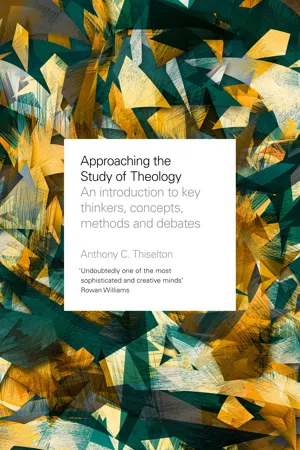
Approaching the Study of Theology
An Introduction To Key Thinkers, Concepts, Methods And Debates
- English
- ePUB (mobile friendly)
- Available on iOS & Android
eBook - ePub
Approaching the Study of Theology
An Introduction To Key Thinkers, Concepts, Methods And Debates
About this book
Information
Topic
Theology & ReligionSubtopic
Christian TheologyIntroduction:
Landmarks in the study of theology
1 Biblical roots
(a) Doctrine of God
From the earliest books and chapters of the Bible, its writers portray God as Creator of the world, and as One who communicates with humankind. Regardless of the date of Genesis 1, Genesis 1.1 declares, ‘In the beginning . . . God created the heavens and the earth’. Isaiah regularly refers to God as Creator, as in Isaiah 40.28: ‘The Lord is . . . the Creator of the ends of the earth’, and in Isaiah 43.15, where he refers to the creation of Israel: ‘I am the Lord . . . the Creator of Israel.’ God’s creation of humankind occurs in Genesis 1.27; 5.1–2; and 6.7; also in Deuteronomy 4.32 and about 20 passages in Isaiah.
Also in the earliest chapters of Genesis, God addressed humankind, and before the fall normally communicated with them, perhaps every day (Gen. 3.8–9). The commands of God presuppose the notion of God’s self-disclosure or revelation, in contrast to human discovery of God. The frequent use of ‘I’ in direct address also constitutes an event of revelation. Thus in the time of Noah, God says, ‘I will blot out the earth’ (Gen. 6.7), and famously in Exodus 3.13–14, declares to Moses, ‘I am who I am’ (or more probably to reflect the Hebrew imperfect, ‘I will be who I will be’). The prophets maintain this theme, as, for example, in Jeremiah 31.31, 33, ‘I will make a new covenant with the house of Israel . . . I will put my law within them’.
These three fundamental biblical roots develop into doctrine: God as Creator, God as Communicator or Revealer, and God as regularly engaging with humankind. The implication is that God created us because he loves us. God chose not to remain in isolation, but from the first sought the company of humankind. In twentieth-century theology, Jürgen Moltmann has developed these themes.
Setting aside the Mosaic period, some of the oldest passages and traditions of the Old Testament (OT) come from the book of Judges, from the era when Israelite theology encountered the polytheism and the nature worship of the Canaanites. In contrast to the Canaanite deities, Israel’s God was seen as the living God. This characterization of God never disappeared from Israelite faith. The Hebrew word hayah, living, underlined God’s dynamic character, in contrast to the ba‘alim, who were lifeless and static. Often people link the prohibition on making carved images of God, or ‘idols’ (Exod. 20.4–5), with the context of pagan idolatry. But a more likely context is God’s decision to make humanity in his own image (Gen. 1.27), because to bear the image of God is the vocation of his people, and they were not to shift this responsibility on to artificial man-made constructs of an image. The contrast between the tabernacle and the Temple symbolized this, as Stephen explained in Acts 7. The tabernacle represented a place of meeting with God which could move from place to place, as the living God himself might move. The Temple signified a fixed dwelling-place. Some biblical passages suggest caution or partial reluctance to build a temple as a site for the worship of the living, moving, God.
God is also regarded as holy. In Exodus 3.5 God appeared on ‘holy ground’. In Isaiah’s call and vision, the angels cried, ‘Holy, holy, holy, is the Lord of hosts’ (Isa. 6.3). In the equally well-known tradition of Leviticus, God spoke to Moses, ‘You shall be holy, for I the Lord your God am holy’ (19.2). The tradition of the Day of Atonement (Lev. 16), and the system of varied sacrifices, underlined the holiness of God. This is linked with the characteristic of righteousness. In the Song of Moses, Moses declared, ‘All his ways are just. A faithful God, without deceit, just and upright is he’ (Deut. 32.4).
As OT thought developed, the character and characteristic actions of God became increasingly evident. By the period of the Psalms, God is omnipotent (or almighty), omniscient and omnipresent. Psalm 139 begins, ‘O Lord, you have searched me and known me . . . You discern my thoughts from far away . . . and are acquainted with all my ways’ (vv. 1–3). God is also all-knowing. His omniscience sometimes extends to a category of future acts: ‘Before a word is on my tongue, O Lord, you know it completely’ (v. 4). We shall show later that this does not entail radical determinism. God’s omnipresence is seen in verses 7–10:
Where can I go from your spirit?
Or where can I flee from your presence?
If I ascend to heaven, you are there;
if I make my bed in Sheol, you are there.
If I take the wings of the morning
and settle at the farthest limits of the sea,
even there your hand shall lead me . . .
Traces of this tradition occur in Genesis when God said to Abraham regarding the birth of Isaac in his old age, ‘Is anything too wonderful for the Lord?’ (Gen. 18.14). In the New Testament (NT) this is linked to the notion of God as king: ‘The Lord our God, the Almighty (Gk, pantokratōr) reigns’ (Rev. 19.6). Luke recounts Jesus as saying, ‘What is impossible for mortals is possible for God’ (Luke 18.27).
In the OT God is also portrayed as sovereign in Isaiah 46.9–10 where he is depicted as declaring, ‘I am God, and there is no other. I am God, and there is no one like me . . . My purpose shall stand, and I will fulfil my intention’. This echoes 2 Samuel 7.22, ‘You are great, O Lord God, for there is no one like you.’
The most striking example of God’s faithfulness is God’s willingness to make a promise to, and a covenant with, Noah, Abraham, Moses, Israel, and the Church or humankind. To Noah, God promises, ‘I will never again curse the ground because of humankind’ (Gen. 8.21). A promise genuinely ties the speaker’s hands, or limits his options, so that a more desirable course of action may be excluded if it countermands the promise. The OT specialist Walther Eichrodt rightly comments that by means of the covenant, ‘With this God men know exactly where they stand; an atmosphere of trust and security is created, in which they find both the strength for a willing surrender to the will of God and joyful courage to grapple with the problems of life’.1 Eichrodt contrasts this with lack of faithfulness and promise in polytheism, where fear constantly haunts the pagan world, by leaving people with the dread of arbitrariness and caprice in the godhead. The promises of Israel’s God excluded this.
These basic characteristics of God (until recently often called ‘attributes’) feature in numerous discussions today. Richard Swinburne and Wolfhart Pannenberg, for example, have taken pains to show that these do not involve logical contradiction, do not lead to radical determinism and do not imply mere anthropomorphism.2
Biblical roots also assert God’s graciousness, goodness and love, and God’s being as Spirit and light, as eternal and infinite, and as uniquely wise. God is ‘merciful and gracious, slow to anger, and abounding in steadfast love’ (Exod. 34.6); ‘God is spirit’ (or better, ‘Spirit’, John 4.24); ‘The Lord is the true God; he is the living God and the everlasting King’ (Jer. 10.10); ‘From everlasting to everlasting you are God’ (Ps. 90.2). Solomon declared, ‘Even heaven and the highest heaven cannot contain you’ (1 Kings 8.27). God is also ‘the only (Gk, mono, solely or uniquely) wise God’ (Rom. 16.27). All these characteristics are discussed at length in contemporary theology.
(b) Humankind
Genesis 2.7 reads, ‘God . . . breathed into his nostrils the breath of life; and the man became a living being’ (Heb., nephesh chayyā). The word nephesh occurs 755 times in the OT, and the Septuagint (lxx) translates it into Greek by the word psychē 600 times. Hans Wolff comments, ‘Only in a very few passages [does] the translation soul correspond to the meaning of nephesh.’ Indeed, he adds, ‘Man does not have nephesh, he lives as nephesh’ (his italics).3 The Greek term psychē also usually denotes life; only occasionally it denotes soul.
This develops into the concept of the unity of human beings, in contrast to any dualism of mind (or soul) and body, as we find in Plato, Aristotle and Descartes. By the time this question becomes debated in late twentieth-century theology, Pannenberg affirms ‘the biblical idea of psychosomatic unity’, and rejects Plato’s notion of ‘liberation [of the soul] from the body at death’.4 By the time of the NT, the Greek word body (Gk, sōma) usually comes to denote the whole self or a person. On the other hand, in Hebrew nephesh can even denote a corpse. James Dunn, a contemporary specialist on Paul, asserts, ‘While Greek thought tended to regard the human being as made up of distinct ...
Table of contents
- Introduction: Landmarks in the study of theology
- Part 1: Approaches
- Part 2: Concepts and issues
- Part 3: Key terms
- Bibliography
- Search terms for Scripture and patristic references
- Search terms for authors
- Search terms for subjects
Trusted by 375,005 students
Access to over 1.5 million titles for a fair monthly price.
Study more efficiently using our study tools.
Frequently asked questions
Yes, you can cancel anytime from the Subscription tab in your account settings on the Perlego website. Your subscription will stay active until the end of your current billing period. Learn how to cancel your subscription
No, books cannot be downloaded as external files, such as PDFs, for use outside of Perlego. However, you can download books within the Perlego app for offline reading on mobile or tablet. Learn how to download books offline
Perlego offers two plans: Essential and Complete
- Essential is ideal for learners and professionals who enjoy exploring a wide range of subjects. Access the Essential Library with 800,000+ trusted titles and best-sellers across business, personal growth, and the humanities. Includes unlimited reading time and Standard Read Aloud voice.
- Complete: Perfect for advanced learners and researchers needing full, unrestricted access. Unlock 1.5M+ books across hundreds of subjects, including academic and specialized titles. The Complete Plan also includes advanced features like Premium Read Aloud and Research Assistant.
We are an online textbook subscription service, where you can get access to an entire online library for less than the price of a single book per month. With over 1.5 million books across 990+ topics, we’ve got you covered! Learn about our mission
Look out for the read-aloud symbol on your next book to see if you can listen to it. The read-aloud tool reads text aloud for you, highlighting the text as it is being read. You can pause it, speed it up and slow it down. Learn more about Read Aloud
Yes! You can use the Perlego app on both iOS and Android devices to read anytime, anywhere — even offline. Perfect for commutes or when you’re on the go.
Please note we cannot support devices running on iOS 13 and Android 7 or earlier. Learn more about using the app
Please note we cannot support devices running on iOS 13 and Android 7 or earlier. Learn more about using the app
Yes, you can access Approaching the Study of Theology by Anthony Thiselton in PDF and/or ePUB format, as well as other popular books in Theology & Religion & Christian Theology. We have over 1.5 million books available in our catalogue for you to explore.