What has the Reformation ever done for us?
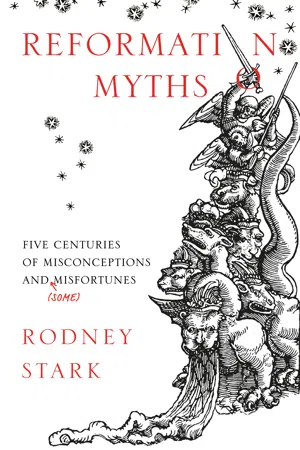
A lot less than you might think, as Rodney Stark shows in this enlightening and entertaining antidote to recent books about the rise of Protestantism and its legacy.
‘Rodney Stark takes no prisoners as he charges through five hundred years of history, upsetting apple carts left and right. Almost everything you thought you knew about the Reformation turns out to be a false narrative. . . In future, anyone who makes sweeping claims about the benefits of Protestantism ought to check their assumptions against Stark’s research first.’ Clifford Longley, author and journalist
‘Stark brings the insights of a distinguished sociologist of religion to bear on a range of inherited assumptions about the impact of the Reformation . . . The result makes for salutary reading in this year of commemoration and (not always justified) celebration.’ Peter Marshall, Professor of History, University of Warwick
‘Stark changed the way we think about the early Church and this book may change the way you think about Protestantism . . . Reformation Myths cuts through pious certainties and challenges us to think again about our cultural history.’ Linda Woodhead MBE DD, Professor of Sociology of Religion, Lancaster University
- English
- ePUB (mobile friendly)
- Available on iOS & Android
eBook - ePub
About this book
Information
Contents
Introduction: the mythical ‘Protestant’
1 The myths of full pews, pious kings and limited monarchies
2 The misfortune of state churches, forced piety and bigotry
3 The misfortune of nationalistic states
4 The myth of the Protestant Ethic
5 The myth of the Protestant scientific ‘revolution’
6 The myth of Protestant individualism and suicide
7 The myth of Protestant secularization
8 The myth of harmful Protestant effects on the Catholic Church
Conclusion: prejudice and persistence
Notes
Bibliography
Index
Introduction
The mythical ‘Protestant’
The date of 31 October 2017 is the 500th anniversary of Martin Luther’s nailing his Ninety-five Theses to the door of the Castle Church in Wittenberg, thereby initiating what became known as the Protestant Reformation. Throughout the year, hundreds of scholarly conferences celebrating the event are being held in all the leading Protestant nations, and even those with Catholic participants will express profound admiration for the many ways in which the Reformation played a major role in the creation of the modern West.
However, an embarrassing question that must be answered at any celebration of the Reformation is: which one do you mean? Three successful Reformations, plus outbursts of Anabaptism, occurred during the sixteenth century (ignoring recent claims that there was a whole series of English Reformations).1 The only common feature of the three successful Reformations was their rejection of papal authority; otherwise they were quite at odds. Luther’s most important theological claim was that salvation comes through faith alone. John Calvin taught that salvation cannot be achieved by any means, but is conferred by God for unknown reasons upon only a chosen few. And Henry VIII’s English Reformation conformed to the Roman Catholic position that salvation can be achieved through works as well as faith.
Bitter hatreds also separated these three Reformations. The Lutherans formed monopoly state churches and prohibited all other faiths, subsequently hunting down ‘crypto-Calvinists’ and burning some of them in Saxony during the 1580s.2 They also were hostile to ‘any people suspected of Anabaptism or of abusing the holy sacraments by practicing Zwinglianism’.3 The Calvinists permitted no ‘heresy’ in Geneva, and persecuted violators. As for Henry VIII, he not only beheaded some Catholic prelates; he also burned a number of Lutherans, Calvinists, Anabaptists and other ‘heretics’.
Consequently, the many celebrations held during 2017 can hardly be in honour of the Reformation. Nor does it seem likely that the celebrants are united in honouring the Lutheran Reformation, let alone the English Reformation. The only plausible common basis for all these events is to celebrate the rise of Protestantism. This raises an even more important matter: that so many of the achievements attributed to Protestantism are entirely mythical and some of the actual results of the rise of Protestantism were quite unfortunate. Thus, there will be frequent tributes incorrectly paid to the myths that Protestantism enabled the rise of science and created capitalism. For partisan reasons, much less is apt to be said about the equally mythical claims that Protestantism spurred the rise of individualism and its presumed consequences or that Protestantism has led to secularization. And very little probably will be said about the need for ‘priest holes’ in many English manor houses, or about laws requiring regular church attendance in England and northern Europe. As for Luther’s legacy of violent anti-Semitism, it probably will not be mentioned.
There is an additional and compelling question that probably also will go unaddressed: what is a Protestant? In this brief Introduction I will demonstrate that the category ‘Protestant’ includes so much variation on such important matters as to be essentially meaningless, except when used very narrowly.
The name Protestant originated with a letter from German princes in 1529 ‘protesting’ against a decision by the emperor to revoke the edict allowing individual princes to choose whether or not to embrace Lutheranism. The word derives either from the Latin pro (for) and testari (witness) or from protestatio (declare). Ironically, perhaps, it was the Vatican that first used the word Protestant ‘to lump together . . . a group of loosely interconnected but ultimately distinct movements’.4 Today, the standard dictionary definition is vague and negative: ‘a Protestant is any Christian who is not a Roman Catholic or an Eastern Orthodox Catholic’. Some dictionaries also exclude Anglicans. Nowhere is there a positive definition such as ‘a Protestant is one who . . .’ The reason for this is simply that it is impossible to list a set of beliefs held in common by all who are called Protestants, or to discover any other feature held in common. Even from earliest days this was true. About all that Lutherans, Calvinists, Anglicans and Anabaptists agreed upon was the divinity of Jesus and the wickedness of the pope.
Thousands of ‘Protestant’ denominations
If, even in Luther’s time, the word Protestant lacked any coherent theological or organizational meaning, consider that since then, ‘Protestants’ have splintered into approximately 33,000 independent denominations worldwide, according to the 2001 edition of the World Christian Encyclopedia. Perhaps as many as 11,000 Protestant denominations are in sub-Saharan Africa alone. Great Britain has more than 500 independent Protestant denominations, ranging from the huge Church of England to small evangelical groups. And there are more than a thousand independent Protestant denominations in the United States, 23 of them having more than a million members each. In his magisterial Encyclopedia of American Religions (9th edition), J. Gordon Melton identifies ten major Protestant ‘families’. These are clusters of denominations sharing common roots and some degree of theological similarity. Nevertheless, there are immense differences both in theology and in cultural outlook not only across these families, but also within them. Consider these two examples.
The Lutheran Family. Even though there has been a recent merger of a number of once-independent ethnic Lutheran denominations (German, Swedish, Danish, etc.), there remain 33 separate Lutheran denominations in the United States. Some of these are very large – the Evangelical Lutherans have nearly 5 million members and the Missouri Lutherans have nearly 3 million. Some are very small – the Lutheran Churches of the Reformation has only about 1,000 members in 15 congregations. There is an amazing degree of theological variation within this ‘family’. The Evangelical Lutherans are very liberal; the Missouri Lutherans are very conservative.
The Reformed–Presbyterian Family. Here are the many variations on Calvinism, including the Puritans who founded the Massachusetts Bay Colony. Melton identifies 44 independent denominations within this group. Some of them are tiny, some of them very large – the Presbyterian Church USA has more than 2 million members and the United Church of Christ has more than a million. Both of these large denominations are very liberal theologically, but many of the other ...
Table of contents
- Reformation Myths
Trusted by 375,005 students
Access to over 1.5 million titles for a fair monthly price.
Study more efficiently using our study tools.
Frequently asked questions
Yes, you can cancel anytime from the Subscription tab in your account settings on the Perlego website. Your subscription will stay active until the end of your current billing period. Learn how to cancel your subscription
No, books cannot be downloaded as external files, such as PDFs, for use outside of Perlego. However, you can download books within the Perlego app for offline reading on mobile or tablet. Learn how to download books offline
Perlego offers two plans: Essential and Complete
- Essential is ideal for learners and professionals who enjoy exploring a wide range of subjects. Access the Essential Library with 800,000+ trusted titles and best-sellers across business, personal growth, and the humanities. Includes unlimited reading time and Standard Read Aloud voice.
- Complete: Perfect for advanced learners and researchers needing full, unrestricted access. Unlock 1.5M+ books across hundreds of subjects, including academic and specialized titles. The Complete Plan also includes advanced features like Premium Read Aloud and Research Assistant.
We are an online textbook subscription service, where you can get access to an entire online library for less than the price of a single book per month. With over 1.5 million books across 990+ topics, we’ve got you covered! Learn about our mission
Look out for the read-aloud symbol on your next book to see if you can listen to it. The read-aloud tool reads text aloud for you, highlighting the text as it is being read. You can pause it, speed it up and slow it down. Learn more about Read Aloud
Yes! You can use the Perlego app on both iOS and Android devices to read anytime, anywhere — even offline. Perfect for commutes or when you’re on the go.
Please note we cannot support devices running on iOS 13 and Android 7 or earlier. Learn more about using the app
Please note we cannot support devices running on iOS 13 and Android 7 or earlier. Learn more about using the app
Yes, you can access Reformation Myths by Rodney Stark in PDF and/or ePUB format, as well as other popular books in Theology & Religion & Christian Denominations. We have over 1.5 million books available in our catalogue for you to explore.