Stress is now a huge factor in modern living, with one-third of British workers likely to suffer from it some stage in their careers. Christians are not immune. Indeed it is arguable that they are even more vulnerable to overstress or burnout than secular people because of behavioural expectations relating to God, Church, society, work and the prevailing culture.
In order to address these particularities, each short chapter in this engaging book responds to a commonly asked question or typical statement, such as 'How can I tell if I'm overstressed?'; 'I'm so disillusioned and swamped at work. I don't know how long I can carry on.'; 'I'm not managing time for God as I used to.' etc. The authors then offer basic information, followed by material for meditation or reflection; encouragement of some sort, and finally something for the reader to work on.
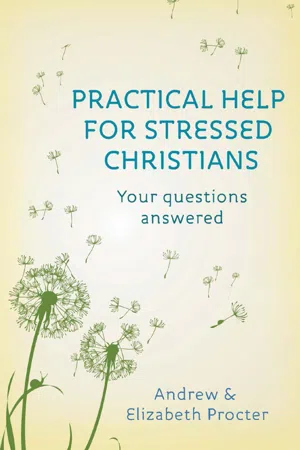
eBook - ePub
Practical Help for Stressed Christians
- English
- ePUB (mobile friendly)
- Available on iOS & Android
eBook - ePub
Practical Help for Stressed Christians
About this book
Information
Part 1
STRESS
1
What is stress?
Problem
People in today’s society seem to be suffering from an epidemic of stress. Almost every day we hear through the media of celebrities or sportspeople succumbing to it, or of surveys showing how stressed we are and how much time is lost at work because of stress-related illnesses. We all know of friends or relations who have said (or have said ourselves): ‘I’m too stressed, I can’t cope with all this pressure.’ No one seems to be immune and for some the pressure becomes so great that they totally collapse or burn out.
Stress is frequently seen as a very unpleasant experience. We feel distressed by it. We chafe at feeling the way we do but it is difficult to escape from and not something we can easily switch out of. This is because these feelings of discomfort and tension arise from certain chemicals called stress hormones being pumped round our bodies in our blood, largely the hormone noradrenaline. The chemicals are released from glands into our bloodstream whenever we perceive (consciously or unconsciously) a demand – a need to perform better or a threat to us. So this might happen if we are meeting someone we love, are asked to squeeze an extra job into a busy schedule, run across a road to avoid traffic or go on a ride in a funfair. Equally the same reaction takes place if we suddenly confront a bull and need to run very fast. So both enjoyable and difficult situations trigger the same release of chemicals.
Good stress
Our bodies are designed to cope with stress. The chemicals have a useful purpose and prepare our bodies to be more efficient and effective. They affect all the organs in our body, diverting blood to our muscles so that we are ‘ready for action’. Blood is diverted from our guts and skin to our brain, heart and limb muscles, and we might feel ‘sick with nerves’ or the colour might drain from us and we go ‘pale with fright’ as a result of the blood being diverted. Our heart may feel as though it is racing as blood is pumped round more quickly to get glucose to our muscles, and we breathe more rapidly. Our eyes open wider and the pupil gets bigger so we can see more clearly. This is often called the ‘fight or flight reaction’ and is a primitive inbuilt response to perceived danger, which was necessary and very useful in the past when we were hunters, and would help us to be at our peak to deal with danger. The adrenaline triggers the release of another hormone called cortisol that helps us cope with stress by boosting our immune system and raising our energy levels.
Once the perceived threat has passed the hormones ebb away and we may then ‘shake like a leaf’ or complain that ‘our legs feel like jelly’ or ‘our guts have turned to water’. This is the result of the adrenaline rush being over. Then we gradually relax and recover.
The world in which we live is very different now but the way our bodies respond to stress hasn’t changed. So what happens to all that raw energy released into our system? We rarely have the opportunity actually to fight or run away in an ordinary day. We are more likely to knuckle down under pressure, hide our emotions and get on with the day. But the adrenaline still courses round our system and isn’t dissipated so easily. Our muscles then feel tense and it may take a long time to calm down. I, Elizabeth, once had to sit a Spanish exam. All was going well until the adjudicator announced only five minutes to go. I was in the middle of copying a story I had written in rough, and as I raced to get it down on the paper before time was called, I felt my breathing get more rapid, my heart pounding as I was full of feelings of panic, anger at myself for mistiming things, and frustration. I sat at my desk writing as quickly as I could. The exam ended, but what surprised me was that my body didn’t calm down straight away. I still felt tense and agitated after the exam, as I drove home and even for about another hour after I arrived home. I simply found it incredibly difficult to relax.
Bad stress
When we hear people complaining of stress they are not usually referring to this inbuilt stress reaction to perceived danger. They are talking about the effects of prolonged stress.
So what has gone wrong? Crucially, the normal ebb and flow of hormones has been disrupted. For whatever reason, after a release of stress hormones we are not able to take adequate recovery time, we do not manage to get back to our resting state, but instead the stress hormones continue to course round our body making us feel very uncomfortable indeed. We may have so much to do that we cannot properly relax and recuperate, and we make demands on our bodies to keep on going. This is not a problem in the short term as eventually we will stop and rest and have some recovery time. However, if more and more demands pile in and we cut out our times of rest and relaxation in order to do everything demanded of us, our stress hormones never return to their resting state but stay abnormally high. As we have seen, stress hormones affect all our body systems, and we notice that we are always tense and on edge. We are overstressed. More noradrenaline gets pumped out, more cortisol is released and we begin to feel terrible. Eventually, when the body’s stores of these hormones become depleted we may reach a state of ill health and even total collapse or burnout.
Angela described various times in her life when she had felt stressed and overwhelmed by what life was throwing at her. She particularly recalled the time her parents split up, when she was so worried that sleep was difficult and she wanted to run away and hide until it was all over. When she was taking university exams and deadlines loomed she found her brain wouldn’t switch off and yet it was very difficult to concentrate and do useful work, and when her mother was in hospital she had to rush from one thing to another to fit in visiting, and barely had time to eat properly. Although she tried to carry on as normal with her church and working commitments, she felt that she gave less time for God when she should have been relying more on him. However, she says that when she did pray, her prayers were more heartfelt as she cried out to God.
People often tried to be helpful and wanted to fix her problems, when she would have preferred to be listened to. What really helped her, and still does, were times of rest, reflection and solitude.
Angela’s advice to Christians suffering with stress is to be prepared to delegate and allow others to take over jobs you normally do, and to give yourself times of rest, to relax and reflect. This will prevent you from becoming more ragged and stressed.
Opportunity
Breathing exercise
If you are feeling stressed and finding it difficult to unwind and relax you can begin to do something about it now. One of the consequences of the stress chemicals in our bodies is to make our breathing rapid and shallow. By concentrating on our breathing we can begin to change this. Take some time to notice how you are breathing. Normally we are completely unaware of how we breathe; we only notice when breathing is difficult or we have a bad cough. So think about it. Now try breathing in deeply and slowly. Make sure that you are comfortable either sitting or lying down, and loosen any tight clothing you are wearing.
Fill up the whole of your lungs with air from the bottom to the top. Breathe in through your nose. Put your hand on your stomach and breathe in until you feel your stomach pushing out. This is called diaphragmatic breathing, filling your lungs to their full capacity with air. Then breathe out deeply through your mouth, gently pushing all the air out of your lungs – your stomach will push in too. Repeat this deep breathing for several minutes, breathing in slowly and counting from one to five and breathing out slowly counting from one to five. Regular relaxed breathing practised for a few minutes two or three times a day helps you to feel calm, and is to do with the balance of chemicals in our bodies. It is also something you will be able to do at times in the day when you are feeling stressed.
Inspiration
Joel Gascoigne writes a blog called buffer.com.1 In May 2014 the following appeared:
[Recently] I religiously tried to follow a new routine I created for myself: a 7 day work week routine.
The idea was quite simple: I would work 7 days a week, rest 7 days a week, go to the gym 7 days a week, reflect 7 days a week. This was less about working lots, much more about feeling fulfilled every day, feeling stretched during the day but also rested. I aimed to work less each day, and replace two hours of work with a long break in the middle of the day . . .
I wanted every day to be exactly the same. So I worked each day, and rested each day. I went to the gym every day, I adjusted my work out so that this would be sustainable . . .
Overall, I feel like the 7 day work week fell apart because of lack of an extended period of renewal. My hypothesis that a couple of extra hours during the day and less overall daily hours working would be enough was invalidated in my experience.
After trying a 7 day work week, I became quite fascinated by the concept of a ‘day of rest’. It occurred to me that this is a tradition that has been around for a very long time, and of separate origins. Almost all the world observes some form of a weekly ‘day of rest’.
I’m no expert on the bible, however with a little research I found that the origin of the ‘seventh day’ or Sabbath is Genesis 2:2–3:
‘And on the seventh day God ended His work which He had made; and He rested on the seventh day from all His work which He had made.’
Similarly, in Buddhism there is the concept of Uposatha, which is the Buddhist day of observance. I find it interesting how Buddhism teaches the purpose of this day:
‘The cleansing of the defiled mind.’
I feel a sense of calm and confidence in the knowledge that many thousands of years of wisdom all converges towards the idea of a weekly day of rest. Certainly from my naive experiment I now feel that this is a very good practice.
Both from my own experiment and the wisdom of the day of rest, I have become interested in the idea of a single day of rest.
However, I have not once come across anything advocating two days of rest. This is one of my biggest takeaways from this experiment, and I plan to continue to work on the basis of 6 days of work and a single day of rest.
He received many comments on this blog, most from people saying they too had burned out when trying to work seven-day weeks and just became less efficient.
Meditation: Mark 2.27, ‘The Sabbath was made for man, not man for the Sabbath’
When we read the creation story in Genesis we are told that on the seventh day God had finished his work and rested from all the creative work he had done (Genesis 2.2–3). He made this day holy and different, and later when the Ten Commandments were given, the fourth commandment reminds us to keep a ‘Sabbath’ when we and our households rest and can be refreshed from our work (Exodus 20.8; 23.12). The Pharisees took this to extremes and made numerous rules about what did and did not constitute work. In the Gospels Jesus rebukes them and points out that the Sabbath was made for humankind, not given so that we would be burdened by rules. He is unafraid to do good and heals people on the Sabbath.
What are we to learn from this? First, that God built in a cyclical pattern of work and then rest for our well-being and refreshment. We ignore this at our peril. For our health’s sake we need time to wind down from the stresses and strains of life.
Second, in Ezekiel 20.12 God says he gave the Sabbath as a sign so that the Israelites would know the Lord had made them holy. It is a regular reminder that we do not become holy by ‘doing lots of good things’; it is a gift of grace, and God gives us time to ‘just be’ if we are prepared to take it. Our regular public worship is there to remind us also that by grace and faith we enter God’s rest (Hebrews 4.2–3).
The problem for all of us is that we wrestle with this, wanting to earn God’s favour, and find it very difficult to refrain from working every day. Like the Pharisees, we wonder what is work? In the ancient world and even until the machine age, people did heavy manual labour, and a day of rest would be a day of physical rest. In our modern world we may spend very little time doing physical work on a day-to-day basis, but lots of mental work (depending on our job and circumstance), and a day of rest may need to include physical things like sport, chopping logs or housework, and to rest and refrain from looking at work emails. The physical labour may be very recreative and refreshing. Perhaps a good rule of thumb is to have weekly time to do what refreshes us, what we find recreative, and also to join with others in worship.
Stressbuster: exercise
Take some regular exercise. It is easy to stop exercising when you are pressed for time. It may be that you exercise already, like John, who enjoyed playing squash once a week and felt that hitting the ball really helped de-stress him. Or perhaps you are more like Sue who decided to walk each lunch hour for ten minutes, not too vigorously, window shopping or enjoying the gardens around, enough to switch her off from her desk work. Exercise is good for every level of our being and is a known de-stressor. It disperses the adrenaline we carry around with us, releases endorphins that improve our mood and helps to keep us healthy. Think of some exercise you could do regularly. You may prefer to cycle, run, swim or do Zumba. Start small and build up to more. Choose something you enjoy and will be able to keep up. Ryan joined a five-a-side football team and valued the camaraderie as well as the commitment, and noticed that he was feeling less stressed as a result.
2
How do I know if I’m overstressed?
Problem
It can be difficult to tell if we are overstressed, particularly if we’ve been exposed over a long period of time to events that make us feel stressed. Although we think we are...
Table of contents
- Cover page
- About the authors
- Title page
- Imprint
- Dedication
- Table of contents
- Acknowledgements
- Introduction
- Part 1: STRESS
- Part 2: GOD
- Part 3: FAMILY LIFE
- Part 4: CHURCH LIFE
- Part 5: WORK
- Part 6: CULTURE AND SOCIETY
- Conclusion
- Resources
- Notes
Trusted by 375,005 students
Access to over 1.5 million titles for a fair monthly price.
Study more efficiently using our study tools.
Frequently asked questions
Yes, you can cancel anytime from the Subscription tab in your account settings on the Perlego website. Your subscription will stay active until the end of your current billing period. Learn how to cancel your subscription
No, books cannot be downloaded as external files, such as PDFs, for use outside of Perlego. However, you can download books within the Perlego app for offline reading on mobile or tablet. Learn how to download books offline
Perlego offers two plans: Essential and Complete
- Essential is ideal for learners and professionals who enjoy exploring a wide range of subjects. Access the Essential Library with 800,000+ trusted titles and best-sellers across business, personal growth, and the humanities. Includes unlimited reading time and Standard Read Aloud voice.
- Complete: Perfect for advanced learners and researchers needing full, unrestricted access. Unlock 1.5M+ books across hundreds of subjects, including academic and specialized titles. The Complete Plan also includes advanced features like Premium Read Aloud and Research Assistant.
We are an online textbook subscription service, where you can get access to an entire online library for less than the price of a single book per month. With over 1.5 million books across 990+ topics, we’ve got you covered! Learn about our mission
Look out for the read-aloud symbol on your next book to see if you can listen to it. The read-aloud tool reads text aloud for you, highlighting the text as it is being read. You can pause it, speed it up and slow it down. Learn more about Read Aloud
Yes! You can use the Perlego app on both iOS and Android devices to read anytime, anywhere — even offline. Perfect for commutes or when you’re on the go.
Please note we cannot support devices running on iOS 13 and Android 7 or earlier. Learn more about using the app
Please note we cannot support devices running on iOS 13 and Android 7 or earlier. Learn more about using the app
Yes, you can access Practical Help for Stressed Christians by Andrew Procter,Elizabeth Procter,Elizabeth Procter in PDF and/or ePUB format, as well as other popular books in Theology & Religion & Religion. We have over 1.5 million books available in our catalogue for you to explore.