eBook - ePub
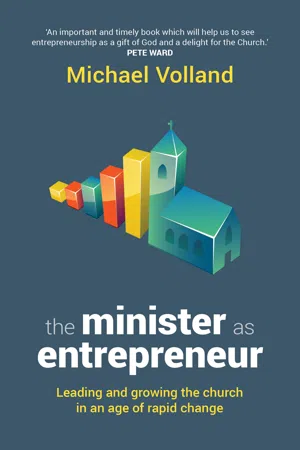
The Minister as Entrepreneur
Leading and Growing the Church in an Age of Rapid Change
- English
- ePUB (mobile friendly)
- Available on iOS & Android
eBook - ePub
The Minister as Entrepreneur
Leading and Growing the Church in an Age of Rapid Change
About this book
A compelling case for an entrepreneurial approach to ministry and mission, exploring its biblical basis and potential benefits. Based on extensive interviews with entrepreneurial ministers from a range of denominations. Draws on examples of 'entrepreneurs' from the Bible and Christian history to help readers imagine how such an approach could work in their own context. Addresses the problems some have with the word 'entrepreneur' and sets out a positive and informed alternative understanding. Full of informative and inspiring case-studies of entrepreneurial ministry in action. Building on his own experiences as a priest and an entrepreneur, Volland argues that the concept of entrepreneurship offers churches a helpful lens through which to view Christian ministry and mission, and an understanding and approach to ministry that is well fitted for the mission task in a rapidly changing world. He shows how an entrepreneurial approach is consistent with understandings of leadership in the major denominations and in the new churches. He also argues that such an approach is consistent both with the nature of God and with human collaboration with God's activity in the world. His conclusions are based on extensive interviews with entrepreneurial ministers (Justin Welby and Steven Croft were among the interviewees), and his findings result in practical suggestions for those seeking to be more entrepreneurial in their ministries as well as in recommendations for strategic change that will encourage sustainable church growth and vitality in the years ahead.
Information
Part 1
ENTREPRENEURS: WHAT? WHO? WHY NOW …?
1
Dragons’ Den? Towards a positive understanding of the entrepreneur
A contested term
The word, entrepreneur, draws a mixed response when it is used in conjunction with Christian ministry. Although some are happy with it, more often than not it prompts responses ranging from discomfort to fervent objection. No doubt this is due to the association of the word with a worldly approach to wealth creation for personal gain.1
I wrote these words in a chapter I contributed to a textbook on fresh expressions of church and pioneer ministry. The comment comes in the middle of a passage of reflection on the kind of approach to Christian ministry that might currently be necessary in the United Kingdom. I deliberately use the term ‘entrepreneur’ to prompt readers to consider the sorts of qualities that might be desirable in those engaging in this task. As part of my research for the chapter I invited 30 men and women who were each engaged in various forms of Christian ministry to complete a survey. They were asked to provide responses to a number of questions, among them the following: ‘Comment on the use of the term “entrepreneur” in relation to Christian pioneering’.2 The responses were interesting and varied, and I have reproduced nine of them below.3
John Went
Sometimes entrepreneurs have a tendency to be sole operators, not good at listening to others, so I would wish to qualify entrepreneur with the ability to listen and to collaboratively involve others in the mission task.
Chris Howson
I loathe the use of the term ‘entrepreneur’. We do not need to borrow more terms from the market – our faith has been privatized enough as it is! The word entrepreneur has too many connotations with taking risks for personal gain. The risks that a Christian takes are at personal cost, not gain. If one looks at contemporary understanding of the entrepreneur it is associated with programmes such as The Apprentice and Dragons’ Den. These programmes reflect the ruthlessness of modern capitalist society, and are inherently confrontational and combative. ‘Collaboration’ and ‘solidarity’ are terms that might be more helpful.
David Wilkinson
I like the term ‘entrepreneur’. In a business context it speaks of someone who builds for the future, who sees new possibilities, who is prepared to take risks. I can see how some within the Church would react against it but there is creativity with entrepreneurship.
Ian Meredith
I run a business as well as being active in ministry (although I don’t agree with the distinction). I am entrepreneurial in both.
Janet Sutton
Entrepreneur is not a term I would use in relation to my own pioneering ministry. I would prefer to use a word like prophetic. I suppose my own role is entrepreneurial as I began more or less with a blank piece of paper and a time span in which to achieve something. But it is not a definition that sits comfortably with me.
John Drane
I have no problem with the use of the word ‘entrepreneur’ in relation to ministry just so long as we don’t imagine it excludes some people.
Jonny Baker
An entrepreneur is someone who builds something. And I like people who spot opportunities or gaps and are able to create something there. It’s an exciting word. For those of us who remember Margaret Thatcher it is also tainted with capitalist overtones but it’s pretty clear that it’s not being used in that way in the context of mission.
Robert Warren
Entrepreneurs are not often team players and can be driven rather than called. Servants and vocation are more important aspects of ministry that need exploring.
Ian Bell
I understand the reason why the term is used, but I struggle to feel entirely comfortable with it. It is difficult to detach the word ‘entrepreneur’ from the world of business and commerce – which has sufficient connotations of consumerism and materialism to make it somewhat unhelpful. Maybe ‘spiritual entrepreneur’ is slightly better?
The nine responses set out above are just a selection of those received, but they highlight the fact that the understanding of the term ‘entrepreneur’ in relation to Christian ministry is not straightforward. Although some of the respondents are content with the association, others express varying levels of concern and one respondent goes as far as stating ‘I loathe the use of the term’. The responses to my survey were not subject to rigorous analysis, and in that sense I cannot claim that they are broadly representative of wider Christian attitudes. However, I strongly suggest that they point to the fact that in relation to Christian ministry the use of the term ‘entrepreneur’ is contested.
The warping power of Loadsamoney
In The Enterprise Culture, Peter Sedgwick acknowledges that ‘There has been a suspicion of the market, wealth-creation and enterprise in the churches for a long time.’4 This suspicion can be shaped by a number of factors, including gender, personality type, social class, family history, political affiliations, profession, personal experience of financial matters, church denomination and tradition, understanding of Scripture and image of God. I suggest, however, that a further, external factor has contributed significantly to the negative perception of the entrepreneur articulated by some Christians. Mark Casson et al. refer to the period in the West, since the early 1980s, during which a particular image of the entrepreneur emerged in the public consciousness. And it is this image which continues to shape perceptions of entrepreneurs and entrepreneurial activity in the minds of many Christians who are uncomfortable with, or hostile to, the term. As Casson et al. write,
The enterprise culture of the 1980s and 1990s was a natural reaction to some of the anti-entrepreneurial attitudes that had taken root in the West in the early post-war period. It should not be inferred, however, that this enterprise culture was based on a correct understanding of the role of the entrepreneur. The highly competitive and materialistic form of individualism promoted by ‘enterprise culture’ did not accurately represent the dominant values of successful entrepreneurs of previous generations.5
This observation is useful because it identifies a significant contribution to the negative associations that some make with the term ‘entrepreneur’. An image of the entrepreneur as being responsible for, as well as a product of, a ‘highly competitive and materialistic form of individualism’6 is arguably dominant even today. One might say that, for some Christians, the entrepreneur has come to personify the morally suspect side of enterprise culture.
This negative image was caricatured and widely popularized in 1988 by the comedian Harry Enfield in his creation of the obnoxious character Loadsamoney, and – as one of the respondents to my survey pointed out – has been maintained by television programmes like Dragons’ Den and The Apprentice. The image of the entrepreneur as obnoxious, self-seeking and motivated by money is still a key association for many Christians. In his interview response, for example, Jonny Baker recognizes that the term ‘entrepreneur’ continues to have negative associations with the culture of greed in the UK during the 1980s and early 1990s; with regard to the use of the term in relation to Christian ministry, Baker states that ‘For those of us who remember Margaret Thatcher it is also tainted with capitalist overtones’.
However, Baker goes on to point out that ‘it’s pretty clear that it’s not being used in that way in the context of mission’. Interestingly, having made their point about the enterprise culture of the 1980s and 1990s generating a wrong understanding of the role of the entrepreneur, Casson et al. go on to argue that the evidence ‘suggests that successful entrepreneurship is as much a co-operative endeavour, mediated by social networks, as a purely individualistic and competitive one’.7
I suggest that Christians who respond hesitantly or negatively to language around entrepreneurship are likely to have less of an issue with entrepreneurship when it is conceived of as a co-operative, mutually supportive and non-competitive approach to life and work (and all that this implies for Christian ministry and mission) rather than as competitive, individualistic wealth creation. In an article on entrepreneurship published in the Church of England Newspaper I wrote, ‘One minister, initially uncomfortable with the prospect of associating her ministry with that of being an entrepreneur, commented after a long discussion, “When I look at it like that, I’d like to be more entrepreneurial!”’8
I am not suggesting that conclusions can be drawn from this single example. However, I do propose that, by explaining the way in which I am using language with regard to entrepreneurship, I may be able to help Christians for whom the term has negative associations to understand how it could also be considered useful in reflecting on the potential shape of Christian ministry and mission today.
Entrepreneurs are not greedy
I have proposed that negative associations of the entrepreneur articulated by some Christians are, at least partially, a result of the image identified by Casson et al. as emerging from the enterprise culture. At the root of discomfort with this image for some Christians is a dual recognition that greed is a primary motivating factor for a good deal of wealth-generating activity and that greed (whether expressed individually or corporately) is inconsistent with Jesus’ proclamation of the coming kingdom of God.9 It is possible to argue that this proclamation includes a ‘preferential option for the poor’10 and implies, therefore, a degree of hostility towards the creation, retention and use of wealth. Exponents of liberation theology,11 for example, ‘respond to the “reality” which confronts millions: poverty, appalling living conditions, malnutrition, inadequate health care, contrasting with the affluence [of the wealthy elites]’.12 Those who cite Jesus’ preferential option for the poor, including those who embrace theologies of liberation, point to the identity of those with whom Jesus chose to spend the majority of his time (the poor), the warnings he aimed at the rich and the explicit message of aspects of his teaching and a number of his parables.
In support of this view, particular examples from the Gospels might include Matthew who, at Jesus’ call, abandons his toll-booth (Mark 2.14; Matthew 9.9; Luke 5.27–28), exchanging lucrative employment for a life on the road with a homeless rabbi.13 One might also highlight the account of the rich young ruler (Matthew 19.16–30; Mark 10.17–31; Luke 18.18–25) to whom Jesus said, ‘Go, sell everything you have and give to the poor, and you will have treasure in heaven. Then come, follow me’ (Mark 10.21). There is the account of Zacchaeus, who upon encountering Jesus repents of his corrupt and self-seeking existence, returns four times what he has taken from those he has cheated and gives half of his possessions to the poor (Luke 19.1–10). Luke also records Jesus telling his hearers to ‘Sell your possessions and give to the poor’ (12.33). In Matthew’s account of the Sermon on the Mount Jesus tells his hearers, ‘Do not store up for yourself treasures on earth … But store up for yourselves treasures in heaven … You cannot serve both God and Money’ (Matthew 6.19–21, 24). We might also note Jesus’ parable of the rich fool (Luke 12.16–21) who resolves to build bigger barns in which to store his surplus, but from whom God demands his life and about whom Jesus says (v. 21), ‘This is how it will be with whoever stores up things for themselves but is not rich towards God.’
It is possible to see from these examples how one might argue that Jesus’ agenda was firmly anti-wealth and its creation and that following him meant becoming like the poor: turning one’s back on worldly wealth and time spent in its acquisition and embracing instead a life of austerity, if not outright poverty.
On the other hand there are plenty of examples of Jesus spending time with wealthy people who nevertheless expressed solidarity with his message. The aforementioned Zacchaeus, described by Luke (19.2) as wealthy, gave away half of his possessions, while Jesus announced about him, ‘Today salvation has come to this house’ (Luke 19.9). But Zacchaeus appeared to continue living in his home with the remaining half of his possessions and to pursue his occupation as a chief tax collector. Luke also reports that as Jesus travelled with his disciples from village to village proclaiming the kingdom, a large number of women, including the wife of the manager of Herod’s household, ‘were helping to support them out of their own means’ (Luke 8.1–3). Joseph of Arimathea is described as a rich man (Matthew 27.57) who is...
Table of contents
- Front Cover
- Title
- Copyright Page
- Contents
- Introduction: Why ‘entrepreneur’?
- Part 1 ENTREPRENEURS: WHAT? WHO? WHY NOW . . .?
- Part 2 DREAMING DREAMS, BUILDING REALITY: ENTREPRENEURIAL MINISTERS IN THEIR OWN WORDS
- Conclusion: What has been said and what do we do next?
- Appendix 1 Suggestions for group discussion
- Appendix 2 Suggested essay questions
- Appendix 3 Avenues for further research
- Notes
- Bibliography and further reading
- Search terms
Trusted by 375,005 students
Access to over 1.5 million titles for a fair monthly price.
Study more efficiently using our study tools.
Frequently asked questions
Yes, you can cancel anytime from the Subscription tab in your account settings on the Perlego website. Your subscription will stay active until the end of your current billing period. Learn how to cancel your subscription
No, books cannot be downloaded as external files, such as PDFs, for use outside of Perlego. However, you can download books within the Perlego app for offline reading on mobile or tablet. Learn how to download books offline
Perlego offers two plans: Essential and Complete
- Essential is ideal for learners and professionals who enjoy exploring a wide range of subjects. Access the Essential Library with 800,000+ trusted titles and best-sellers across business, personal growth, and the humanities. Includes unlimited reading time and Standard Read Aloud voice.
- Complete: Perfect for advanced learners and researchers needing full, unrestricted access. Unlock 1.5M+ books across hundreds of subjects, including academic and specialized titles. The Complete Plan also includes advanced features like Premium Read Aloud and Research Assistant.
We are an online textbook subscription service, where you can get access to an entire online library for less than the price of a single book per month. With over 1.5 million books across 990+ topics, we’ve got you covered! Learn about our mission
Look out for the read-aloud symbol on your next book to see if you can listen to it. The read-aloud tool reads text aloud for you, highlighting the text as it is being read. You can pause it, speed it up and slow it down. Learn more about Read Aloud
Yes! You can use the Perlego app on both iOS and Android devices to read anytime, anywhere — even offline. Perfect for commutes or when you’re on the go.
Please note we cannot support devices running on iOS 13 and Android 7 or earlier. Learn more about using the app
Please note we cannot support devices running on iOS 13 and Android 7 or earlier. Learn more about using the app
Yes, you can access The Minister as Entrepreneur by Michael Volland in PDF and/or ePUB format, as well as other popular books in Theology & Religion & Christian Ministry. We have over 1.5 million books available in our catalogue for you to explore.