- English
- ePUB (mobile friendly)
- Available on iOS & Android
eBook - ePub
About this book
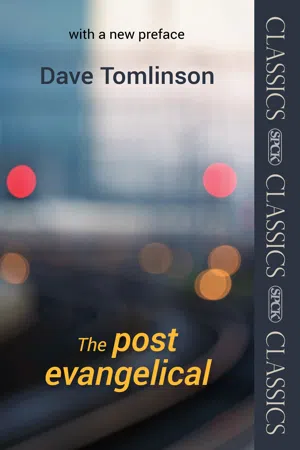
Ground-breaking and hugely controversial on first publication in 1995, this classic text pre-empted the emerging church movement, questioning whether the certainties of evangelical orthodoxy could survive in a postmodern world
Information
Topic
Theology & ReligionSubtopic
Christian Ministry1
A symbol of hope
It may seem strange to be talking about ‘post-evangelical’ just as others are talking about an evangelical renaissance, yet the subject is of vital concern to an increasing number of people who, for various reasons, feel the urge to explore new possibilities with regard to their faith. At the time of writing the term ‘post-evangelical’ has no formal definition, there is no body of theology behind it, no published agenda and certainly no organization, and yet it is surprising how many people on hearing the word for the first time immediately understand its significance, and have a rough idea what it might imply. Indeed, for lots of them it is a welcome rallying point, a symbol of hope.
Why do people need such a hope, and what do they expect to find? These are the questions we are about to discuss, but first, I should briefly explain a little about this book. Although I talked extensively to many people with different viewpoints, I have not set out to present a survey of their opinions, and I am not writing as a dispassionate onlooker: I consider myself post-evangelical. The book is really intended to operate on three levels. First, it is an apologetic, an explanation of what is going on and why. Second, it is a pastoral response to those who feel confused as to where they stand, and wonder if, perhaps, they are alone in thinking and feeling as they do. I wish to say that probably they are not alone. And third, it aims to discuss some of the thorny issues and offer possible alternative interpretations to those that such people often feel stuck with. I believe the lack of ready alternatives is a major source of people giving up the quest altogether, and consequently becoming ex-Christians rather than post-evangelicals.
An example of this is a man I met at a garden party a couple of years ago. After a brief conversation, he confessed that he had once been an evangelical Christian, but that he now considered himself an agnostic. On hearing more of his story, it seemed quite clear to me that his problems were more to do with the dogmatic strand of evangelicalism he had encountered than with God himself. I told him this, and we talked for a long time about the difficulties which had finally led him to throw in the towel. He was a thinking person who could not accept things simply because he was told that they were so, and unfortunately this is exactly what had been expected of him. If only there had been space for him to explore ideas for himself, albeit with guidance and care from others, I believe his story could have turned out quite differently. Thankfully, he has now found that space, and is rediscovering a way forward within the Christian faith.
Why ‘post’-evangelical?
Most of those who contemplate the possibilities of being ‘post’-evangelical do so because of a difficulty they find in reconciling what they see and experience in evangelicalism with their personal values, instinctive reactions and theological reflections. For some people the agony created by this conflict is very considerable, as became quite evident in my many conversations with people while I was researching this book. One young man, who had grown up in an evangelical home, spoke with pain about the dilemma: ‘I don’t know where to go. I no longer feel I can call myself an evangelical, yet I certainly don’t wish to be a liberal. What am I?’ Other people are more nonchalant about it, like the young woman who told me: ‘Evangelicalism helped me to begin with, but I feel I’ve outgrown it now.’ Arrogant? Possibly, yet she was voicing something which cropped up continually in my discussions with people: the feeling that evangelicalism is supremely good at introducing people to faith in Christ, but distinctly unhelpful when it comes to the matter of progressing into a more ‘grown up’ experience of faith.
What do they mean by ‘grown up’? Lots of things, but I will just mention the one which is cited most often: the desire to interact on a more positive level with theologies and perspectives which do not come from an evangelical source.
The feeling people have is that such perspectives are only ever mentioned in evangelical circles in order to be promptly dismissed as rubbish or as a disgraceful compromise. ‘I have suffered twenty years of religious and theological censorship’, one person exclaimed. ‘I have been warned about this and told to keep away from that. I’ve had enough of it. It’s time for me to make up my own mind.’ Let me illustrate this point with an analogy. Being a frequent traveller up and down the motorways, I know what it is like to scan the airwaves for something of interest to listen to. I never cease to be amazed at the different ways in which the same news items are reported by various radio stations; sometimes I wonder if I am hearing about the same events. The contrast becomes even greater if I listen to reports of the same incidents from overseas stations, and if I really want to be confused, I listen to the in-depth commentators, who seem able to produce diametrically opposing views on virtually any subject!
The point is that these people are tired of listening only to the evangelical networks. Indeed, they have already tuned in to other stations and have found that initial confusion has soon given way to great exhilaration, as they realized the diversity of possible interpretations of the Christian faith. A more ‘grown up’ environment, in their view, would be one in which there were fewer predigested opinions and fewer categorical conclusions, and where there was a lot more space to explore alternative ideas. They would also like room to express doubt, without having someone rush around in a mad panic trying to ‘deliver’ them from unbelief. Far too often, doubt is portrayed simply as an enemy rather than as a potential friend; as something mature Christians should not suffer from, rather than as a vital means of Christians becoming mature.
The temptation for post-evangelicals is simply to up and leave the evangelical tradition and move elsewhere. For some this may be a good decision, but it would be a great mistake to imagine that the things we are discussing are a mere ‘storm in an evangelical teacup’: narrow-mindedness and dogmatism are to be found in churches of all traditions. The theological issues under question may not always be the same, but the feeling of social claustrophobia can be exactly the same, as was demonstrated by a television documentary made by Karen Armstrong, the author and former nun. The similarity between the things Catholics were saying to her about the Roman Catholic Church, and things post-evangelicals might say about evangelical churches, was quite extraordinary. And the same could be said of other traditions: even liberals can be dogmatically liberal! All in all, swapping traditions is not necessarily a solution.
But there is another difficulty about switching churches, because when the chips are down, disillusioned evangelicals quite often discover that their evangelical background still counts for something. At this point, it might be helpful to give a brief explanation of the term ‘evangelical’.
What do we mean by ‘evangelical’?
The evangelical tradition, which incidentally exists across the denominations rather than in any one in particular, has been identified as coming to prominence in at least three periods of Protestant history.1 Although the term itself derives from the Greek word euangelion, meaning ‘gospel’ or ‘good news’, its use in this form dates back to the Reformation, when it simply described the emerging Protestant movement, and especially the Lutheran wing of the movement. Then there was the period of the great evangelical revivals during the eighteenth and nineteenth centuries, associated with people like Wesley, Moody and Finney, and lastly, during the late nineteenth and early twentieth centuries, there was the period of evangelical fundamentalism. Each of these periods has contributed substantially to the character of the present-day movement. The Reformation established the supremacy of biblical authority over the authorities of both the Pope and church tradition; it also gave prominence to the doctrine of justification by faith. The emphasis of the evangelical revivals was on personal conversion, holiness of life and the need to preach the gospel. The fundamentalist period was characterized by the defence of the Bible in the face of attacks from science, history and modernist theology.
Although one writer has described no fewer than sixteen distinct strands of evangelicalism,2 we can, even from this simple historical outline, identify several major features common to all evangelicals. Evangelicals recognize the gospel of salvation through faith in Christ’s atoning work as absolutely central; they assert that this faith must be personal, leading to an experience of conversion; they stress the importance of declaring the gospel to those who do not believe, and they hold to the supremacy of Scripture over all other sources of authority. Many argue, like the fundamentalists, for the ‘inerrancy’ of the Bible (the belief that in its original form it contained no errors or mistakes) and most, in fact, hold a position which is very close to inerrancy, while they may not particularly like the word. It also goes without saying that evangelicals universally believe in the actual historical nature of events like the virgin birth, the miracles, and the death and bodily resurrection of Christ.
It would be quite misleading, however, to describe evangelicalism simply in terms of beliefs: evangelicalism must also be understood in terms of its ‘culture’, or its social ambience. When a person becomes an evangelical Christian, they are walking into a new world: they will soon discover an entire sub-culture of church services, events, festivals, concerts, conferences, magazines, books, merchandise, record companies, mission organizations, training schemes, holiday clubs and celebrities. They will also encounter distinctive social attitudes and behavioural expectations, which at best might be interpreted as the right way for Christians to live and at worst are criticized as being christianized, middle-class conservativism. To be fair, there is probably a good mixture of the two.
The upshot of entering this strange new world of evangelicalism is that individuals are expected to change, and they generally do change. How much of this change stems from the Holy Spirit recreating the individual in the image of Christ, and how much is the pressure of a social situation, squeezing that person into the mould of evangelical culture, is a matter of judgement.
What is a ‘post-evangelical’?
Several people have suggested to me that ‘post-evangelical’ is really just a fashionable way of saying ‘ex-evangelical’, but this is not necessarily the case; properly used, ‘post’ means something quite different from ‘ex’. ‘Post’, which means ‘after’, has connotations of ‘following on from’, whereas ‘ex’ implies ‘ceasing to be’. To be post-evangelical is to take as given many of the assumptions of evangelical faith, while at the same time moving beyond its perceived limitations. Linguistically, the distinction is similar to the one which sociologists make between the ‘modern’ and the ‘postmodern’. It is taken for granted that in order for something to be postmodern it has to be building on, or be linked with, or be continuous with, that which is modern.
But is ‘post-evangelical’ still ‘evangelical’ or is it something quite different? The problem with this sort of discussion is that it becomes horribly theoretical. Who decides where lines are drawn or who is the appointed keeper of the gate of evangelical tradition? Interestingly enough, academics have a similar debate with regard to whether postmodern really is ‘post’ modern or just another manifestation of modern. Probably the best thing we can do is remind ourselves of the old dictum, that there will be no evangelicals in heaven! No Catholics, no Protestants, no Baptists, Methodists or Orthodox, and no post-evangelicals – just people who love God. Labels may serve some earthly purpose, but in eternal terms they are entirely inconsequential.
A more interesting question concerns the roots and influences of the movement towards being post-evangelical. It is quite clear that personal frustration, hurt and boredom all play their part, but there is much more to it than this. My thesis is that post-evangelicals are influenced by a different culture from the one which helped shape present-day evangelicalism. Sociologists tell us that Western societies have undergone and are undergoing a major cultural shift, from what they call modernity to postmodernity. We will look at the meaning of this more closely in the next chapter. For the time being, we must simply note that during the twentieth century evangelicalism has had to situate itself in the world of modernity, and it has had to experience and express its faith, and contend for the integrity and credibility of that faith, in the cultural environment of modernity. Post-evangelicals, on the other hand, are people who relate more naturally to the world of postmodernity, and consequently this is the cultural environment which influences the way they think about and experience their faith; and this is the context in which the integrity and credibility of their faith must be tested.
Many people will feel distinctly uneasy about such a close connection being made between faith and culture; some may even argue that their faith is based on ‘naked’ truth, which is unaffected by culture. Nowadays, such a naive view is impossible to sustain; it is now understood that our whole perception of the world – including our faith – is deeply influenced by culture and language. The way we perceive the being and person of God is influenced by culture, the way we think of redemption is influenced by culture, the way we imagine heaven is influenced by culture, the way we approach the Bible is influenced by culture. The idea that we can simply pick up the Bible and read it, devoid of any cultural conditioning is, quite frankly, nonsense: a great gulf lies between the world of the Bible and our own world. It is a gulf which we can and do seek to bridge both by hard work and by the inspiration of the Spirit, but it is there all the same.
The implications of the cultural differences to which I refer are enormous, and the two most apparent areas which are affected are those of spirituality and theology. It is probably fair to say that the post-evangelical impetus generally begins in individuals with a growing awareness of surface cultural differences between themselves and their evangelical surroundings: they are irritated by different aspects of evangelical ‘culture’. It may be the style of worship, the music, the language, the attitudes towards the rest of the world or the political assumptions. But these things are just the beginnings, and before long differences begin to appear with regard to spirituality and theology.
As we shall see, one of the strands of postmodern culture is a longing for the spirituality which had been squeezed out by materialism and rationalism. In his excellent book What is the New Age Saying to the Church?3 John Drane has shown how and why this spiritual hunger has largely been directed into the New Age movement rather than into the church. The post-evangelical impetus, however, is to search for this fresh sense of spirituality in the symbolic and contemplative traditions of the church rather than in the New Age movement. Failing to find much evidence of these elements in evangelical spirituality, it is inevitable that post-evangelicals seek to find them in ancient Celtic Christianity, as well as in aspects of Catholicism and Eastern Orthodoxy. Post-evangelicals also have a heartening appetite for theology. They not only want to feel the surgings of a fresh spirituality, they want to understand their faith; yet the influence of their culture turns them away from the certainty and absoluteness of much evangelical theology. So where do they turn? This is a key question, and one which we must tackle before we are through.
The only other thing I need to say at this point regarding the nature of the term ‘post-evangelical’, is that it certainly does not describe a movement as such. John Drane says that it is in the nature of the New Age movement that relatively few people actually label themselves ‘New Age’, although an enormous number of people identify with some aspects of what New Age stands for.4 It is fairly similar with post-evangelicalism: very many people who have never even heard of the term ‘post-evangelical’, much less used it as a self-conscious label, will, I believe, identify strongly with much of what we are discussing. And they may not all be evangelicals.
Footnote: and this is me
By way of a footnote to this introductory chapter, it may help if I say a few things about myself and the rather unusual church I am involved with, as I shall be making references to it throughout the rest of the book.
My background has been thoroughly evangelical. I grew up in a Brethren Church, and made a personal commitment of faith as a young teenager. Some years later, I received what was called the baptism of the Holy Spirit, and was subsequently asked either to renounce it, or leave the church: this was because the experience of the baptism of the Spirit, which has subsequently become widespread throughout the charismatic movement, was at the time considered by many church leaders as pentecostal ‘emotionalism’, and something definitely to be avoided. I did leave and became involved in the early house church movement (now generally known as the New Churches). When I reached the tender age of 22, now married to Pat and with a young family, we branched out and planted our first church. This was to open up into twenty years of full-time work among the New Churches, ten years of which were spent leading a team of fifteen people, who gave oversight to some fifty churches.
Towards the end of the 1980s, Pat and I felt we needed a fresh focus in our lives. Without intending to do so, we became caught up with people who were either on the edges of evangelical and charismatic churches or who had fallen off the edge altogether. Much rethinking took place with regard to theological issues and with regard to the way churches (of all types and traditions) tend to demand a degree of conformity over and above the essential requirements of the gospel. We were amazed to discover how many ex-churchgoers there were around: people who though they no longer attended church, certainly still retained their faith. Then there were the many people we began to meet at the Greenbelt Arts Festival: people who treated the Festival as their church, but obviously only attended it once a year! I am now convinced that we are aware only of the tip of an enormous iceberg. Literally tens of thousands of people continue to practise their faith privately, while finding no real relevance for church in their lives. By no means all of these people are post...
Table of contents
- Cover page
- About the author
- Title page
- Imprint
- Dedication
- Table of contents
- Preface to the SPCK Classics edition
- 1. A symbol of hope
- 2. We’ve never had it so good!
- 3. Worlds apart
- 4. Longing to grow
- 5. Woolly liberals?
- 6. ‘Let me tell you a story’
- 7. The truth, the whole truth, and something quite like the truth
- 8. Is the Bible the word of God?
- 9. Positively worldly
- 10. Christianity for a new age
- Notes
Trusted by 375,005 students
Access to over 1.5 million titles for a fair monthly price.
Study more efficiently using our study tools.
Frequently asked questions
Yes, you can cancel anytime from the Subscription tab in your account settings on the Perlego website. Your subscription will stay active until the end of your current billing period. Learn how to cancel your subscription
No, books cannot be downloaded as external files, such as PDFs, for use outside of Perlego. However, you can download books within the Perlego app for offline reading on mobile or tablet. Learn how to download books offline
Perlego offers two plans: Essential and Complete
- Essential is ideal for learners and professionals who enjoy exploring a wide range of subjects. Access the Essential Library with 800,000+ trusted titles and best-sellers across business, personal growth, and the humanities. Includes unlimited reading time and Standard Read Aloud voice.
- Complete: Perfect for advanced learners and researchers needing full, unrestricted access. Unlock 1.5M+ books across hundreds of subjects, including academic and specialized titles. The Complete Plan also includes advanced features like Premium Read Aloud and Research Assistant.
We are an online textbook subscription service, where you can get access to an entire online library for less than the price of a single book per month. With over 1.5 million books across 990+ topics, we’ve got you covered! Learn about our mission
Look out for the read-aloud symbol on your next book to see if you can listen to it. The read-aloud tool reads text aloud for you, highlighting the text as it is being read. You can pause it, speed it up and slow it down. Learn more about Read Aloud
Yes! You can use the Perlego app on both iOS and Android devices to read anytime, anywhere — even offline. Perfect for commutes or when you’re on the go.
Please note we cannot support devices running on iOS 13 and Android 7 or earlier. Learn more about using the app
Please note we cannot support devices running on iOS 13 and Android 7 or earlier. Learn more about using the app
Yes, you can access The Post-Evangelical by Dave Tomlinson in PDF and/or ePUB format, as well as other popular books in Theology & Religion & Christian Ministry. We have over 1.5 million books available in our catalogue for you to explore.