- English
- ePUB (mobile friendly)
- Available on iOS & Android
eBook - ePub
About this book
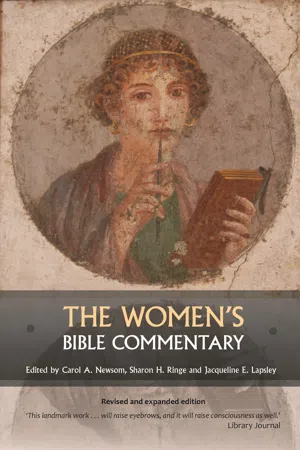
The Women's Bible Commentary gathers the best feminist scholars in the field today to produce a commentary on every book of the Bible, including the apocryphal books, with additional articles on the reception history of biblical women, feminist critical method, and women's religious life in ancient Israel and the early Church. The commentary explores the ways in which women and other marginalized people are portrayed in the Bible, and raises questions about gender roles, sexuality, political power, and family life, while challenging long-held assumptions about how biblical texts should be read and appropriated for today. 'With The Women's Bible Commentary, careful and critical feminist biblical interpretation is made accessible for preaching, study groups, and seminary courses.' Professor Letty M. Russell, Yale University
Information
Topic
Theology & ReligionSubtopic
Biblical CommentaryHebrew Bible/Old Testament
GENESIS
Susan Niditch
Introduction
Contents, Composition, and Context
The group of narrative and genealogical traditions called the book of Genesis describes the origin of the cosmos and its first inhabitants and unfolds the life stories of the earliest ancestors of ancient Israel. In this way the creation of the people Israel is set within the context of the very creation of the universe itself.
To read Genesis is to immerse oneself in the worldview and values of a distant and foreign culture, of a people who believed in a deity, YHWH God, imagined as parent, river spirit, traveling man, and warrior, communicating with the ancestors through dream visions and waking revelations. To read Genesis is to encounter a people who considered the land of Canaan an eternally promised possession, a people who regularly petitioned and appeased their God with the blood sacrifice of animals and who could imagine this God demanding as sacrificial offering a mother’s only son (Gen. 22) and the father’s submitting to the demand.
Genesis portrays a people whose women do not appear to exercise power in the public realm but who hold considerable power in the private realm of household and children. Theirs is a different world and a different way of imagining and ordering reality from our own; yet they too love spouses and children, resent siblings, mourn the loss of kin, fear and face deprivation in the form of famine and infertility, attempt to take stock of the comprehensible and make sense of the incomprehensible features of their existence. All of these very human concerns and emotions emerge in the Israelite literature of Genesis; but in approaching this material with special interest in passages pertaining to women and gender, one must ask, Whose stories are these?
Questions of History and Historicity
The culture of Israel was never monolithic. The history of Israel spans thousands of years and can be divided into three periods: the time before the monarchy (pre-1000 BCE); the time when kings ruled (1000 BCE–586 BCE); and postmonarchic times (586 BCE on). Given the major changes that took place in social structure over this long expanse of time, one must be careful not to generalize about “Israelite culture” or “the life of the Israelite woman” or “Israelite attitudes to women.” Biblical texts reveal considerable variation in the ways Israelites lived and expressed their beliefs. Nevertheless, it is not easy to track changing Israelite attitudes via apparent differences in the texts of the Bible.
The Bible’s own story provides a chronology that seems to match the historical periods sketched broadly above. In premonarchic times are the matriarchs (Sarah, Rebekah, Rachel, and Leah) and patriarchs (Abraham, Isaac, Jacob, Joseph), the exodus (the time of Moses, Aaron, and Miriam), and the age of the judges (including the warrior heroines Deborah and Jael). In monarchic times are Saul, David and Bathsheba, Solomon, the building of the great temple in Jerusalem, the eventual establishment of the northern and southern kingdoms, the so-called Josianic reform of the seventh century, and the age of classical prophecy. This period ends with the Babylonian conquest and the destruction of the temple. The postmonarchic period includes the rebuilding of the temple, the last of the biblical prophets, and the work of Ezra and Nehemiah. Within the Bible’s own chronology Genesis is clearly set in premonarchic times, but “real” history and biblical narration are not as neatly matched as they may seem at first reading. The stories now found in Genesis do not necessarily stem from premonarchic authors, nor do they necessarily contain information about the way of life of Israelites who lived before 1000 BCE.
Questions about the Genesis of Genesis
Many of the stories in Genesis are very old, perhaps as old as storytelling itself. The essential pattern of world creation in Genesis 6–9, for example, is represented in the lore of many cultures and times: from a watery flood emerge or reemerge a world and its inhabitants. Long before the existence of the people Israel, ancient Near Eastern narrators preserved several versions of a tale about the great flood with its favored human survivor(s), very much like the biblical tale of Noah. The story of Noah was no doubt a popular tale in ancient Israel, told by various tellers with their own nuances and variations long before it was first set down in writing. Nor did this writer have the last word, for the biblical tale has been transmitted, elaborated, and edited by subsequent writers until it reached the form in which we now read it. In exploring the text of Genesis one must be aware that the ancient stories were once told in a variety of ways, oral and written.
Theories about the Sources behind Genesis
Over the last hundred years, biblical scholarship has spoken of separable “sources” or “documents” out of which the whole cloth of Genesis has been woven. The sources are called J (the Yahwist, or Jahwist, source), E (the Elohist source), and P (the Priestly source). J is characterized by the use of the name YHWH for God, by a down-to-earth style, and by a theology that allows God a certain closeness to the human realm; for example, God walks in the garden (Gen. 3:8). The Elohist source calls God the more generic Elohim (Hebrew for “god”), supposedly reserving the special name YHWH until the revelation to Moses in Exodus 3; in E, God communicates more indirectly, through mediating dreams and angels. The P source employs the divine epithet El Shaddai (often translated “God Almighty”) in Genesis; God emerges in this source as an even more transcendent being. The interests of P are genealogy, ritual matters, and laws of purity. J, E, and P sources are said to be layered throughout the first four books of the Bible. J is dated by scholars to the tenth or ninth century BCE of the southern or Judahite monarchy, E to the ninth or eighth century BCE of the northern or Israelite monarchy, and P to the sixth century BCE, the exilic period. Thus Yahwist (J) tales in Genesis should be expected to reflect the worldview of a Davidic courtly writer, and so on.
This theory has been modified over the years and recently has been strongly criticized, though in some form it still reigns supreme among theories about the composition of Genesis. The often too neat, line-by-line assignments of verses and larger literary units of Genesis to J, E, and P are not convincing, though variations in style, content, literary form, and message do confirm that various authors, worldviews, and life settings lie behind Genesis. Some of these differences may point to sources of different date, while others may point to authors from different sectors of Israelite society: aristocratic versus popular authors, urban versus rural ones, men versus women. To distinguish the various authors and origins of biblical texts is a complex matter, but one especially important for a feminist enterprise asking whether the Hebrew Bible reveals something about attitudes toward women in ancient Israel and/or about their actual lives.
The Patriarchal Age
Do the stories of the matriarchs and patriarchs actually tell us about life in pre-1000-BCE Israel, even if the final form of the tales is from a later date? The tales of Genesis portray specific marriage practices; customs of inheritance and the rights of the firstborn; work roles of men and women; and attitudes toward male and female children, toward family and sexual ethics, and toward widows, barren wives, and other marginal females such as prostitutes. Can one connect such information with the considerable extrabiblical information about life in the non-Israelite ancient Near East of the second millennium BCE (e.g., from the ancient Mesopotamian cities of Mari or Nuzi), as some scholars have done, in order to reconstruct a world of early Israelite women? Can one connect the view of the workaday roles of men and women implied in God’s punishing words to man and woman in Genesis 3 with archaeological and ethnographic reconstructions of life in the pioneer highland culture of premonarchic Israel, as Carol Meyers attempts to do? Or should one assume that if the texts were written down and shaped during the tenth to sixth centuries BCE, they do not contain reliable information about the lives of women from an earlier, premonarchic period? Some scholars think that the evidence to reconstruct any history of Israel before 1250 BCE is lacking and refuse to speak of this so-called patriarchal age. Others remain confident that even though Genesis was written down in the first millennium BCE, it nevertheless does reflect the lives and attitudes of the second millennium BCE, of a people who lived by farming and herding, without kings or elaborate forms of government, whose lives and work centered on family and flocks.
Given these debates and difficulties, how should one read and understand the tales of the lives of the women of Genesis? Rather than beginning with assumptions about the historical reliability of a text and the date when it was written down, one should ask: What sort of literature is this in terms of its style, structure, content, and messages? What sort of audience is this meaningful to? What are its authors’ apparent worldview and concerns, especially those pertaining to women’s issues broadly defined? A range of authors and worldviews should emerge, providing a reflection of the richness and complexity of the tradition in its relationship to women.
Traditional Literature, Genesis, and Women’s Tales
Much of biblical literature is traditional literature. Recurring patterns in language, imagery, plot, and theme resonate in the ancient Israelite literary tradition. In the Hebrew Scriptures there are certain ways to describe God’s victories, recurring reasons for a patriarch’s initial lack of children, ways in which the long-awaited conceptions are announced, favorite plots about the success of the underdog or the escape from seemingly powerful enemies. There are ways to frame a genealogy, to compose a lament, to describe a receiving of divine revelation. When Israelite authors set about presenting a piece of the tradition, they were at home in these conventions and creatively adapted them in accordance with their own perception of aesthetics and their understanding of political and theological verity. Through time, from author to author and editor to editor, various sorts of traditional patterns recur, giving the biblical tradition a certain unity even within its great variety. In exploring the women of Genesis and issues of gender, one must pay attention to the book’s traditional style. Recurrences in language and literary form also imply recurrences in essential messages and meanings; changes in form may mark varying messages. Out of these patterns emerge symbolic maps in which woman is a key feature.
Paying attention to these similarities and differences gives rise to questions: Why does the creation myth of Genesis 1, which echoes the basic plot of creation found in the Mesopotamian myth Enuma Elish, not depict the watery chaos as female, even though Isaiah 51:9–11 does preserve this motif? Why are so many tales of women in Genesis tales about tricksters who employ deception to improve their marginal status? Why are wives regularly found by wells? Why are the important mothers barren? Many of the tales in Genesis deal with matters of home, family, and children. These are issues typical of tales from other cultures considered by ethnographers to be women’s stories. Is it possible that many of the Genesis tales were popularly told among women? Can we speak of qualities of male voice and female voice in biblical portrayals? Finally, in what ways are men and women gendered by biblical authors?
Comment
Creating and Ordering the World (Gen. 1–11)
Creation is not merely the initial coming into being of the universe and its life forms; it includes also the ordering and continuous unfolding of the world. All of Genesis 1–11 is about the creation of the cosmos, including the more obvious creation accounts in Genesis 1 and 2, the Eden narrative in chapter 3, the tale of fratricide in chapter 4, the flood story of chapters 6–9, the story of the tower of Babel in chapter 11, and the genealogies in chapters 5, 10, and 11, which help to weave together Genesis 1–11 and form the transition to the stories of the mothers and fathers of Israel in Genesis 12–50.
The Creation of Woman in Genesis 1
Woman first appears in the elegant creation account of Genesis 1. Repeating frame language neatly reveals the origins and ordering of the universe with its topography, its solar system, and its rich variety of plant and animal life. God creates by the word—“God said, ‘Let there be’ … and it was so”—building day by day—“there was evening and there was morning, the xth day”—until the sixth and final day, on which God makes humankind, a mirror of the divine image itself. And of this creation “in the image of God,” it is said “male and female he created them.” Without establishing relative rank or worth of the genders, the spinner of this creation tale indicates that humankind is found in two varieties, the male and the female, and this humanity in its complementarity is a reflection of the Deity. For feminist readers of Scriptures, no more interesting and telegraphic comment exists on the nature of being human and on the nature of God. The male aspect and the female aspect implicitly are part of the first human and a reflection of the Creator.
Scholars often attribute Genesis 1 to a Priestly writer (P) because of its image of a transcendent, all-powerful deity, its almost genealogical style, and its explanation of the origin of the Sabbath. If so, this Priestly writer’s views of men and women differ from the much more male-centered Priestly writers of Leviticus, for whom a woman’s menstruation and childbearing are sources of pollution, separating her from the sacred realm. She regularly lacks the pure status necessary to participate fully in Israelite ritual life. In reading the Hebrew Scriptures as a narrative whole, including both Genesis 1:27 and Leviticus, one may receive the message that the genders were meant to be equal at the beginning.
In Genesis 1 the Hebrew term for “deep waters” (tehom) is related to the name of the mother goddess Tiamat in the Mesopotamian creation myth Enuma Elish. Tiamat, the salt waters of chaos, is killed and split like a mussel by the young god Marduk, who builds the world out of her carcass. The Israelite author who has provided the opening chapter of the Bible wants none of the uncertainty of this battle motif. His account of creation by God’s word is as solid and inevitable as his style. If his account lacks a matriarchal goddess, it also does not present the creation of the world as dependent on her death.
The Becoming of Woman in Genesis 2–3
Written in an earthier style than Genesis 1, the tale of Genesis 2–3, with its less-than-complete outline of God’s creations (2:4b–25), its homespun reflections on marriage (2:23–24), and its God who walks in the garden (3:8) and fears humans’ potential divinity (3:22), has been more influential than Genesis 1:27 in shaping and justifying attitudes toward and the treatment of women in Western tradition.
This tale of creation has two parts: the emergence of the cosmos out of the mist of chaos and the emergence of “real life” from the ideal of paradise. Man is the first of God’s creations in Genesis 2 (2:7). His formation is from the dust of the earth (’adamah). He is thus Adam/Earthling. The creation of other living beings (2:18) is motivated by God’s concern that “it is not good that the man should be alone.” But none of the birds or beasts is deemed a suitable counterpart for the man (2:20). So, out of man’s own rib, God forms woman. The sayings in 2:23 and 2:24 comment positively on the closeness of the conjugal bond. Man and woman are parts of a whole, anticipating the genealogical patterning of Genesis. Men and women will unite and have children, the male children leaving to join wives and form new families. The conjugal couple is the foundation of social and cultural relationships for the writers of Genesis. Even when the world is temporarily subsumed by the renewed chaos of the flood in the tale of Noah (Gen. 6–9), social order remains afloat on the ark in the form of Noah and his wife, his sons and their wives (6:18). This generative, culture-affirming process, however, does not actually begin until Genesis 4:1, for 2:25 declares that man and woman are naked and not ashamed. That is, they are not aware of their sexual differences; their sexuality is yet to be discovered and expressed.
Jewish and Christian traditions postdating the Hebrew Bible and a long history of Western scholarship have viewed woman’s creation in Genesis 2 as secondary and derivative—evidence of her lower status. The tale explaining the departure from Eden into a real world of work, birth, and death in Genesis 3 is taken to be an even stronger indictment of woman as the gullible, unworthy partner who let loose sin and death. Her biological function as conceiver and bearer of children is perceived as confirmation of her fall, a punishment shared by all women who come after her.
In fact, Genesis 3 has been misunderstood. Certainly, like Pandora in the comparable Greek cosmogonic tradition, the curious woman is a linchpin in the ongoing process of world ordering. She, like Lot’s wife, dares to disobey a command not to use all her sensory capacities in a particular situation—to taste or to look—and this curiosity about forbidden fruit is often in Mediterranean tradition associated with the female. On the other hand, in the lore of all cultures interdictions such as Genesis 2:17 (“But of the tree …”) exist to be disobeyed by the tales’ protagonists. That is what makes the story. Eve, as she is named in 3:20, is the protagonist, not her husband...
Table of contents
- Cover page
- Title page
- Imprint
- Dedication
- Table of contents
- Abbreviations
- Contributors
- Introduction to the Twentieth-Anniversary Edition
- Introduction to the Expanded Edition
- Introduction to the First Edition
- When Women Interpret the Bible
- Women as Biblical Interpreters before the Twentieth Century
- Hebrew Bible/Old Testament
- The Apocrypha
- New Testament
- Acknowledgments
Trusted by 375,005 students
Access to over 1.5 million titles for a fair monthly price.
Study more efficiently using our study tools.
Frequently asked questions
Yes, you can cancel anytime from the Subscription tab in your account settings on the Perlego website. Your subscription will stay active until the end of your current billing period. Learn how to cancel your subscription
No, books cannot be downloaded as external files, such as PDFs, for use outside of Perlego. However, you can download books within the Perlego app for offline reading on mobile or tablet. Learn how to download books offline
Perlego offers two plans: Essential and Complete
- Essential is ideal for learners and professionals who enjoy exploring a wide range of subjects. Access the Essential Library with 800,000+ trusted titles and best-sellers across business, personal growth, and the humanities. Includes unlimited reading time and Standard Read Aloud voice.
- Complete: Perfect for advanced learners and researchers needing full, unrestricted access. Unlock 1.5M+ books across hundreds of subjects, including academic and specialized titles. The Complete Plan also includes advanced features like Premium Read Aloud and Research Assistant.
We are an online textbook subscription service, where you can get access to an entire online library for less than the price of a single book per month. With over 1.5 million books across 990+ topics, we’ve got you covered! Learn about our mission
Look out for the read-aloud symbol on your next book to see if you can listen to it. The read-aloud tool reads text aloud for you, highlighting the text as it is being read. You can pause it, speed it up and slow it down. Learn more about Read Aloud
Yes! You can use the Perlego app on both iOS and Android devices to read anytime, anywhere — even offline. Perfect for commutes or when you’re on the go.
Please note we cannot support devices running on iOS 13 and Android 7 or earlier. Learn more about using the app
Please note we cannot support devices running on iOS 13 and Android 7 or earlier. Learn more about using the app
Yes, you can access The Women's Bible Commentary by Carol A. Newsom in PDF and/or ePUB format, as well as other popular books in Theology & Religion & Biblical Commentary. We have over 1.5 million books available in our catalogue for you to explore.