![]()
1
Introduction
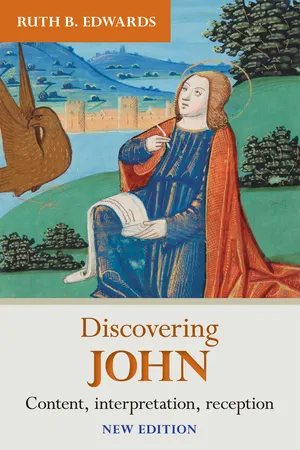
For many centuries John’s Gospel1 has been treated as the crown of the Gospels. Its author, identified with the seer of Revelation, the ‘elder’ and author of the Johannine Epistles, and the apostle John, was seen as the New Testament ‘theologian’ par excellence, Ioannēs ho theologos, St John the Divine. Evidence for his especially close relationship to Jesus was found in the allusions to ‘the disciple whom Jesus loved’, who lay on Jesus’ breast at the Last Supper, said to have written ‘these things’ (John 21.24). The ‘mystical’ theology of his Prologue was interpreted as revealing John’s closeness to God himself. John’s very name, derived from the Hebrew word for ‘grace’, was seen as disclosing his true character, as one who revealed in an unparalleled way the grace of God. It is no wonder that the Gospel has inspired artists and musicians, theologians, poets and thinkers, and countless ordinary Christians. It has sustained faith, aroused love and encouraged heroism, and profoundly shaped Christian doctrine. In patristic and medieval times John was symbolized as an eagle, ‘the spiritual bird, fast-flying, God-seeing’ (Eriugena),2 an image still used in church art. He was so much revered that artists often depicted him as Christlike and enthroned; sometimes he was spoken of as ‘angelic’ or ‘deified’ (Hamburger, 2002, with illustrations).
J. B. Lightfoot called John’s Gospel the ‘most divine of all divine books’ (1893, p. 122). It has been seen as speaking tellingly to the simple believer, as well as soaring to the heights or plumbing the depths of the Christian faith for the sophisticated (cf. Marsh, 1968, p. 81). Jean Vanier (2004, p. 15) speaks of the ‘music’ he hears behind John’s words; Martin Hengel calls him ‘a towering theologian’, a ‘great teacher to whom the church owes a good part of its foundation’ (1989, pp. ix, 135). But John has also been criticized as ‘world-denying’ and ‘sectarian’, ‘androcentric’, and ‘anti-Jewish’ – ‘a Gospel of Christian love and Jew hatred’ (Kohler, 1905, p. 251). While in the past it was seen as painting ‘a perfect portrait of Jesus’ (Temple, 1939, p. xvi), today some view it as historically inaccurate, ‘a presentation of falsehood’, and responsible for stimulating and supporting the vilest anti-Semitism (Casey, 1996, esp. pp. 198, 218–29).
What is this writing that has provoked such diverse responses? Who wrote it, and why was it written? Can a study of its context and circumstances of composition help us understand it? It has been said that the questions asked of a text are as important as the answers given (Malbon, 2000, p. 1). Readers with a historical bent may be stimulated by the questions just posed; those with more literary interests may be intrigued by the Gospel as ‘story’. How does its ‘plot’ work? How does its author use characters, and what literary devices are employed? Their questions and motivation for study will be different from those of the first set of readers. Others will be more interested in John’s theology. How does John relate to the religious thought of its day? What is distinctive about its message? Christians (and others) study biblical texts to deepen their personal faith, or find guidance for living. Many are inspired by John; for others, it raises problems. Does its message need to be reinterpreted for today’s world? How should Christians respond to recent criticisms of it? Does John still have meaning for the Church and contemporary society?
This book is intended for those interested in any of these aspects of John. It will not answer all their questions, but it is hoped that it may help them to think out for themselves where they stand. Chapters 1–2 outline the shape of the Gospel and review its interpretation over the centuries and different ways it may be read. Chapters 3–5 investigate authorship and composition, including the questions of John’s sources, historical accuracy, purpose in writing and intended audience. Chapters 6–9 focus more sharply on theology, especially John’s Christology (understanding of Christ). They explore the various methods by which he seeks to convey Jesus’ identity through miracles, faith confessions, and Jesus’ words and actions, death and Resurrection. Chapter 10 discusses John’s use of characters, both from a literary angle, and to see how they illuminate John’s understanding of faith in Jesus. Chapters 11–12 tackle different facets of the question whether John’s Gospel is ‘anti-Jewish’ (or ‘anti-Semitic’),3 and how John’s belief in Jesus’ divinity relates to Jewish monotheism. Chapter 13 draws together the threads of this study, centring on whether John’s Gospel has any abiding value for today. Excursus 1 discusses John’s textual tradition, and Excursus 2 explores the question of eyewitness testimony in John.
Reading John’s story
At this point you are invited to read John’s Gospel for yourself in the same way as you would read any book, following its storyline and enjoying its shape. As you read, you may like to refer to Table 1 (pp. 170f.), which summarizes the themes of the following discussion.
I. Proem: Prologue and Testimony
The Gospel opens with a proem (Greek prooimion, ‘opening’), consisting of an elevated ‘Prologue’ followed by a plain prose narrative, sometimes called the ‘Testimony’ (Dodd, 1953, p. 292). The Prologue (1.1–18) is mysterious, not readily grasped on a quick reading, or even on several readings, conveying its message through images of light, darkness, life, birth, grace, truth and glory. It meditates on Jesus as the divine, pre-existent Word, who became flesh to make God known to humankind. Apart from Jesus, only one historical personage is mentioned: John (the Baptist), sent by God as a witness (1.6, 15).
The Testimony (1.19–51) takes us from eternity to time: different characters are shown who testify to Jesus through christological confessions. He is acknowledged in turn as God’s ‘lamb’, ‘son’, ‘messiah’ and ‘Israel’s king’. But although the Testimony seems to be historical narrative, being marked off by clear indications of time (e.g. 1.29), it too is preparatory for the main story. Its purpose, like that of the Prologue, is to herald themes which will be important for John – not just ‘titles’ for Jesus, but also motifs like ‘water’ (1.26), ‘Spirit’ (1.32) and ‘witness’ (1.7f., 34). It also anticipates future events, e.g. the recognition of Jesus as ‘messiah’ (1.41), placed much later by the other Gospels (cf. Mark 8.29 par.).
II. Jesus’ self-revelation and ministry
The main narrative is generally divided into two sections, with further subdivisions (cf. Table 1). John 2—12, sometimes called ‘the Book of Signs’,4 reflects on Jesus’ disclosure of himself and his ministry. Interest centres on his miracles and teaching, and controversies arising from them. Only a few miracles are related, but those chosen have a significant role. Beginning with that at Cana (2.1–11), they are called ‘signs’ (Greek sēmeia) and function as pointers to Jesus’ identity. Their climax is the raising of Lazarus (11.1–44), demonstrating Jesus’ control over death and looking forward to his own Resurrection. These miracles are often associated with dialogues bringing out their meaning. Jesus also discloses his identity through his actions in the Temple (2.13–22), in his dialogue with Nicodemus (3.1–15) and in his meeting with the Samaritan woman (4.4–42). Particularly intriguing are the references forward to Jesus’ Passion, e.g. ‘Destroy this Temple and in three days I will raise it up’ (2.19), ‘As Moses lifted up the serpent in the desert, so must the Son of Man be lifted up’ (3.14). These grow in frequency and intensity as the narrative advances.
Another prominent theme of these chapters is Jesus’ relationship to Moses, flagged in 1.17 and 1.45. By his miracles and teaching, Jesus shows himself to be like Moses, and yet as greater than Moses (6.4–59, esp. 41–51; cf. Boismard, 1993). Jesus is also presented as greater than Jacob (4.12) and greater than Abraham (8.53–58). This interest in Moses and the patriarchs, together with numerous allusions to the Jewish Scriptures, raises questions about how John saw Christianity’s relation to Judaism. Some (e.g. Moloney, 1996; Brown, 1997, p. 334) have suggested that by giving prominence to Jewish religious feasts – Sabbath, Passover, Dedication, Tabernacles – John depicts Jesus as superseding (for Christians) many aspects of Judaism, including both Temple and festivals.
By his words and actions Jesus antagonizes ‘the Jews’, and their leaders ‘the Pharisees’ and ‘High Priests’. These are represented as misunderstanding Jesus, ‘persecuting’ him and seeking to kill him. Some scholars (e.g. Harvey, 1976) see John as presenting Jesus ‘on trial’, or as the focus of a juridical controversy (Asiedu-Peprah, 2001). ‘The Jews’ make charges, and Jesus defends himself and makes counter-accusations. The Baptist, the disciples and the crowd all bear witness to him, as do the Scriptures and, most importantly, the Father (8.18). Readers find themselves drawn into the process and having to make up their own minds about Jesus. There is also a deep irony about all this: although Jesus appears to be ‘on trial’, he is in fact serving as judge over, and witness against, those who accuse him (this element is brought out very fully by Lincoln, 2000). This stylized presentation, though dramatic, presents problems: by using ‘the Jews’ to stand for opposition to Jesus, John lays himself open to ‘anti-Jewish’ readings of his text, with dire consequences.
Another feature of this section is Jesus’ ‘elusiveness’ (Stibbe, 1991). The Pharisees send officers to arrest him (7.32), but they are so impressed by his words they fail to do so (7.45f.). After Jesus’ statement that he existed before Abraham, ‘the Jews’ try to stone him, but he hides himself (8.59). Again they attempt to stone him, or arrest him, but he escapes (10.31, 39). Jesus is also ‘elusive’ in the sense that he speaks enigmatically, and is often misunderstood (see further Hamid-Khani, 2000). This ‘elusiveness’ is also part of the pattern of John’s plot.
In John 2—12 Jesus appears as both life-giver (e.g. 4.13f., 50; 6.68; 11.25f.) and judge. By coming as a ‘light’ to the world, Jesus shows up the darkness (3.19–21): by speaking the truth, he makes people come to a decision between truth and falsehood, ‘light’ and ‘darkness’, himself and ‘the world’. His coming separates people into those who accept him and those who reject him. This recurring dichotomy climaxes in John 11, where Jesus raises Lazarus after Martha has confessed him as the Christ. ‘The Jews’ are divided into those who put their faith in Jesus and those who inform on him to the Pharisees, leading to the plot to kill him (11.45f.). Chapter 12 acts as a transition between Jesus’ public ministry and his Passion. Mary anoints his feet, and a crowd acclaims him ‘Israel’s king’. He speaks allusively of his death, agonizing over his ‘hour’ (12.23–33), and tells of the casting out of ‘the ruler of this world’ (12.31). This section ends with a sombre quotation from Isaiah about God blinding eyes and hardening hearts, and an appeal from Jesus to believe, with both a warning of judgement and promise of eternal life (12.37–50).
III. Passion and Resurrection Narrative
This part is sometimes called ‘the Book of Glory’,5 because John sees Jesus’ suffering and death not as his humiliation, but rather as his ‘lifting up’ or ‘glorification’. Jesus’ death, Resurrection and return to the Father are presented as part of a single movement. Thus the ‘hour’ of his death is also the ‘hour’ of his glory (13.31f.; 17.1, etc.). Chapter 13 both introduces the Passion and provides a key to its understanding. At his last meal, on the eve of the Passover, Jesus washes his disciples’ feet as an example of love and humble service; by this act he foreshadows his loving ‘to the end’ (cf. Edwards, 1994). The emotional tension grows as he gives Judas a morsel from the common dish, and Satan enters him. Judas leaves to betray Jesus, ‘and it was night’ (13.30).
Jesus’ tender farewell to his disciples and his ‘High-Priestly Prayer’6 occupy John 14—17. The pace is slow and reflective, as the Evangelist mingles reassurances for the future, promises of the Paraclete (Holy Spirit, seen as advocate and guide) and injunctions to love. He calls the disciples his ‘friends’, warns them that ‘the world’ will hate them, speaks of his ‘departure’, and promises to return. But there is also a note of triumph: Jesus’ farewell ends with the words, ‘Be encouraged; I have defeated the world’ (16.33). He has fulfilled his mission: he has made God known to those given him. He now consecrates himself and his disciples, praying that they may be one. His closeness to the Father is intensely expressed as he prays that the disciples may know the love with which God loves him.
The pace quickens with the narrative of Jesus’ trial and death. Roman soldiers and Jewish officers arrest him. In a series of dramatic scenes Jesus appears first before the ‘High Priest’ Annas, then Caiaphas, and finally the Roman governor, Pilate. There is further irony here as ‘the accused becomes the accuser’ (Lincoln, 2000, p. 126). Pilate asks, ‘What is truth?’ (18.38), but Jesus, who is ‘the way, the truth and the life’ (14.6) and who came to bear witness to the truth (18.37), gives him no answer. Pilate believes he has power to condemn or release Jesus, but the only authority he has is that given him from God (19.11). He finds no crime in Jesus and wishes to release him but is unable. The High Priests and their officers call for his death, and ‘the Jews’ likewise insist that he must die ‘because he made himself the Son of God’ (19.6f.). Pilate complies, and Jesus is scourged, then crucified, having carried his own cross to Golgotha, the place of execution. Soldiers cast lots for his seamless robe, in fulfilment of Scripture (19.23f.); Jesus commends his mother and ‘the disciple whom he loved’ to one another (19.26f.). He ‘thirsts’ (again in fulfilment of Scripture), and ‘yields up his spirit’ (19.30). He dies on the day of preparation for Passover. In another Scripture fulfilment, a soldier pierces his side, from which blood and water flow. Meditation on the Hebrew Bible clearly helps interpret these painful events.
In his account of Jesus’ Passion John stresses his autonomy and kingly authority. Jesus identifies himself to those who come to arrest him with his majestic ‘I am’; they step back and fall to the ground (18.6). The soldiers dress him in purple, crown him with thorns, and mockingly hail him as king (19.2f.). Even Pilate refers to him as ‘king’; but his kingship is ‘not of this world’ (18.36–39). He dies beneath a superscription, ‘Jesus of Nazareth, the king of the Jews’ (19.19), which Pilate refuses to change despite the request of the High Priests. In contrast to Mark (15.34), where his last words are a cry of dereliction, ‘My God, my God, why have you forsaken me?’, Jesus dies with the triumphant words, ‘It is accomplished’ (19.30). He truly reigns from the cross.
Jesus is buried with vast quantities of spices supplied by Joseph of Arimathea and Nicodemus, a member of the Jewish Sanhedrin, who had earlier come to Jesus by night (some see this as a ‘royal’ burial). John 20 tells the powerful end of the story – Resurrection! This is depicted in a series of vivid scenes: the encounter with Mary Magdalene at the tomb, framing the run of Peter and ‘the disciple whom Jesus loved’ there, and their discovery that it was empty; the appearances to the disciples when Jesus gives them his ‘peace’ and commissions them; the second meeting when Thomas was present and Thomas’ climactic recognition of Jesus as ‘My Lord and my God’ (20.28). John concludes with a statement on the purpose of the Gospel (20.31).
IV. Epilogue or Appendix
The story is completed by a further appearance of Jesus and a final miracle when the disciples catch a huge draught of fish. Peter, who had earlier denied Jesus three times (18.15–18, 25–27), is restored and commissioned. His role as pastor and martyr is predicted, and the future destiny of the ‘beloved disciple’, the witness to these things, is hinted at. The Gospel ends with a second conclusion (21.25).
The distinctiveness of John
Although at first sight this Gospel appears much like the first three, the ‘Synoptics’ (so called because of their common viewpoint), attentive readers cannot fail to observe differences, which sometimes earn it the epithet ‘maverick’ (e.g. Kysar, 1976, 2007). Unlike Matthew and Luke, John gives no account of Jesus’ birth or human ancestry. He relates fewer miracles, and those included function as signs pointing to his identity. In contrast to the Synoptists, he describes no exorcisms, whereby individual sufferers are freed from the grip of demonic forces, possibly because his whole Gospel represents a confrontation of Jesus with the powers of evil, culminating in their defeat on the cross.7
Until the last week of Jesus’ life the Synoptics picture his ministry as taking place largely in Galilee,8 whereas John describes regular visits to Jerusalem. Jesus’ Temple action occurs at the start of his ministry, rather than just before his Passion as in the Synoptics. John mentions three Passovers, indicating at least two years of active ministry, contrasting with the apparent single year of the Synoptics. He also differs from them in his chronology of the Last Supper and crucifixion. He narrates incidents not found in them (wine miracle, raising of Lazarus, coming of the ‘Greeks’, foot-washing), and omits others. These omissions include some significant episodes, e.g. Jesus’ temptation, his baptism (only referred to indirectly), his agony in the garden, his words of interpretation over the bread and the wine at the Last Supper (though note 6.51–58).
The disciples are also handled differently. Their call follows a different pattern; they are never called ‘apostles’,9 and are not sent out until after the Resurrection (contrast Mark 6.7–13; Matt. 10.1, 5–15; Luke 9.1–6). The names of the Twelve are not listed, and they are rarely mentioned as a group (only at 6.67, 71; 20.24). Neither Levi/Matthew, nor Bartholomew, nor Simon the Zealot, nor James and John are mentioned by name (though note 21.2); but other disciples appear, including Nathanael, Lazarus and the mysterious ‘beloved disciple’. Several disciples take a more active part than in the Synoptics – Philip, Andrew, Thomas and Judas (not Iscariot). Women too feature quite prominently, notably the Samaritan woman (not in the Synoptics), Martha and Mary of Bethany, Jesus’ mother and Mary Magdalene. This has raised questions about the role of women in John’s ‘community’.
John’s Passion Narrative als...