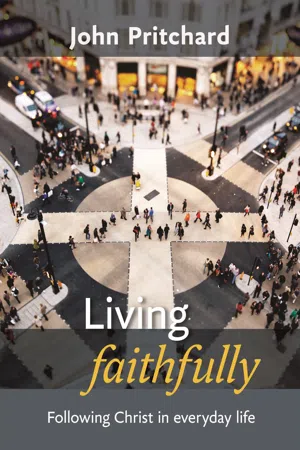
- English
- ePUB (mobile friendly)
- Available on iOS & Android
eBook - ePub
About this book
The faith we proclaim on Sunday is just as relevant to the rest of the week. However, too often the teaching and support that church life offers us can seem aimed at deepening our personal commitment to Christ and our involvement in church activities, rather than enabling us to live out our faith at work and in the world. We need to close the gap between sacred and secular, and that's what this book aims to help us do. Each chapter identifies an issue, explores how we might respond and encourages us - through practical ideas, stories, humour, quotes, Scripture, questions and prayer - to seek to make a difference.
Information
Topic
Theologie & ReligionSubtopic
Christlicher DienstPART 1
Facing God
Until I was 31 I was confident I could achieve more or less any task I took on in ministry as long as I had enough time to do it. After the age of 31 I knew I needed God’s grace and strength to do anything at all. What made the difference was an episode of nervous exhaustion, when I found that all the essential organs of my body were making their displeasure known at the same time because they were being starved of sufficient energy to perform their normal tasks. I needed to stop. From then on I knew from experience rather than from theory that I needed the strength and wisdom of God to be an effective disciple.
What’s the problem?
Former Archbishop William Temple once wrote: ‘When we fail in discipleship it is always for one of two reasons: either we are not trying to be loyal, or else we are trying in our own strength.’1 If we are to be followers of Jesus it’s important that we follow and don’t try to get in front of him. It’s possible to believe we believe in God when in reality we are only believing in ourselves and our own capacity to be Christians.
In running the Christian race it would be a strange disciple who ran with a full-length mirror held out in front of him, enabling him to look at himself, assess his own performance and adjust his own appearance for maximum effect. And yet that’s what it can seem like if we make our point of reference our own selves, so that it’s ‘my faith’, ‘my ministry’, ‘my spirituality’ and so on that absorb us. ‘How am I doing?’ may be a legitimate question every so often, but Christian living is not an exercise in narcissism. Our constant point of reference as disciples has to be the figure of Jesus.
How could we think about this?
I remember a conversation I had with an ordained RE teacher when I had recently found a faith for myself rather than a faith from my family. I was trying to explain the difference I now experienced, and spoke about now being a ‘committed Christian’. He rather abruptly asked me what I meant by a ‘committed Christian’ as opposed to an ordinary one. I was irritated; it was so obvious. Once it had been a faith in which I believed in God in an unexamined and ineffective way and went along to church in pursuit of girlfriends; now it was a faith with the living Jesus Christ at its heart and the promise of a deepening trust and friendship with God for a lifetime.
I might have been a little gauche in the way I expressed myself but there is, surely, a difference in those two versions of Christian faith. Even if we have been lifelong, faithful members of the church community, most of us can identify a time when faith became a more significant dimension of our lives, when the graph of faith went up more sharply. Christians have all sorts of ways of describing the experience: ‘God moved from the edge of my vision to the centre’, ‘a second-hand faith became a first-hand faith’, ‘God moved from optional to essential in my life’, ‘Jesus stepped out of the pages of the Gospels and into my own experience.’ In my case I often say that I had many of the pieces of the Christian jigsaw scattered around, but I seemed to have missed the big central piece – the living Jesus – and it was when that piece went in that the rest of the jigsaw fitted into place.
This move from the edge to the centre is when the journey of discipleship properly starts. Before that, the Christian faith is rather like looking at maps and reading guidebooks; after that, faith is walking the paths among the lakes and mountains, and following the Guide who knows the territory like the back of his hand.
The move from one to the other, however, has no blueprint. After all, we may cross a border into a new country by simply wandering along a country path with minimal awareness of where we’re going, or by coming to a border post and making a conscious decision to enter the new territory, or by rushing through a highly defended border-crossing with guns blazing around us. Whichever way it is, we find ourselves in new terrain and gradually, over time, the differences in the countryside, the architecture, the language, the culture, become clearer. The culture of the kingdom of God should emerge naturally as one of love, justice and joy as we travel deeper into its heartland.
The journey of faith, therefore, may be quick or slow, or quick–quick–slow. It may be alone or accompanied, more intellectual or more emotional in character, and with a wholehearted or a fingertip faith as a result. No matter how it happens, what matters is that the journey has entered a new and potentially exciting phase, and the term ‘disciple’ seems appropriate at last. It’s sobering to remember that Jesus never seems to have invited anyone to come to church (synagogue). It isn’t churchgoing that is of the essence of being a Christian, but following Jesus on the path of daily discipleship, being different and making a difference as we go.
——————————
☆ In 1938 … I [Simone Weil] was suffering from splitting headaches; each sound hurt me like a blow … I discovered the poem … called ‘Love’ [by George Herbert]. I learned it by heart. Often, at the culminating point of a violent headache, I make myself say it over, concentrating all my attention upon it and clinging with all my soul to the tenderness it enshrines. I used to think I was merely reciting it as a beautiful poem, but without my knowing it the recitation had the virtue of a prayer. It was during one of these recitations that … Christ himself came down and took possession of me. In my arguments about the insolubility of the problem of God I had never foreseen the possibility of that, of a real contact, person to person, here below, between a human being and God.
(Simone Weil)2
——————————
Disciples may be said to enter a pattern of relationships (a dance), which in the Christian faith is called the Trinity – God as Father, Son and Holy Spirit. You can’t take a dance apart without losing its beauty, so it’s undoubtedly artificial to analyse the dance of love in the Trinity too much. Nevertheless, when disciples participate in the life of the Trinity, it means being:
Fascinated by God The God question haunts our society but to Christians it has the added quality of a holy fascination. This is a God who cannot be smaller than infinity, even though sceptics insist on trying to lay God out on a table as one object in a field of objects. The only concept of God worthy of the name is one who ‘imagined’ the universe into being and sustains it by his thought. This is no divine errand-boy waiting to do trivial tasks for us. This is the God beyond creation who nevertheless invites creation to join the dance of love for love’s sake. I gladly admit to being fascinated by God, and happily have my vision of God enlarged by scientists, enriched by artists, and deepened by theologians. There’s enough material to explore here for an infinite number of lifetimes.
Friends of Jesus Christ This is the term used by Jesus in John’s Gospel when he reminded his disciples at the last meal they had together that he didn’t call them servants but friends (John 15.14, 15). We inherit that privilege. Christ invites us into that intimacy which St Paul consistently describes as being ‘in Christ’ – although he also describes the relationship as: knowing Christ (Philippians 3.10), receiving Christ (Revelation 3.20), Christ living in the believer (Galatians 2.20), and more. ‘Friendship’ is another lovely metaphor. As present-day followers of Jesus Christ we’re just as much like Keystone Cops as the first disciples, running around without much clue as to what we should be doing, but we might get a little less erratic if we keep our eyes on this best of all friends.
Full of the Spirit A prayer often on my lips at the start of the day is that I may be full of the Spirit so that I can live in God’s world with God’s help. The problem is that we all leak. The image of a football in the corner of my study tells the same story. Because it has a puncture it’s partially deflated and therefore whenever it’s kicked its shape is distorted: if it were punted down the field it would sink to the ground without a bounce. If the puncture were to be repaired, however, and new air blown into it, the football would resist the kicks and be full of bounce. It would be what it’s meant to be. In the same way, Christians, full of the Spirit, would become the followers Christ invites them to be. Of course, this is the ideal; we are all punctured to some degree or other, but ‘fresh air’ is always available.
What could we do differently?
This section of the book is probably the shortest but it’s the most important. We can’t live this Christian life in our own strength. It’s too demanding, too much of a foreign language in our society, to tackle by ourselves. All the rest of the book depends on getting this first stage in our discipleship right. We need to face God and draw on God’s limitless life.
The characteristic stance of disciples, therefore, is that they have their lives turned towards God as their consistent point of reference. This is as practical as it is profound. At any time through the day the disciple is able to remember the presence of God, without needing to be unduly pious or to show off by random levitation. Looking in the direction of God for a moment is a timely action whenever we do it. It puts things in perspective, it reminds us whose we are and whom we serve, and it opens us to grace. But even more than this intentional looking towards God, having our lives turned in his direction is an attitude of life and a disposition of the heart. The ideal is that it’s ‘just the way we are’, whatever we’re doing.
To help us live our lives facing God we have the gifts of Scripture, sacrament, prayer and the fellowship of the Church. These are the four legs of a sturdy table where we can sit and eat. We ignore this feast at our peril because this relationship with God is like any relationship – it doesn’t flourish on nice thoughts and good intentions; it needs time, love and commitment. Discipleship starts with a life that characteristically faces God, and loves to do so. We live in the gaze of God, and one way of describing the life of discipleship is that we spend our lives trying to return that gaze. To be held in that gaze, and to return it forever, is to be in heaven.
From that vantage point all of life takes on a different meaning. Every action is significant as one that may reflect the invigorating presence of God. George Herbert caught this precisely in the words of a well-known hymn:
Teach me, my God and King,
in all things thee to see;
and what I do in anything
to do it as for thee.
A man that looks on glass,
on it may stay his eye;
or, if he pleaseth, through it pass,
and then the heav’n espy.
All may of thee partake;
nothing can be so mean
which, with this tincture, ‘For thy sake’,
will not grow bright and clean.
A servant with this clause
makes drudgery divine;
who sweeps a room, as for thy laws,
makes that and the action fine.
This is the famous stone
that turneth all to gold;
for that which God doth touch and own
cannot for less be told.
If we look through the surface level (the glass) of any action we can see deeper significance (heav’n), and by doing it ‘for thy sake’ even menial tasks (sweeping a room) can take on meaning (‘makes that and the action fine’). This is the secret of discipleship (the famous stone). Any part of our lives, offered to God, can be turned to gold.
They said this
The one thing truly worthwhile is becoming God’s friend.
(Gregory of Nyssa, AD 395; the last words of his last book)
If you can stand where Jesus is standing, you can say what Jesus says; you can come to God as father without going through a lot of complex religious or ritual conditions. To be with him is to be – so to speak – under a clear sky, with no intermediaries between you and the maker of all things … He has marked out the place for us all to stand.
(Rowan Williams)3
God is like love going everywhere.
(Amanda, age five, apropos of nothing at all, striking up another theological conversation at the tea table)
Taking it further
Anchor passage: 2 Corinthians 5.16–end
Read once, take a full two minutes to reflect, then read it again.
To think a...
Table of contents
- Cover
- Author information
- Title page
- Imprint
- Table of contents
- A word at the beginning
- The case for the prosecution
- Part 1: Facing God
- Part 2: Facing myself
- 1. Living gracefully
- 2. Knowing God’s guidance
- 3. Handling money
- 4. Handling our sexuality
- 5. Facing temptation
- 6. Being healthy
- Part 3: Facing the world
- 7. Working faithfully
- 8. Going shopping
- 9. Being political
- 10. Making peace
- 11. Doing justice
- Part 4: Facing others
- 12. Being attentive
- 13. Being married
- 14. Nurturing friendships
- 15. Building community
- 16. Sharing faith
- Part 5: Facing the future
- 17. Handling future shock
- 18. Loving the planet
- 19. Living in an online world
- 20. Worrying about religion
- 21. Facing death
- PS Enjoy life!
- Notes
Trusted by 375,005 students
Access to over 1.5 million titles for a fair monthly price.
Study more efficiently using our study tools.
Frequently asked questions
Yes, you can cancel anytime from the Subscription tab in your account settings on the Perlego website. Your subscription will stay active until the end of your current billing period. Learn how to cancel your subscription
No, books cannot be downloaded as external files, such as PDFs, for use outside of Perlego. However, you can download books within the Perlego app for offline reading on mobile or tablet. Learn how to download books offline
Perlego offers two plans: Essential and Complete
- Essential is ideal for learners and professionals who enjoy exploring a wide range of subjects. Access the Essential Library with 800,000+ trusted titles and best-sellers across business, personal growth, and the humanities. Includes unlimited reading time and Standard Read Aloud voice.
- Complete: Perfect for advanced learners and researchers needing full, unrestricted access. Unlock 1.5M+ books across hundreds of subjects, including academic and specialized titles. The Complete Plan also includes advanced features like Premium Read Aloud and Research Assistant.
We are an online textbook subscription service, where you can get access to an entire online library for less than the price of a single book per month. With over 1.5 million books across 990+ topics, we’ve got you covered! Learn about our mission
Look out for the read-aloud symbol on your next book to see if you can listen to it. The read-aloud tool reads text aloud for you, highlighting the text as it is being read. You can pause it, speed it up and slow it down. Learn more about Read Aloud
Yes! You can use the Perlego app on both iOS and Android devices to read anytime, anywhere — even offline. Perfect for commutes or when you’re on the go.
Please note we cannot support devices running on iOS 13 and Android 7 or earlier. Learn more about using the app
Please note we cannot support devices running on iOS 13 and Android 7 or earlier. Learn more about using the app
Yes, you can access Living Faithfully by John Pritchard in PDF and/or ePUB format, as well as other popular books in Theologie & Religion & Christlicher Dienst. We have over 1.5 million books available in our catalogue for you to explore.