- English
- ePUB (mobile friendly)
- Available on iOS & Android
eBook - ePub
About this book
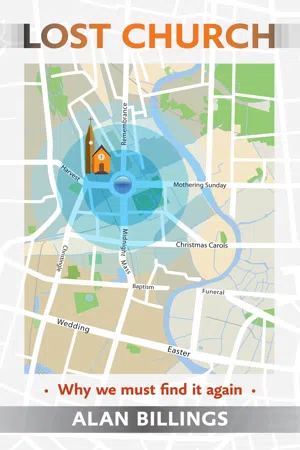
In trying to understand the relationship of the British people to religion - specifically Christianity - we tend to say that people: believe - or do not; attend - or do not. The argument of Lost Church is that the majority of people do not really fit either of these categories. Rather, they 'belong' - in the sense that they feel some affinity to Christianity and the Church; they are not hostile to its ministers; they do not find churches alien places to be, and they turn to the Church and its clergy on specific occasions. But they do not want to attend regularly and their beliefs may be incoherent or even nonexistent, and often flicker on and off like a badly wired lamp. This absorbing and encouraging volume is a call to lay Christians and clergy to take stock of what is happening and to recover an understanding of the Church that will not alienate those who 'belong' but rather enable ministry to them to continue.
Information
1
Belonging

Just as there are many Jews who keep the Friday ritual in their home despite describing themselves as atheists, I am a ‘tribal Christian’, happy to attend church services.
Lord Rees, Master of Trinity College, Cambridge, and Astronomer Royal
In Britain an increasingly faithless land finds itself ironically turning to faith institutions as symbols of local cohesion. Long may such places survive.
Simon Jenkins, The Guardian columnist and non-believer
I suggested in the Introduction that we need to understand the relationship of the British to Christianity and the Church according to three categories: belonging, believing and attending. In this first chapter I will seek to explain and expand on what I mean by ‘belonging’. I will differentiate it from attending and believing – though there will be some overlapping – and say why the idea of belonging is both important to understand and why it can be so easily misunderstood or overlooked. I will also suggest that a large part of the Christian constituency in this country consists of those who belong. They are in addition to those who attend. In both of these groups – belongers and attenders – there will be believers; though some may belong or attend and not believe. If this sounds complex it is because the religious situation is more complex than the usual binary divisions – believer/non-believer, attender/non-attender – suggest. But if the Churches lose sight of those who belong they will not understand how the nation may still be considered Christian. If the Church of England loses sight of them, it will cease to be the national Church whatever its constitutional position. It will have disestablished itself.
Those who ‘belong’ to Christianity and the Church are not an entirely homogeneous group; but there are some things we can say about them. In the first place, most of them, though not all, would define themselves as Christians even though they rarely attend church. They struggle to articulate any beliefs, because for them Christianity is not primarily a matter of beliefs. Some are not believers in any orthodox sense, and some are not believers at all. This latter group may be the most puzzling of all. We are used to the idea of the secular Jew, but not the secular Christian.
In what sense, then, are those who do call themselves Christians but do not attend church Christian? They are Christian because in terms of the Christian faith they respond positively to the life, teaching and example of Jesus Christ. They seek to base their own lives as best they may on what they believe he stood for and taught: they want to be as generous, merciful, forgiving and loving as he was. They are also positive in their attitude towards the Church. They are not hostile to its ministers, whom they believe do valuable work in the community, not least when individuals or communities are struggling or in need. They do not regard church buildings as alien places or church services as alien activities. But they see no reason to attend regularly and they have little time for creeds, confessions of faith or theology. There is a smaller group who would call themselves ‘non-believers’ yet still think Christianity has value and believe society is better for having churches; they do not want the Christian Church to disappear from the land. There can be many variations on these themes, but taken together, those who in some sense ‘belong’ to Christianity and the Church are a very large part of the general population. They are probably most people.
But those who ‘belong’ are generally unrecognized and uncounted: they will not show up in the Census data as a discrete category or an identifiable group and opinion pollsters would have difficulty framing a question that would enable us to identify them. Yet it is especially important for the Church of England as the national Church to understand what belonging is and who the ‘belongers’ are. If the Church is to remain credible and to have any social value beyond its own regular congregations, it needs to acknowledge that many people continue to have a sense of belonging. If it can do that, it will continue to find ways in which it can serve that wider constituency. If it fails to do so, it will condemn itself to eventual social irrelevancy. But time is short and the omens are not all good.
Walking away from organized religion
In saying that the British ‘belong’, I am not denying for one moment the truth of the statistical evidence that Grace Davie amassed in her 1994 book, and which has continued to be gathered since. This shows that the British people have stopped attending churches in any numbers. They have been walking away from organized religion throughout the later twentieth century. There is little point in revisiting all of that data since it is now well known and broadly accepted. Whatever statistics we choose to consider – from numbers on electoral rolls to communicant or baptism figures – and while there might have been an increase in Christian practice in the first ten years or so after the Second World War, the decline from the end of the 1950s is undeniable and continuing. We need to recognize the gravity of that situation and the amount of ground that has been lost: as far as attending goes, in Britain in the early decades of the twenty-first century, churchgoing is reaching an all-time and critical low point. In addition, religion is no longer something taken in with mother’s milk. Each new generation knows less about the content of the faith and becomes less ‘attuned’ to religious experience. This is reflected in the fact that in answers to opinion pollsters and in the latest National Census, more people than ever are prepared to say they have ‘no religious beliefs’. According to the 2009 British Social Attitudes Survey, those who profess no religious belief have been steadily rising – from 31 per cent in 1983 to 51 per cent in 2009.1 Religion no longer plays a conscious role in the lives of most people – though that is not the same as saying it plays no unconscious role or no role at all. But for at least a substantial number of people, the truths to which the Church has historically borne witness are no longer taken for granted.
As the Church began to be uncomfortably aware of the extent of this change and to the fall in regular attenders, it turned its attention to the need to halt and reverse the decline. But here it made a fatal mistake. It failed to distinguish between believing, attending and belonging – and conflated the last two. As a result, those whom I have called ‘belongers’ disappeared from sight: there could only be attenders/non-attenders and believers/non-believers – the binary divisions that I have said offer an inadequate analysis.
So who are those who ‘belong’ but do not attend and do not necessarily have much if anything by way of belief? How are we to recognize them? How numerous are they and how are we to support them?
The persistence of ‘belonging’
Between 2000 and 2002, researchers from Lancaster University conducted a survey of the religious commitments and sensibilities of people in the town of Kendal in Cumbria, where I was a parish priest. They found all the indices of church decline that I mentioned above and the rise of alternative, ‘holistic’ spiritualities as well. In addition, when some of the researchers went from door to door and interviewed residents in selected streets, they made another important discovery.2 This was that most people were neither religious nor anti-religious but, most of the time, simply indifferent.3 This ‘most of the time’ is an important qualification, as we shall see. Most of the time, they could see few reasons for becoming involved in a church or thinking too much or too often about Christian beliefs. What could either bring to their lives? As a result, they never had reason to discuss religious matters with their spouses or partners whose religious sensibilities, if they had any, were completely unknown to them. The researchers found that while some women might discuss some aspect of religion with their women friends – on a girls’ night out, for instance – men never would. They simply could not see how religion might add value to the way they lived. Most parish priests who have any serious engagement with people beyond their congregations will recognize what I describe as part of contemporary reality.
In light of this general indifference, we learn two important lessons. The first is that indifference is not the same as hostile rejection. The British people have been influenced by two decades of attack on belief by the New Atheists, but it has left many, perhaps the majority, indifferent rather than convinced unbelievers. They are certainly no more impressed by strident atheism than they are by strident Christianity. But they are open to persuasion – if they can see the value of religion to human life, something that enables them to live well because it sustains the values they think important.
The second lesson is that this indifference was ‘most of the time’ and not ‘all of the time’. There could be occasions when the Church might have something to say or to offer. Indeed, on these occasions, the Church might be the only institution to which people could turn. We need, therefore, to be very attentive to those times when the ministry of the Church is sought and to think carefully about what they tell us. In a more secular age, this is a matter of greater significance than it was in a time when religion was taken for granted. It means that people who, for instance, seek a christening for their child are going against the secular grain of contemporary society. That is a more significant act than asking for baptism in a time when the majority of children were baptized. Such parents may well have to explain their behaviour to family or friends and be a little clearer in their own mind why they are doing it. Equally, the Church needs to understand that it is able to offer something of value unavailable elsewhere.
When ‘belonging’ shows itself
The fact is that the ministry of the Church is still sought by people in certain circumstances. These circumstances may not occur every week, but they have not disappeared entirely. It is in this sense that I believe we need to speak of people who ‘belong’. What we mean is that many people continue to feel some affinity with the Church (of England) and the faith it stands for and proclaims; they still feel able to ask for ministry in some form and on specific occasions; the local clergy are deemed approachable and on their side. Above all, we mean that there is a sizeable body of people who may not attend and who may not believe in any orthodox sense, or whose beliefs are not formulated as doctrines or who do not believe at all, but who still feel that there are occasions on which the Church can supply meaning or be pastorally helpful.
Anglicans should not be surprised by this since we have encouraged people to feel this way for the whole of our history. Indeed, this takes us to the heart of what the Church of England is about.4 We have taught people down the five centuries of our existence that everyone lives in a parish, and everyone in that parish is welcome at the parish church. We expect people to hold a range of theological views; we are a broad Church; we have no pope or curia. The ‘vicar’ is not just the ecclesiastical leader of one Christian church among many, but ‘our vicar’; everyone can lay claim to him or her and can call on their services. In these ways, the Church of England has encouraged the development of this idea of ‘belonging’. This is something ‘tribal’ – though not in the sense that it seeks to exclude. On the contrary, this is a tribe that welcomes all people who inhabit a particular place – the parishes of England. Lord Rees, the Astronomer Royal, summed up one important aspect of this when he said that he was happy to attend Anglican services even though he was not a believer, and hoped to be buried in a country churchyard according to the rites of the Anglican Church; these were the rituals of his tribe. He belongs.5
‘Belonging’, in the sense I am defining it, makes itself apparent at different times and in many different situations. But it can easily be misunderstood. The Church that recognizes what it is to belong, and believes that this is something to be welcomed, encouraged and sustained, is the Church we have almost lost and need to recover.
Let me give some examples of how the sense of belonging continues to show itself and how it may be lost. I will comment on a range of different situations before finally seeking to summarize what all of these instances have in common.
Times of community solidarity
We can probably all agree that one feature of contemporary society is the loss, or at any rate the weakening, of any sense of community. The attempt by the Prime Minister and the Conservative–Liberal Democrat government after 2010 to bring to birth the ‘Big Society’ was a response to that. There was a feeling that while society had become more prosperous, and that was a great gain, modern city living in particular had made us more individualistic and less inclined to join with others in any community activity. This was resulting in greater social separation than in the past, and this showed itself in more people becoming isolated in later life, especially as they tended to live longer. As we g...
Table of contents
- Cover
- Author information
- Title page
- Imprint
- Dedication
- Contents
- Acknowledgements
- Introduction
- 1. Belonging
- 2. Attending
- 3. Believing
- 4. Reclaiming Lost Church
- Note
- Bibliography
- Search items
Trusted by 375,005 students
Access to over 1.5 million titles for a fair monthly price.
Study more efficiently using our study tools.
Frequently asked questions
Yes, you can cancel anytime from the Subscription tab in your account settings on the Perlego website. Your subscription will stay active until the end of your current billing period. Learn how to cancel your subscription
No, books cannot be downloaded as external files, such as PDFs, for use outside of Perlego. However, you can download books within the Perlego app for offline reading on mobile or tablet. Learn how to download books offline
Perlego offers two plans: Essential and Complete
- Essential is ideal for learners and professionals who enjoy exploring a wide range of subjects. Access the Essential Library with 800,000+ trusted titles and best-sellers across business, personal growth, and the humanities. Includes unlimited reading time and Standard Read Aloud voice.
- Complete: Perfect for advanced learners and researchers needing full, unrestricted access. Unlock 1.5M+ books across hundreds of subjects, including academic and specialized titles. The Complete Plan also includes advanced features like Premium Read Aloud and Research Assistant.
We are an online textbook subscription service, where you can get access to an entire online library for less than the price of a single book per month. With over 1.5 million books across 990+ topics, we’ve got you covered! Learn about our mission
Look out for the read-aloud symbol on your next book to see if you can listen to it. The read-aloud tool reads text aloud for you, highlighting the text as it is being read. You can pause it, speed it up and slow it down. Learn more about Read Aloud
Yes! You can use the Perlego app on both iOS and Android devices to read anytime, anywhere — even offline. Perfect for commutes or when you’re on the go.
Please note we cannot support devices running on iOS 13 and Android 7 or earlier. Learn more about using the app
Please note we cannot support devices running on iOS 13 and Android 7 or earlier. Learn more about using the app
Yes, you can access Lost Church by Alan Billings in PDF and/or ePUB format, as well as other popular books in Theology & Religion & Christian Theology. We have over 1.5 million books available in our catalogue for you to explore.