eBook - ePub
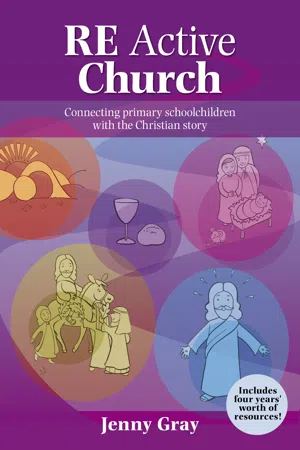
RE Active Church
Connecting Every Primary School Child With The Christian Story
- English
- ePUB (mobile friendly)
- Available on iOS & Android
eBook - ePub
About this book
Primary school children are required to learn about Christianity and local churches are often keen to help, but don't know where to start. This book provides a four-year cycle of resources that churches can offer to children at Key Stage Two (years 3 to 6, ages 7 to 11). The tried-and-tested workshop material covers Christmas, Easter and stories about Jesus and includes all you need to know to run sessions in your local church. 'RE Active Church workshops help children realise they all belong to a bigger family. RE Active Church . . . will broaden each child's holistic education. My staff have benefited hugely from working alongside the church.' Vicky Parsey, Headteacher, Applecroft School, Welwyn Garden City.
Information
Part 1
RE Active Church practicalities
1
Working with schools
Why work with schools?
Mission has always been fundamental to who we are and what we do as church. The continued overall decline in average weekly attendance, however, has given the Church new challenges.
Many people in the UK today have little connection with the Church or real knowledge of the Christian story. In 2007, a British Sociological Association survey found that 45.7 per cent of the adult population had ‘no religion’, while Tearfund (April 2007) listed 33 per cent as ‘unchurched’, 33 per cent as ‘dechurched’, 15 per cent as attending church at least once a month and 10 per cent occasionally. Church clergy and congregations are ageing and attendance is forecast to fall by 55 per cent of the level in 1980 by 2020.1
In some sectors, there is outright hostility to the Church and religion of any kind. Religion is often misunderstood and equated with fundamentalism, terrorism, war, intolerance, outdated superstition or a preoccupation with sex. Media reports focus on the scandalous, while faith at its best is given little attention. Clergy in TV soaps and films are often figures of fun rather than people to look up to.
For many children, Christianity is no longer part of home life. Parents may have little understanding of Christian belief and practice, and if they don’t go to church, their children are unlikely to think of going. If children have never been to church they don’t know what it is like. Nationally just 4 per cent of children attended Sunday school in 2001.2 Many predict this figure will drop to 1 per cent in 2020, although some dioceses do report increases in children attending worship.3
The challenge for churches
Many in the Church are recognizing this challenge and doing something about it. Some have started ‘fresh expressions’ of church. In addition, Mission Action Planning was developed in the London diocese in the 1990s to encourage parishes to agree a vision statement, engage in a mission audit and produce a clear Mission Action Plan (MAP).4 Such plans include organizing work with children. This was ‘warmly endorsed’ for use in parishes by the Archbishops’ Council and House of Bishops in May 20115 and has been commended in at least 20 dioceses and in denominations other than the Church of England.
Teaching children about God through word and practice is central to the Old Testament (Deuteronomy 6, 11.19) and part of the Great Commission Jesus gives his followers (Matthew 28.18–20). The Gospels (Matthew 19.13–14; Mark 10.13–16; Luke 18.15–20) show the importance of children to Jesus – his message is not reserved for grown-ups! The Church has a long history of contributing to religious and general education, but in today’s sceptical, postmodern, secular culture, it is looking for new ways to connect with children who have little understanding or experience of the Christian faith. In the 2011 Anglican General Synod debate on education, the Archbishop of Canterbury Rowan Williams encouraged ‘a critical partnership with the State that seeks to keep open for as many children as possible the fullest range imaginable of educational enrichment’, assuming ‘an honest and thoughtful exposure to the Christian faith’.6
Despite some positive initiatives by local churches, however, inviting children to church or church activities may not be enough. There are now many competing attractions on a Sunday. Our secular, postmodern society no longer treats Sunday as special and different. Even in Christian families, going to church has to compete with sport, shopping and other leisure activities.
A 2001 survey showed that 57 per cent of children who used to go to church stop before they leave primary school – the key age for stopping being between seven and ten years of age.7 RE Active Church provides a small but regular and positive contact with church, which can contribute to children making up their own minds about the Christian faith.
Children’s experiences of church
Children’s experience of church is varied, but for those who currently go to church or who once went and have now stopped, it is not always positive, despite genuine attempts by churches to welcome children:
• Sunday congregations may be largely middle-aged or elderly – two churches in five in England have no children or youth work;8
• it can be difficult to engage with church music and liturgy – even all-age services can seem an alien world that children do not understand;
• men are under-represented in children’s work in churches, which means a shortage of positive role models for boys;
• children’s groups may lack critical mass – primary school age children, like teenagers, enjoy meeting and interacting with their peers;
• more churches now employ children’s workers, but their work is often under-resourced and priority given to adults in the congregation.
Peter Brierley’s survey in 20019 of ten-year-olds lists the top five reasons children give for not going to church as:
1 it’s boring;
2 isn’t cool;
3 can’t be bothered;
4 other things to do;
5 friends don’t go.
Also significant were:
• no parental encouragement;
• don’t get up early;
• it’s irrelevant;
• feel out of place.
The survey highlights the importance of churches taking the initiative, investing time and resources to work with schools, welcome children to church and present the Christian faith in authentic, creative and enjoyable ways that change these views.
The advantage of running RE Active Church workshops is that they engage children in their existing class friendship groups through creative and age-appropriate material. They also go against the stereotype that no one laughs in church!
Will schools be open to an approach from the local church?
Anecdotal evidence suggests that primary schools are currently receptive to approaches from churches, and churches are eager to work with children.10 There is growing interest in the partnership between churches and schools beyond the traditional religious assembly, and there are some excellent initiatives, such as RE Inspired,11 Stream Sacred Spaces,12 the Diocese of Gloucester’s resources for festivals13 and ‘Easter Cracked’ and ‘Christmas Unwrapped’ presentations for Year 6 children.14
How RE Active Church can help schools
There are a number of reasons for schools to be positive about an approach from a local church, one of which is that it could help them meet the requirements of the RE curriculum. Although it is not a statutory part of the National Curriculum, RE remains a compulsory subject in schools and, at present, the teaching of RE is governed by the locally agreed syllabus. All children are required to learn about and learn from religions and their beliefs in RE. RE seeks not only to impart knowledge but also to develop understanding of religious experiences, feelings and attitudes. RE is also expected to contribute to the spiritual, moral, social and cultural development of pupils.
• RE Active Church supports teachers, some of whom may have little experience of church, prayer or worship, in meeting the requirements of the RE curriculum to teach key elements of Christianity and its meaning for Christians.
• Schools are also required to visit local places of worship. Visits, including visits to churches, enhance pupils’ educational experience and help them connect with their local community and cultural heritage.
• RE Active Church is cross-curricular, helping schools cover aspects of RE in imaginative and enjoyable ways that spill over into other subjects, including PSHE, art, music, geography, history and technology.

One teacher’s follow-up work with her class included designing and producing four acetate ‘stained-glass’ window panels for the church, to the delight of members of the congregation and the children on subsequent visits. The RE Active Church workshop ‘ticked boxes’ for the art and technology as well as RE syllabuses.

• RE Active Church resources take account of different learning styles, ages and abilities of children in school Years 3–6. Material for each workshop should be sent to the RE coordinator in each school ahead of visits to church. Feedback should be invited from schools before and after visits.
Other benefits
The resources help to teach values. Children’s role models are often footballers, music, TV and film celebrities who are glamorous, rich and famous, but not necessarily happy or healthy, and who don’t always behave responsibly!
The government-commissioned review, ‘Letting children be children’, by Reg Bailey, chief executive of the Mothers’ Union,15 highlights widespread concern over the sexualization and commercialization of childhood. This follows academic studies by Professor Tanya Byron in 200816 on the impact of new technology on children, Professor David Buckingham in 200917 on the commercialization of children and Dr Linda Papadopoulos in 201018 on the sexualization of young people. In partnership with schools, RE Active Church challenges the prevailing consumer-driven, materialistic, ‘me first’, celebrity culture and reinforces value...
Table of contents
- Cover page
- About the author
- Title page
- Imprint
- Table of contents
- Foreword by John Pritchard, Bishop of Oxford
- Introduction: What is RE Active Church?
- Part 1: RE Active Church practicalities
- Part 2: RE Active Church resources
- Notes
Trusted by 375,005 students
Access to over 1.5 million titles for a fair monthly price.
Study more efficiently using our study tools.
Frequently asked questions
Yes, you can cancel anytime from the Subscription tab in your account settings on the Perlego website. Your subscription will stay active until the end of your current billing period. Learn how to cancel your subscription
No, books cannot be downloaded as external files, such as PDFs, for use outside of Perlego. However, you can download books within the Perlego app for offline reading on mobile or tablet. Learn how to download books offline
Perlego offers two plans: Essential and Complete
- Essential is ideal for learners and professionals who enjoy exploring a wide range of subjects. Access the Essential Library with 800,000+ trusted titles and best-sellers across business, personal growth, and the humanities. Includes unlimited reading time and Standard Read Aloud voice.
- Complete: Perfect for advanced learners and researchers needing full, unrestricted access. Unlock 1.5M+ books across hundreds of subjects, including academic and specialized titles. The Complete Plan also includes advanced features like Premium Read Aloud and Research Assistant.
We are an online textbook subscription service, where you can get access to an entire online library for less than the price of a single book per month. With over 1.5 million books across 990+ topics, we’ve got you covered! Learn about our mission
Look out for the read-aloud symbol on your next book to see if you can listen to it. The read-aloud tool reads text aloud for you, highlighting the text as it is being read. You can pause it, speed it up and slow it down. Learn more about Read Aloud
Yes! You can use the Perlego app on both iOS and Android devices to read anytime, anywhere — even offline. Perfect for commutes or when you’re on the go.
Please note we cannot support devices running on iOS 13 and Android 7 or earlier. Learn more about using the app
Please note we cannot support devices running on iOS 13 and Android 7 or earlier. Learn more about using the app
Yes, you can access RE Active Church by Jenny Gray in PDF and/or ePUB format, as well as other popular books in Theology & Religion & Christianity. We have over 1.5 million books available in our catalogue for you to explore.