eBook - ePub
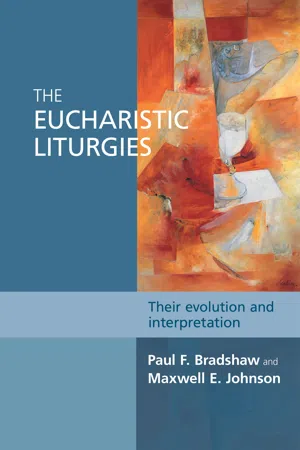
The Eucharistic Liturgies
Their evolution and interpretation
- English
- ePUB (mobile friendly)
- Available on iOS & Android
eBook - ePub
About this book
This study proceeds historically, from the origins of the Eucharist up to our own day. Unlike most studies of this kind, it includes an introduction to and developmental summary of the diverse Eucharistic liturgies of the Christian East. It also explores the various Western rites (Ambrosian, Gallican, and Mozarabic) in addition to the Roman. With regard to theological themes, the authors give special attention to the topics of real presence (including the "consecration" of the bread and wine) and eucharistic sacrifice, the most central and most ecumenically challenging issues since the sixteenth-century Reformations. Making the book especially teacher- and student-friendly are the summary points at the end of each chapter. Each chapter also contains an abundance of liturgical texts for ease of reference.
Information
Topic
Teología y religiónSubtopic
Rituales cristianos y prácticaChapter 1
Origins
The historical root of the Christian Eucharist has traditionally been sought in the words and actions of Jesus at the Last Supper that he is said to have eaten with his disciples on the night before he died, and that is recorded in varying forms in Matthew 26:20-29; Mark 14:17-25; Luke 22:14-20; and 1 Corinthians 11:23-26. Modern liturgical scholarship concerning eucharistic origins, therefore, at first tended to focus on a literary-critical and traditio-historical analysis of these texts. In the last fifteen to twenty years, however, there has been a growing awareness that study of the Last Supper needs to be set within the broader context of the other meals in which Jesus participated and within the even wider sociological context of the form and dynamics of the Hellenistic group supper and the culture relating to meals in antiquity in general, which is where we begin.
MEAL CUSTOMS IN THE GRECO-ROMAN WORLD
In the ancient world, social life centered around eating and drinking every bit as much as it does for most people today, whether that was, for example, a banquet given at a rich person’s house or a regular gathering of associations that were often formed around a trade guild or profession. There has been a good deal of interest in recent years in the way in which the earliest Christian assemblies would have resembled such groups.1 Despite minor local variations that were due to particular social or ethnic distinctions, formal meals were broadly similar in character throughout that culture, and all would have contained some religious dimension, even if that were not their primary orientation.
Accustomed as we are to visualize the Last Supper through its depiction by Renaissance artists as having the disciples seated at one long table with Jesus in the center, it requires an effort to understand that this was not, in fact, how people in the ancient world dined. Instead, participants would normally have reclined on a number of couches arranged around three sides of the room, with the food presented in common dishes on low tables in front of them, from which they would have helped themselves with their hands. Often diners would share couches, and they would all be ranked according to their social status, with the host at one end and the most important guest immediately to the right and the others in descending social order around the room.2 Moreover, the wealthy might invite to dinner not only friends of similar social standing but also people of lower status, known as clients, who gave their patron loyal support in any of his ventures and in return received aid and protection of their interests. They would often be seated apart, however, and the food and drink served to them would be of a quite different quality from that being enjoyed by the host and his more privileged guests.3 Similarly, there were times when these clients would have to make do with a charitable handout of food to take home rather than with a place at table.4
Such formal meals thus not only created and strengthened social bonds between the participants but defined boundaries between communities (who was included, who excluded) and relative status within them. Reclining was itself a sign of status, since traditionally it had been the preserve of free citizens, while women, children, and slaves did not usually recline but ate quite separately. In time, however, this rule came to be relaxed and women might recline among the men, although there was still a danger that such women could be viewed as courtesans; on rare occasions slaves might be invited to eat with their masters.5
In contrast to modern times where wine is generally served throughout a meal, at these banquets a meal of several courses of food was eaten first, and then hands were washed and the tables removed before the second half of the evening began, the drinking-party or symposium (from the Greek word symposion, meaning literally “drinking together”). As each bowl of wine was needed, it was prepared by being diluted with something like two to three times its volume of water, and then a libation was offered to a particular deity, accompanied by a short prayer. Such a sharp separation of the two halves of the evening was not always preserved, however: Pliny the Elder reports that the custom of taking an aperitif of wine mixed with water before the meal began had been introduced during the reign of the Roman emperor Tiberias (14–37 CE),6 and wine drunk unmixed during the meal itself is attested even earlier, in the first century BCE.7 Nevertheless, occasions like these were—at least ideally—not just drinking parties. They were as much occasions for conversation, philosophical speculation, and the recitation of poetry or mythical stories, as well as for the fostering of relationships.
Naturally, meals among the poor did not follow the pattern of those among the rich. There, bread with salt and water would have formed the staple ingredients, augmented if possible with a little cheese or whatever else they could obtain—perhaps as leftovers from the banquets of the rich.8 Not having couches, they would sit on the ground or on cushions, a custom still found today in the Middle East.
JEWISH MEAL PRACTICES
Formal meals among Jews in the first century generally would have followed the pattern of those in the prevailing culture. There is, for example, clear evidence both from the Jewish sectarian community at Qumran and also from the Therapeutae residing by Lake Mareotis in Egypt, described—if in a somewhat idealized manner—by Philo, that at their shared meals participants were arranged according to their status within the community:
They shall eat in common and bless in common and deliberate in common. Wherever there are ten men of the Council of the Community there shall not lack a Priest among them. And they shall all sit before him according to their rank and shall be asked their counsel in all things in that order. And when the table has been prepared for eating, and the new wine for drinking, the Priest shall be the first to stretch out his hand to bless the first-fruits of the bread and new wine. (1QS 6.3-8)9
So then they assemble, white robed and with faces in which cheerfulness is combined with the utmost seriousness but before they recline . . . they take their stand in a regular line in an orderly way. . . .[T]hey pray to God that their feasting may be acceptable. . . . After the prayers, the seniors recline according to the order of their admission, since by senior they do not understand the aged . . . but those who from their earliest years have grown to manhood and spent their prime in pursuing the contemplative branch of philosophy. . . . The feast is shared by women also, most of them aged virgins. . . . The order of reclining is so appointed that the men sit by themselves on the right and the women by themselves on the left. Perhaps it may be thought that couches though not costly still of a softer kind would have been provided. . . . Actually they are plank beds of the common kinds of wood, covered with quite cheap strewings of native papyrus. . . . They do not have slaves to wait upon them as they consider that the ownership of slaves is entirely against nature . . . but the services are rendered by free men who perform their tasks as attendants not under compulsion. . . . No wine is brought during those days but only water. . . . The table too is kept pure from the flesh of animals; the food laid on it is loaves of bread with salt as a seasoning, sometimes also flavoured with hyssop as a relish for the daintier appetites. . . . When the guests have laid themselves down arranged in rows as I have described . . . the President of the company . . . discusses some question arising in the Holy Scriptures or solves one that has been propounded by someone else. . . . When then the President thinks he has discoursed enough . . . then the President rises and sings a hymn composed as an address to God, either a new one of his own composition or an old one by poets of an earlier day. . . . After him all the others take their turn as they are arranged and all in the proper order while all the rest listen in complete silence except when they have to chant the closing lines or refrains, for then they all lift up their voices, men and women alike. When everyone has finished his hymn the young men bring in the tables mentioned a little above on which is set the truly purified meal of leavened bread seasoned with salt mixed with hyssop.10
We may also recall the admonition given by Jesus to his followers not to take one of the higher places at table at a marriage feast lest someone more exalted should arrive and displace them (Luke 14:7-9).
Chief among regular Jewish formal meals was the weekly Sabbath supper, eaten on Friday evenings before sunset and the onset of the Sabbath, when the lighting of fires and cooking would be prohibited, resulting in little food, often cold, being eaten during the day itself.11 According to the Mishnah (the first systematic collection of rabbinic judgments about religious practices made around the end of the second century CE), nothing was to be eaten without God having first been blessed for it, and short blessings to be used for each kind of food are quoted there.12 It is unlikely, however, that this fully fledged system was already in use in the first century prior to rabbinic attempts to codify Judaism after the destruction of the temple in the year 70, and even later it may not have exercised influence outside rabbinic circles.13 On the other hand, the custom of saying some sort of blessing of God (in Hebrew berakah) over certain items at a meal was certainly known among pious Jews in the first century. The Qumran community, as we have seen, said blessings over bread and new wine together at the very beginning of their communal meals, and Josephus also reports that they said grace both before and after their meals, praising God for bestowing their food upon them.14
It is often assumed that at least the substance of what later became the standard Jewish grace at the end of the meal, known as the Birkat ha-mazon, was already in use in the first century. Although the full text of this prayer is known from only the ninth century onward, it does have a tripartite structure, and the Mishnah refers to the grace after meals as comprising three blessings without specifying what they were, as if they were well-known to its readers (Ber. 6.8). Moreover, the Book of Jubilees, usually dated somewhere in the middle of the second century BCE, p...
Table of contents
- Cover
- Opening words
- Alcuin club
- Title page
- Imprint
- Dedication
- Table of contents
- Abbreviations
- Acknowledgements
- Introduction
- 1. Origins
- 2. The second and third centuries
- 3. The fourth and fifth centuries: historical context
- 4. The fourth and fifth centuries: questions in anaphoral development and eucharistic theology
- 5. The christian east
- 6. The medieval west
- 7. The protestant and catholic reformations
- 8. The modern period
- Search items
Trusted by 375,005 students
Access to over 1.5 million titles for a fair monthly price.
Study more efficiently using our study tools.
Frequently asked questions
Yes, you can cancel anytime from the Subscription tab in your account settings on the Perlego website. Your subscription will stay active until the end of your current billing period. Learn how to cancel your subscription
No, books cannot be downloaded as external files, such as PDFs, for use outside of Perlego. However, you can download books within the Perlego app for offline reading on mobile or tablet. Learn how to download books offline
Perlego offers two plans: Essential and Complete
- Essential is ideal for learners and professionals who enjoy exploring a wide range of subjects. Access the Essential Library with 800,000+ trusted titles and best-sellers across business, personal growth, and the humanities. Includes unlimited reading time and Standard Read Aloud voice.
- Complete: Perfect for advanced learners and researchers needing full, unrestricted access. Unlock 1.5M+ books across hundreds of subjects, including academic and specialized titles. The Complete Plan also includes advanced features like Premium Read Aloud and Research Assistant.
We are an online textbook subscription service, where you can get access to an entire online library for less than the price of a single book per month. With over 1.5 million books across 990+ topics, we’ve got you covered! Learn about our mission
Look out for the read-aloud symbol on your next book to see if you can listen to it. The read-aloud tool reads text aloud for you, highlighting the text as it is being read. You can pause it, speed it up and slow it down. Learn more about Read Aloud
Yes! You can use the Perlego app on both iOS and Android devices to read anytime, anywhere — even offline. Perfect for commutes or when you’re on the go.
Please note we cannot support devices running on iOS 13 and Android 7 or earlier. Learn more about using the app
Please note we cannot support devices running on iOS 13 and Android 7 or earlier. Learn more about using the app
Yes, you can access The Eucharistic Liturgies by Paul F. Bradshaw,Paul Bradshaw in PDF and/or ePUB format, as well as other popular books in Teología y religión & Rituales cristianos y práctica. We have over 1.5 million books available in our catalogue for you to explore.