- English
- ePUB (mobile friendly)
- Available on iOS & Android
eBook - ePub
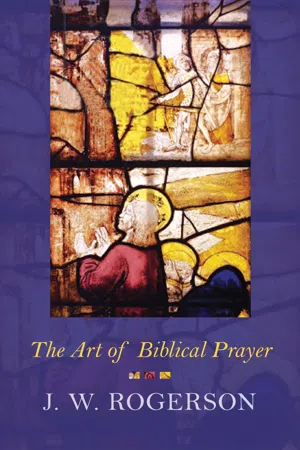
The Art of Biblical Prayer
About this book
Prayer' is a word that is used in a number of different ways. For many people it means essentially petition or intercession. Understood in this way, prayer easily becomes an 'extra' - something that is not essential to Christianity, but that some Christians do sometimes, as the need arises. This book aims to show that prayer should be understood as inseparable from Christianity, in the sense that to practise Christianity is to practise prayer and vice versa.
Information
Topic
Theology & ReligionSubtopic
Christian Rituals & Practice1
What is prayer?

‘Prayer’ is a word that is used in a number of different ways. For many people it means essentially petition or intercession. When we say, ‘I’ll remember you in my prayers,’ we mean something like, ‘I’ll ask God to bless/heal/support you.’ Understood in this way, prayer easily becomes an ‘extra’ – something that is not essential to Christianity, but something that some Christians do sometimes, as the need arises, when they are not in church. Later on in this book there will be a chapter on intercessory or petitionary prayer; but for the moment it will be argued that prayer should be understood as inseparable from Christianity in the sense that to practise Christianity is to practise prayer and vice versa. How can this be?
In his Reality and Prayer, J. B. Magee writes that ‘prayer is a gift of God and a work of his grace’.1 This quotation will be the driving force behind much that follows in these pages. In the first place it puts a question-mark against the idea that prayer is primarily petition or intercession. In these latter activities it is we who take the initiative in bringing our concerns before God, not God who gives us something through which grace is worked. The way in which I want to spell out how prayer can be thought of as a divine gift is by comparing it with a special language.
I do not have in mind a foreign language, but the language that has to be learned if a person is to become a specialist in a particular trade, profession or creative sphere. My father, who studied at night school to become a carpenter and joiner, and for whom I spent many hours as a boy holding, fetching and carrying items, taught me terms such as architrave (the moulded rectangular frame round a door or window), nogging (brickwork set within a frame) and tenon (a protruding piece of wood to be inserted into a mortice, a mortice being a specially cut cavity). A niece of mine who is studying dentistry uses a formidable array of technical terms in her written course work.
It is important to stress here that I am not talking about something that is intellectual and elitist. Unfortunately, when it comes to Christian faith, there seems to be a presumption in the Church not only that it would be too much to expect ‘ordinary people’ to master any distinctive concepts fundamental to Christianity, but also that this would be undesirable in principle. It is true that while Dietrich Bonhoeffer was detained by the Nazis in prison in 1944, he wrestled with the question of whether it was possible to formulate a version of Christianity that did not require any distinctive theological concepts and thus a special type of Christian language; but it is doubtful whether this, if possible, would be any more likely to succeed than an interpretation of, say, Islam, that avoided any mention of the Qur’an, Muhammad or the pilgrimage to Mecca.2 Bonhoeffer was probably criticizing ‘religion’ in the sense of a set of widely held beliefs deemed both inside and outside the churches to be an essential part of Christianity. I would agree with his criticisms. When I speak of a distinctive language of Christianity and prayer, I have something else in mind.
I have in mind a particular way of looking at the world. That way is best arrived at, in my opinion, by considering some of the best-known parables of Jesus. These are stories that are easily remembered and which express an understanding of the world that is challenging and inspiring. I begin with the parables of the Lost Sheep and the Lost Coin in Luke 15.1–10.3 These ‘Parables of Human Instinct’, as Oliver Quick called them, set out from human feelings. We have all temporarily lost something at some time in our lives – keys, watches, mobile telephones, books – and we have had feelings of frustration and loss out of all proportion to the fact that we had not lost the overwhelmingly vast remainder of our possessions. Again, the joy and relief of finding a lost object, when we do so, is out of all proportion to its insignificance as a part of our possessions; yet we want to tell others that we have found what was lost, and want them to share our joy.
In the two parables exactly this same thing is described. The shepherd forgets that he has 99 sheep that are safely in his care, and goes after the one lost sheep because he feels somehow incomplete without it. He may even put the safety of the 99 at risk, but in such situations instinct can overrule calculation. When he finds the lost sheep he is overjoyed and calls on his friends and neighbours to share this joy. Precisely what the woman has lost is disputed by the commentators. Was it a coin from a kind of necklace that was her insurance against her husband divorcing her? Was it part of scarce savings? Was it a comparatively valueless object? It makes no difference to the parable. People can feel as incomplete and frustrated over the loss of a trivial item as over the loss of a valuable one. Whether valuable or not, the lost item causes the woman to search exhaustively in the house, and when she finds the coin she calls on her friends and neighbours to rejoice with her. At the end of each story Jesus used these human emotions to describe what happens in heaven in connection with human behaviour. There is more joy in heaven (a possible way of saying ‘God’, observing Jewish conventions about treating the word ‘God’ with respect) over one sinner who repents than over 99 who do not need to do so. Similarly, in the case of the Lost Coin, there is joy among the angels of God over one sinner who repents. Quick draws out the implications of this memorably:
‘You belong to God’, he [Jesus] seems to say, ‘you are in fact his property, his children. Can you suppose that men care more about their property and their own children than God cares about his? Can you believe that he implanted these instincts of ownership and parental affection in man’s soul, and that they are not dim reflections of something infinitely more glorious in himself?’4
The realization that our best human instincts may also be a clue to God’s concern for us may, for some, be a starting-point for Christian faith. It is certainly fundamental to the way of understanding the world that affects the language of prayer.
The parable of the Prodigal Son (Luke 15.11–32) is different from the two parables that precede it, in that some human instincts are shown not to be clues to the nature of God. The elder brother no doubt sums up what many people would instinctively do if they were in his position, and I have known people to be deeply offended by what they perceive, not unreasonably, to be the unfairness of the parable: that the wasteful, good-for-nothing son seems to finish up better off than the hard-working son who was loyal to his father. In actual fact the parable clearly marks out the difference between a world that is based on strict justice and what is deserved, and one that takes seriously the implications of repentance and forgiveness. The elder son represents justice and what is deserved, but cannot bring himself to forgive his brother. This inability to forgive would have been bad news for the prodigal if he had been met on his return not by his father but by his brother. Light is shed on the saying of Jesus that if we cannot forgive others, God cannot forgive us (see Matthew 6.14–15). The father’s reaction in welcoming home his wayward son seems to create injustice and to overlook loyalty, but they are necessary if the prodigal is to become what he had ceased to be, namely a son in his father’s house. Two theological technical terms are implicit in the father’s treatment of the returning son: justification and sanctification. Justification in the parable means that the broken relationship between father and son has been restored, and restored by the undeserved mercy extended by the father to the son. Sanctification means that the son has returned to the one place where he can become a loyal son once more; where he can turn his back on the ‘loose living’ that had devoured his fortune, and be remade because of his father’s mercy and love.
A fourth parable that is relevant to this chapter is that of the Labourers in the Vineyard (Matthew 20.1–16). Much light has been shed on this story by recent research into the social and economic background to the New Testament.5 This has explained why the owner of the vineyard did not employ sufficient workers at the beginning of the day, but visited the market place on four occasions, the latest being one hour before the end of the working day. Workers engaged later than the beginning of the day were entirely at the mercy of any employer as to what he would pay them (see Matthew 20.4). An unscrupulous employer could keep his wage bill down by employing few workers at the beginning of the day for the agreed daily wage, and more workers later in the day for much less than the daily rate. In the parable, the owner of the vineyard pays the agreed daily wage to all the workers, whether they worked for twelve hours or for one hour. This naturally causes resentment on the part of those who worked for twelve hours, but the employer seems to have been mindful of the fact that it cannot have been pleasant for men with dependants to support to have stood idle in the market place all day hoping that someone might give them work. The parable shows that in the kind of world in which we live, generosity that is intended to do something about the injustices that people suffer, will itself create injustice for anyone with no room for compassion.
A particular view of the world begins to emerge from a consideration of these parables. It is a world in which justice and what people strictly deserve have to be tempered by forgiveness, mercy and generosity. Where this is done, it becomes possible for people to find their way back from the many equivalents of the riotous living in the far country, to the welcome and healing of the father’s house. It gives hope to people who would otherwise have no hope. The parables outline the alternative: the equivalent of the repentant son being turned away from the door; the exploited workers going back empty-handed to hungry families. But this world epitomized by hope and compassion is not simply one that could be thought of and endorsed by sensitive humanists; it appeals to human instincts to look beyond human hopes and aspirations to a divine order that itself can be thought of in terms of longings for restoration and wholeness. It is this fact that links this view of the world to prayer. Prayer can have many definitions, but whatever else it means, it is about uniting human hopes for a better world with the divine dimension to which the human experience of losing and finding points. It is within that union of human hope and divine reassurance that the special language of prayer emerges, and enables people to express their hopes and aspirations. Some of these special items of language have been mentioned. It is time to mention them again and to define them more closely. I shall discuss forgiveness, grace, mercy, repentance, justification and sanctification.
Forgiveness is not about forgetting the past; it is about handling the past creatively. An unforgiven past can become like a festering wound in the memory of an individual or group. It can enable the past to dominate the present and future as old grievances are continually given fresh life and enabled to nourish feelings of bitterness. Forgiveness is not a matter of forgetting about past wrongs of injustice. Where possible it is about putting them right. It may involve the admission that wrong was on both sides, not merely one side. Forgiveness is about overcoming evil with good. It is not about using the word ‘sorry’ as though it were a truce word whose mere utterance cancels out any responsibility there might be for the damaging of a relationship. Forgiveness is always the more difficult option. It is easier to let the past blight the present and future than to rob the past of its power to cast a shadow over the present. In the parable of the Prodigal Son, the elder brother is unable to forget the past; the father does not forget it either, but ensures that it does not prevent the returning son from beginning a new life.
Grace is a free gift offered by the giver without any intention or expectation that any obligation should thereby be created. If someone says to another, ‘Because I have given you this and that, I expect you to be loyal to me and respect me,’ then whatever else was being exercised in the giving, it was not grace. This can be illustrated by the elder brother in the parable. No doubt he had the right to expect his father’s gratitude. But to the extent that he expected his father’s gratitude, his service was not an act of grace even though it was undoubtedly praiseworthy. Grace therefore has about it an element of irrational and exorbitant generosity, but this is what gives it the potentiality to transform lives and situations.
Mercy is closely allied to grace and forgiveness in that it sees the limitation of justice in a world that is shot through with structural unfairness and the maintenance of double standards. The owner of the vineyard in the parable is merciful in the sense that he sees the limitations of the economic rules that apply to day labourers and the powerful advantage that these rules give to employers. He deliberately does not apply the rules. The mercy of God means, among other things, that God sees the shortcomings and dilemmas in terms of which people have to live out their lives and passes upon them a judgement that is sensitive to these factors.
Repentance is often wrongly understood in terms of the Greek word metanoia, which means to change one’s mind, as opposed to the Hebrew concept of teshuvah, which means ‘turning’ or ‘returning’. The Hebrew verb shuv is simple and graphic. It means ‘turn’ or ‘return’, the underlying idea being that someone is going along a false or dangerous path and needs to turn back or to turn onto a better path. It has to do with acting, not merely thinking. In the parable the prodigal certainly changed his mind; but more importantly, he retraced his steps and returned to his father’s house. This was costly. There was not only the uncertainty of how his father or brother would react, but also the shame that he would feel when he met those who had known him. Suppose his father had made him one of his hired servants (cf. Luke 15.19)? If forgiveness and grace are costly, so is true repentance.
Justificatio...
Table of contents
- Cover page
- About the author
- Title page
- Imprint
- Dedication
- Table of Contents
- Introduction
- 1. What is prayer?
- 2. Prayer and the ‘scientific’ world-view
- 3. Asking God for things
- 4. Confession
- 5. Affirmation, meditation, mysticism and prayers for the dead
- 6. Praying with the Old Testament
- 7. The Lord’s Prayer
- Epilogue: when prayer is difficult or impossible
- Bibliography
- Search items of biblical references
- Search items of names and subjects
Trusted by 375,005 students
Access to over 1.5 million titles for a fair monthly price.
Study more efficiently using our study tools.
Frequently asked questions
Yes, you can cancel anytime from the Subscription tab in your account settings on the Perlego website. Your subscription will stay active until the end of your current billing period. Learn how to cancel your subscription
No, books cannot be downloaded as external files, such as PDFs, for use outside of Perlego. However, you can download books within the Perlego app for offline reading on mobile or tablet. Learn how to download books offline
We are an online textbook subscription service, where you can get access to an entire online library for less than the price of a single book per month. With over 1.5 million books across 990+ topics, we’ve got you covered! Learn about our mission
Look out for the read-aloud symbol on your next book to see if you can listen to it. The read-aloud tool reads text aloud for you, highlighting the text as it is being read. You can pause it, speed it up and slow it down. Learn more about Read Aloud
Yes! You can use the Perlego app on both iOS and Android devices to read anytime, anywhere — even offline. Perfect for commutes or when you’re on the go.
Please note we cannot support devices running on iOS 13 and Android 7 or earlier. Learn more about using the app
Please note we cannot support devices running on iOS 13 and Android 7 or earlier. Learn more about using the app
Yes, you can access The Art of Biblical Prayer by J.W. Rogerson,J. W. Rogerson in PDF and/or ePUB format, as well as other popular books in Theology & Religion & Christian Rituals & Practice. We have over 1.5 million books available in our catalogue for you to explore.