1
Politician of integrity
PAUL NASH WITH STEVE HIRST
I never did, or countenanced, in public life, a single act inconsistent with the strictest good faith; having never believed there was one code of morality for a public, and another for a private man.
(Thomas Jefferson, third president of
the United States of America)
It’s a good thing to assume, to act on the basis that . . . others are [people] of integrity and honour . . . because you tend to attract integrity and honour if that is how you regard those with whom you work.
(Nelson Mandela)
Have you ever asked yourself or been asked by others any of these questions?
• If you were offered your heart’s desire, what would it be?
• If you were offered any spiritual gift or character quality, what would it be? If you had to give something up for it, what would you be willing to give up for it?
• Does character matter?
Your answers will reflect something of your approach to integrity.
Why do we have a chapter called ‘Politician of integrity’ in a youth ministry book? Because whenever we work for an organization and with people there are political dimensions. This is politics with a small ‘p’ which includes things like structural issues, organizational dynamics and power. Integrity is the quality of being honest and having strong moral principles, the state of being whole and undivided, being sound in construction and having internal consistency (all elements from dictionary definitions of ‘integrity’).
We want to suggest a model of youth worker that picks up the best of being political. Someone who
• represents everyone (John 3.16);
• advocates for marginalized and oppressed groups (Luke 4.18f.);
• has influence and is willing to help (John 11.3);
• treats everyone fairly and with respect (Micah 6.8);
• is trustworthy (1 John 5.14);
• is servant-hearted, wanting the best for those in his or her care (John 13.15–17).
The best politician is a leader of integrity. You know when you have been around people of integrity. It feels different; it feels honest, open, transparent, and fair. They tend to be people who know how to relate to others to bring about the best outcome, and they are able to get things done.
Integrity as a virtue
The concept of a politician of integrity draws on virtue ethics, which is a slightly different way of looking at how we act in our day-to-day life as well as in difficult dilemmas. Virtue ethics has its root in classical thought: Aristotle, Socrates and Plato all wrote about virtue, with Aristotelian ethics being known as virtue theory (Vardy and Grosch 1999). Classic virtues are wisdom, courage, temperance and justice. Virtues are concerned with inner values and the external expressions of those values. For instance, I want to be an honest youth worker, therefore I will be truthful when I am asked how the work is going. Within Christianity the most frequently mentioned virtues are faith, hope and love or charity (1 Corinthians 13.13). As we may well have experienced, to be faithful or loving requires a sustained commitment to act in such a way. We will only become politicians of integrity with repeated choices that reinforce that.
Virtues for Christian youth workers
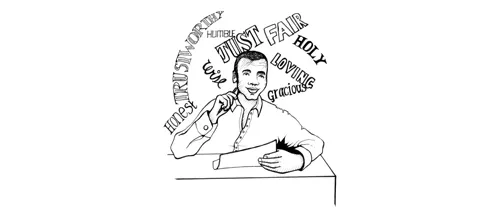
There are many virtues Christian youth workers can choose to embody and embrace, such as being loving, holy, gracious, forgiving, courageous, respectful, just, wise, humble, honourable, compassionate, equitable, trustworthy, honest, thorough, good. Virtues for caring professions have been identified, such as professional wisdom, care, respectfulness, trustworthiness, justice, courage and integrity (Banks and Gallagher 2009). All these have merit, but if we could have only one what would it be and how would we nurture this choice? The Bible tells us that love is the greatest virtue (1 Corinthians 13.13) but I want to suggest that integrity can make a claim to be the most important virtue in the life of a youth worker: without it everything else may come to nothing.
Case study: fundraising
In organizations Steve has been involved in there have often been ethical debates around the issue of funding, especially funding from government agencies, which may specify that they will not fund religious projects. This raises the question of whether it is ethically wrong for an organization with underlying Christian principles to apply for such funding (even if their work is in no way overtly Christian).
For me this brings up huge questions about one’s definition of ‘Christian work’ and where one’s virtues and principles are birthed. However, within all these questions there is undoubtedly an element of honesty and integrity which must be considered. Within my work we have always considered this and made funding application decisions based on the principles of integrity and of not misleading people. If we have felt that we can maintain these principles and that they are not being compromised then we will happily consider funding from a range of sources.
Definition of a politician of integrity
Our definition of a politician of integrity in a youth work context is
a virtuous person who, both in public and in private, speaks and acts with integrity, displays a commitment to and engagement with the work of the kingdom of God (Matthew 6.33) and seeks to have the mind of Christ (1 Corinthians 2.16) and to live a life worthy of his or her calling (Ephesians 4.1), manifesting the fruit of the Spirit (Galatians 5.22).
How can we develop this life of integrity?
To be a politician of integrity is choosing a way of being that encompasses the following qualities, values and virtues:
• graciousness – being generous, gentle, forgiving;
• honesty – not misleading people and speaking the truth in love;
• wisdom – an underrated virtue. We need wisdom before most virtues and need to be wise before we act. Wisdom will save us from much grief and give us a firm foundation for our work;
• bravery – politicians sometimes need to be brave, to make the best decision although they know it will not be immediately popular or perhaps understood;
• shrewdness – what did Jesus mean when he told us to be as wise as serpents and as gentle as doves (Matthew 10.6)? We cannot be naive, thinking others are always honest when they tell us things, ask for our help or offer to help (Luke 16.1–16). I do not tell everyone I meet all that I am thinking all the time. I have a responsibility to be discerning and discreet;
• discernment or good judgement – particularly taking note of the movement of the Holy Spirit within us and our values and principles;
• far-sightedness – articulating what you believe God is doing or is calling you to;
• a servantlike attitude – imitating Jesus, being a servant to all and choosing the lowly position, e.g. clearing up when no one is watching;
• trustworthiness – being a person of your word, doing things for deadlines and being ready for both important and seemingly unimportant meetings;
• advocacy – speaking and acting on behalf of the voiceless, marginalized or oppressed.
To be transparent is to be see-through. One of the criticisms of our politicians is that they act in secret. Now there is nothing wrong with being discreet, and above I commend shrewdness, but our actions and our motivations should be out in the open. Translucence – being semi-transparent – is not good enough. What are your responses if asked by your church leader or young people about films you have seen, websites you have visited, things you have said about other people, how you got so and so to do something for you, how you raised that pot of money. Double test: one of the nicest things that has ever been said to me by a young person was that he had never heard me say anything nasty about someone else, but the double test is what he would have heard me say when I was with my friends or if he could read my thoughts!
Attitudes of a politician of integrity
Decide not to play games. I don’t mean football or cricket, I mean colluding with others to manipulate the outcome. Not playing games means taking things seriously, dealing with the real issue and not being side-tracked or taken down a dead end. This can be initiated by us or by others, when they seek to draw us in to rescue or save them, again! Think and act win:win (Covey 2004). To have integrity is to want everyone to win as far as this is possible. Work collaboratively (Nash et al. 2008), as to be a leader of integrity will lead us to a place of realizing we cannot do it on our own. This is not because we are not clever or godly enough: it is because we were made to work together (Genesis 1.27). Valuing availability and accountability over ability is important. Steve tells how through his youth work practice he has experienced the truth of that statement:
At an early stage of a mentoring relationship I remember feeling that this young person’s needs were far beyond my level of training, understanding and experience, as he had some very deep-rooted issues. However, through building up a relationship built on accountability and the young person understanding my level of availability I was able to guide him through many of the issues he was facing. It also enabled me to refer him for more specialized support in specific areas.
Self-awareness
Self-awareness is a core skill that is vital for a politician of integrity. As youth workers we must be aware of many things: the needs of our young people, the aspirations of their parents, the principles of the kingdom of God. An underpinning skill to all these is self-awareness. To know myself, my weaknesses, my strengths, my biases, to be aware of all these and more, will enable me to be more effective and to be aware of their consequences in my work. Whether or not we like it – and, as an important aside, I hope not much – we have power and authority. Being aware that we have this is the first step, and learning to handle it healthily and responsibly is the next. Young people, other leaders and adults will look to us to act appropriately and with integrity, and in a way that is not abusive or oppressive. Steve writes,
I am continuously learning the importance of self-awareness. Through my experiences I am aware this is not only about ...