eBook - ePub
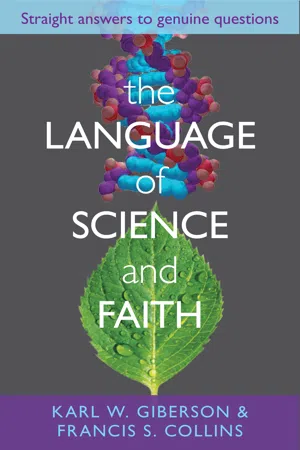
The Language of Science and Faith
Straight answers to genuine questions
- English
- ePUB (mobile friendly)
- Available on iOS & Android
eBook - ePub
The Language of Science and Faith
Straight answers to genuine questions
About this book
World-renowned scientist Francis Collins and fellow scientist Karl Giberson show how we can embrace both science and faith, without compromising either. Their fascinating treatment explains how God cares for and interacts with his creation while science offers a reliable way to understand the world he made.
Information
1
Do I Have to Believe in Evolution?
Now the earth was formless and empty, darkness was over the surface of the deep, and the Spirit of God was hovering over the waters.
GENESIS 1:2
Because BioLogos takes science seriously, respecting both scientists and the scientific process, we take biological evolution seriously. We view science as a gift from God requiring three things: (1) An orderly, reliable and predictable creation with patterns to be discovered, (2) minds capable of a deep level of abstract thought, and (3) a burning curiosity to understand the world around us. If any of those three things are missing, then we cannot have science.
When there is a near-universal consensus among scientists that something is true, we have to take that seriously, even if we don’t like the conclusion. We don’t have to accept everything blindly, of course, just because scientists believe it, but we should demand compelling reasons for rejecting such a consensus. This is the case with evolution.
Because the term evolution is used in so many ways, many of them inappropriate, we will define it briefly here so we know what we are talking about, and elaborate on the definition in the following pages. Evolution as a formal theory contains a set of simple, interlinked propositions:
1. All current species have descended from common ancestors. Just as all humans alive today are descended from an increasingly smaller group of previous humans, so all mammals are descended from an earlier group, and all vertebrates from an earlier group of vertebrates, and all animals from an earlier group and so on. Ultimately, all the life that has ever existed on earth is descended from a single-celled life form that lived almost four billion years ago.
2. Changes in species occur gradually over time as a consequence of mutations—small chemical changes in our DNA that are constantly occurring. Most mutations are irrelevant; many are harmful, but some are beneficial and enhance the reproductive success of their hosts.
3. Species change when beneficial mutations allow certain of them to have more offspring than others. Because the mutation results in more offspring, it spreads throughout the population and comes to dominate.
This, in a nutshell, is the theory of evolution. Note that it does not deal with the origin of life; whether chemicals can combine to produce life is not a part of the theory of evolution, although it is an interesting scientific question. It also does not say anything about whether the processes that drive it have purpose. Such questions are theological, not scientific.
The percentage of scientists who reject evolution is very small—so small that in most large gatherings of scientists you would not find even one person who rejects the theory of evolution. And almost all Christian biologists accept evolution as well.
Critics of evolution challenge these claims. You may have heard that “many scientists are abandoning evolution” or that “a large number of scientists have publicly repudiated evolution.” The Worldview Weekend organization, for example, states confidently that evolution is receiving “fatal” blows and will soon die. “Like a cat whose nine lives are running out, evolution is, bit by bit, discovery by discovery, coming to a point of total demise.”1 We find this claim quite remarkable, as we are unaware of a single discovery any time in the last decade that, even with great exaggeration, could be described as “fatal.”
The author goes on to make the even more extraordinary claim: “Few premier scientists any longer believe in Darwin’s evolution,” and that eventually only the “terminally stubborn will accept evolution.”2 We wonder about the basis for this statement. Just as we are unaware of any “fatal blows” that evolution has received, we are equally unfamiliar with any premier scientists who reject evolution. There are certainly a few scientists who reject evolution, just as there are scientists who reject relativity, big bang cosmology, quantum mechanics or that HIV causes AIDS and every other mainstream scientific idea. There are even a couple of “scientists” who reject the sun-centered model of the solar system, insisting that the earth does not move. But these are never premier scientists.
Unfortunately, these claims abound within the anti-evolutionary literature and are repeated so often by so many different and apparently credible people that it is easy to be misled. These claims are simply false. They are not mere “differences of opinion.” They are aimed at laypeople unfamiliar with science and the scientific community, which is why they can take root and flourish. Scientists, for example, are constantly refining the details of evolution, but they are not abandoning it. If they were, this would be newsworthy and would circulate both informally in the scientific community and in the trade publications that report on developments in science. The scientists at the BioLogos Foundation are unaware of any biologists who have abandoned evolution in the past few years. Not one.
As for those scientists who publicly repudiate evolution or express concerns about it, there is indeed a famous list called “Dissent from Darwin” where more than five hundred “scientists” have signed the following statement: “We are skeptical of claims for the ability of random mutation and natural selection to account for the complexity of life. Careful examination of the evidence for Darwinian theory should be encouraged.”3
This claim, at first glance, is an impressive and effective piece of anti-evolutionary public relations. Surely such widespread dissent must indicate that something is wrong with evolution. But let’s look closer.
For starters, there are problems with the list itself. Many of the scientists listed are not trained in biology and so are not in a position to evaluate the central theory of that field. Of the two authors of this book, only one is a trained biologist capable of speaking with authority about evolution. The other is a trained physicist, who took his last biology course in 1975 in high school. When scientists comment on developments in fields they have not studied, they have no real authority. The “Dissent from Darwin” list includes philosophers, physicists, engineers, mathematicians and academics from other fields. Many of them never took even a single course in biology beyond high school. No doubt they are sincere in their views, but do we need to take their concerns about evolution seriously?
Many names on the list are of emeritus professors from various institutions. Emeritus is a recognition that institutions bestow on faculty when they retire, typically around age seventy to seventy-five. Seventy-five-year-old emeritus professors would have finished most of their education a half-century ago, before the developments of the past few decades provided so much support for evolution. The presence of so many emeritus faculty on this list is another red flag, alerting us to the fact that these “dissenters” are not active members of the scientific community.
A list of over five hundred names may seem significant and, were they all gathered in one place, the group would be impressive. But the scientific community is huge, and this group represents an insignificant fraction of the whole. To show just how truly insignificant this list is, an organization called the National Center for Science Education created a parody list of scientists who were “evolution supporters” and who were all named Steve! Despite the fact that only 1 in 100 scientists is named Steve, this list has over a thousand names on it, and most of them are working biologists, which is not true of the Dissent from Darwin list.4
We also note that the statement in question does not really indicate repudiation of evolution. Even enthusiastic evolutionists don’t all believe that “random mutation and natural selection” are the only relevant explanatory elements in evolution. Merely expressing skepticism about the adequacy of these two features of evolution to explain everything is hardly equivalent to repudiating the theory; in fact it’s not even genuine dissent from evolution as it is understood today in the biological community.
And, finally, scientific truth is not decided by the number of names on a list, or who wins the debate or convinces the most people. It is based on evidence. There is a scientific method, and the ideas that are widely accepted are those that have met criteria for being strongly supported by evidence and consistent with the rest of science. In all cases the validity of scientific ideas is best addressed by the leading experts who understand those ideas most thoroughly.
Any time the authority of a scientist is invoked we should check to see if the scientist is an authority on the topic on which they are speaking. In addition, we should consider whether they are simply using the authority of the scientific community to support a position on which they are no better informed than a layperson. Expertise matters.
For these and other reasons we suggest that the opposition to evolution has been greatly exaggerated. The evangelical literature is so filled with misrepresentations and outdated information about evolution that even a lot of research might not lead an honest seeker to the truth. We caution that Christians should take no comfort in the misplaced hope that the scientific community is gradually abandoning the theory of evolution. The case is quite the opposite.
So What Is Evolution?
Evolution in the most general sense—not the narrow technical sense we introduced earlier—means simply “change over time.” For example, we can say that iPods have evolved over the past few years; they have gotten smaller, hold more songs and no longer use disk drives to store the music. This is one use of the word evolve. But when scientists use the term, sometimes imprecisely despite the fact that they should know better, they refer to the entire history of life on earth and sometimes even the entire history of the universe from the big bang to the present.
Biological evolution, our topic here, refers to the way that species from the past developed into the diverse roster of species that exist today.5 This incredibly slow process takes millions and even billions of years, a time frame beyond our comprehension, which is one reason why so many people have trouble understanding evolution. Not even scientists have an intuitive feel for millions of years.
Evolution in the sense of “change over time” is displayed clearly in the fossil record, where stacked geological layers reveal a progressively changing roster of animals and plants as we move from ancient to more modern strata. There are many layers with absolutely no human fossils in them, for example. And then, in more recent layers, humanoid fossils appear. By the time humanoid fossils appear in the record there are no more dinosaur fossils. We can thus infer, quite reasonably, that dinosaurs flourished during an era when there were no humans, but dinosaurs went extinct and millions of years later humans appeared. Many less dramatic changes are displayed as well, including animals developing feathers from ancestors with scales, or animals that lived on land adapting to living in the water and gradually losing their limbs. All this is clear from the fossil record.
What Is the Role of Genes?
The physical features of animals and plants are based, in large part, on their genes, which guide the development of the organism throughout its life. Genes are the fundamental units of heredity and are made of DNA, the famous molecular double helix that unzips and copies itself in the reproductive process. The molecules that make up DNA are arranged in a long chain. They have some flexibility to change and move around, more or less randomly, which modifies the chain in unpredictable ways. These changes alter the genes which, of course, changes the instructions that the genes provide to guide the development of the organism.
Modifications to DNA are called mutations. These mutations change the biology of the organism, sometimes in important ways, but most often in irrelevant ways not much different than when we pull a book from our bookcase and put it back in a different spot. Readers of this book have mutations in their genomes of which they are not even aware. In fact, each of us has about one hundred mutations that arose for the first time in us. Each of these mutations represents a tiny experiment.
Sometimes mutations are beneficial. They might make the organism more attractive to the opposite sex, making it easier to find mates and reproduce—or they might lay eggs that are less fragile or better camouflaged from predators. Changes like these are favorable to the production of offspring, and organisms with these “new and improved” features will have more offspring than their old-fashioned peers. In this way a disproportionate number of the new genes will be passed on to the next generation.
Often mutations are harmful. If a bird has a mutation causing it to lay eggs that are too fragile, for example, the eggs may break open too soon and none of the hatchlings will survive. A mutation like this interferes with successful reproduction, and since the offspring that possess it won’t survive, these mutations will generally be eliminated in the population.
If a population of some species undergoes a substantial number of such changes, it can eventually turn into a new species, a process called speciation. Usually speciation requires that the population be geographically isolated from other related populations so that the beneficial genes do not get diluted among the entire population. Mutations in the human species, for example, can easily spread among the entire population. But if everyone from, say, Canada, moved to the moon, then mutations in that population could eventually, over millions of years, lead to a new species that would be unable to breed with the parent species on earth. The new species would not necessarily be more advanced in any meaningful sense; it might even be less advanced according to some criteria. But it would be different.
Species change slowly, so these processes are, for practical purposes, invisible. Even over the course of a millennium a species with a reproductive cycle like humans would typically not change in any noticeable way. Our knowledge that species have changed dramatically over time does not come from watching them. Nevertheless ...
Table of contents
- Praise for The BioLogos Foundation
- Title page
- Imprint
- Table of contents
- Preface
- Acknowledgements
- Introduction
- 1. Do I Have to Believe in Evolution?
- 2. Can We Really Know the Earth Is Billions of Years Old?
- 3. How Do We Relate Science and Religion?
- 4. Can Scientific and Scriptural Truth Be Reconciled?
- 5. Science and the Existence of God
- 6. Why Is Darwin’s Theory So Controversial?
- 7. What Is the Fine-Tuning of the Universe, and How Does It Serve as a Pointer to God?
- 8. Evolution and Human Beings
- 9. The Grand Narrative of Creation
- Annotated Bibliography
- Notes
- Name Search items
- Subject Search items
- Search items of Questions
Trusted by 375,005 students
Access to over 1.5 million titles for a fair monthly price.
Study more efficiently using our study tools.
Frequently asked questions
Yes, you can cancel anytime from the Subscription tab in your account settings on the Perlego website. Your subscription will stay active until the end of your current billing period. Learn how to cancel your subscription
No, books cannot be downloaded as external files, such as PDFs, for use outside of Perlego. However, you can download books within the Perlego app for offline reading on mobile or tablet. Learn how to download books offline
Perlego offers two plans: Essential and Complete
- Essential is ideal for learners and professionals who enjoy exploring a wide range of subjects. Access the Essential Library with 800,000+ trusted titles and best-sellers across business, personal growth, and the humanities. Includes unlimited reading time and Standard Read Aloud voice.
- Complete: Perfect for advanced learners and researchers needing full, unrestricted access. Unlock 1.5M+ books across hundreds of subjects, including academic and specialized titles. The Complete Plan also includes advanced features like Premium Read Aloud and Research Assistant.
We are an online textbook subscription service, where you can get access to an entire online library for less than the price of a single book per month. With over 1.5 million books across 990+ topics, we’ve got you covered! Learn about our mission
Look out for the read-aloud symbol on your next book to see if you can listen to it. The read-aloud tool reads text aloud for you, highlighting the text as it is being read. You can pause it, speed it up and slow it down. Learn more about Read Aloud
Yes! You can use the Perlego app on both iOS and Android devices to read anytime, anywhere — even offline. Perfect for commutes or when you’re on the go.
Please note we cannot support devices running on iOS 13 and Android 7 or earlier. Learn more about using the app
Please note we cannot support devices running on iOS 13 and Android 7 or earlier. Learn more about using the app
Yes, you can access The Language of Science and Faith by Karl W. Giberson and Francis S. Collins,Karl Giberson,Karl W Giberson,Francis S Collins in PDF and/or ePUB format, as well as other popular books in Theology & Religion & Christian Theology. We have over 1.5 million books available in our catalogue for you to explore.