- English
- ePUB (mobile friendly)
- Available on iOS & Android
eBook - ePub
About this book
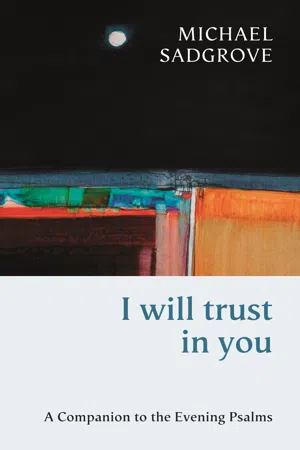
In his introduction to this beautifully written companion to the Evening Cycle of Psalms (as set out in the Church of England's Book of Common Prayer), Michael Sadgrove reminds us that the Psalms have been central to public worship and personal prayer for the entire history of the church. They are indeed one of the world's greatest spiritual treasures- in the words of Martin Luther, 'full of heartfelt utterances'- and are as vital a source of comfort, challenge and inspiration to people of faith today as they have ever been. I Will Trust in You will greatly benefit anyone who wishes to engage more deeply with the riches of the Psalms.
Information
1
Hurt, hopeful, human
The First Evening: Psalms 6, 7, 8

The First Evening of the month’s cycle of Psalms includes one of the greatest and most beautiful psalms of all. Psalm 8 is a song celebrating the majesty of the creation and its Creator, and is rightly admired as one of the Psalter’s jewels. However, before we come to it we must travel through the first two of the three psalms set for the day. And while they are much less familiar to most readers, they are actually more typical of the Psalter as a whole.
Psalms 6 and 7 are both personal laments, that is, prayers uttered by an individual man or woman who is undergoing suffering in which only God can help. In Hebrew, the Psalms are known as the ‘praises’, yet the largest class of Psalms turns out to be not the hymns of praise (like Psalm 8) but the laments of the individual or the community. So we shall encounter a good many laments as we journey through the Psalms. Indeed, of the first fourteen Psalms in the book, only three are not laments. And as we shall see, while laments have much in common in both their spiritual character and their poetic form, it seems that the circumstances that gave rise to the need for lament were very varied. We shall consider the laments of the community later. As for those of the individual sufferer, his or her plight could include sickness, persecution by an enemy, the onset of death, the loss of a loved one, being separated from the place of prayer, betrayal by a friend, being on trial falsely and, not least, a personal sense of hopelessness, guilt or failure. We shall meet all of these predicaments in due course.
The first psalm of the First Evening, Psalm 6, appears to be a prayer for healing in sickness. It’s impossible to be certain: one of the aspects of the laments we shall notice is how often very general language is used to describe the psalmist’s suffering or ‘complaint’, and it is often difficult to be specific about the ordeal itself. So while in Psalm 6 the psalmist prays for healing (2) and asks that his life might be spared (4–5), the passionate outpouring of grief that follows (6–7) is connected with his ‘foes’ (7) who remain very much in the picture in the rest of the psalm.
This psalm introduces us to one of the most characteristic and beautiful features of the laments. It is the way in which the psalmist holds to an indomitable belief that it is worth praying to YHWH even in times of pain and suffering. We shall frequently use the phrase ‘certainty of hearing’ to describe this powerful conviction that God cares enough about suffering to listen and respond to the prayer of the psalmist. Here, as in most of the laments, there is a clear sense that the psalmist turns a corner in the course of pouring out his lament. Whereas the psalm began with the desperate plea not to be destroyed by suffering, as it progresses, the shadows begin to be dispersed by the growing conviction that God has promised deliverance, and this can already be anticipated: ‘Depart from me, all you workers of evil, for the LORD has heard the sound of my weeping. The LORD has heard my supplication; the LORD accepts my prayer’ (8–9). This lament ends on a note of confidence that God has heard, and will act.
Psalm 7 makes a similar journey, but goes even further. Whereas Psalm 6 ended in confidence, Psalm 7 climaxes in an outburst of praise and thanksgiving for the deliverance that is promised (17). In this psalm the ordeal is clearly caused by enemies whose persecution of an innocent sufferer is pictured as both violent and bestial (2). So convinced is the psalmist of the injustice he is undergoing that he takes a solemn vow against himself as a witness to his own innocence (compare this with the self-imprecation of another legendary biblical sufferer in Job 31). What is made clear in this lament and many like it is that the psalmist’s suffering is undeserved. The laments often put a direct question-mark against the doctrine of ‘rewards’, popular then and not quite dead even now, according to which the question to ask in the face of suffering is, ‘what did I do to deserve this?’ This psalm’s answer is: nothing at all.
What is the ground of the psalmist’s prayer? It is that God rules the world purposefully, and wishes to reinstate in it the moral order with which he endued it at creation. Hence the plea: ‘rise up, O LORD, in your anger … Let the evil of the wicked come to an end, but establish the righteous, you who test the minds and hearts, O righteous God’ (6–11). So the petition of so many laments, that God will deal with the wicked, is not principally motivated by the desire for revenge, but, rather, to see ethical order and divine justice reinstated in the face of the moral chaos induced by evildoers. Hence the psalmist’s conviction that God will soon take action unless the wicked change their ways (12); ultimately, they are not so much his own enemies as God’s. They will reap the consequences of their own actions (16), while the psalmist himself lives on to praise and thank his vindicator, YHWH.
Psalm 7 ends with the psalmist’s vow to praise ‘the name’ of ‘the LORD, the Most High’. Psalm 8 begins (and ends) by extolling that same exalted name: ‘O LORD our Sovereign, how majestic is your name in all the earth!’ It’s a fitting climax to the laments that have gone before, for the ground of the psalmist’s prayer has all along been that God is both the Creator and the Ruler of the universe, however much the ‘enemy’ remains evidence of the forces of disorder and chaos still at work in the world. And while Psalm 8 is an exultant hymn of praise, the enemy is present even here: ‘Out of the mouths of babes and infants you have founded a bulwark because of your foes, to silence the enemy and the avenger’ (2). In other words, the very act of celebrating the divine beauty and order of the creation, and praising the Creator himself, is what keeps the foe at bay.
The sweep of this psalm is nothing less than the entire cosmos, from the glory that is above the heavens (1, 3) to the teeming life of air, earth and sea (7–8). In the face of this eternal splendour that so dwarfs our little mortal lives, the psalmist’s question is both inevitable and natural: ‘What is man, that thou art mindful of him, and the son of man that thou visitest him?’ (4, BCP). It’s a rhetorical question, with the expected answer: nothing at all; a human being is a mere speck of no significance in a vast, magnificent cosmos. And here is where we see the skill of the psalmist at work. For a rhetorical question with its obvious response becomes a real question with an entirely unexpected answer, as if to say: you thought a human being was a nobody in the divine scheme of things. But on the contrary: human-ity is the pinnacle of creation, made (just) ‘a little lower than the ’elohim’ (the heavenly beings? God himself?) ‘and crowned with glory and honour’. Glory was the word associated with God at the beginning of the psalm (1). It would be impossible to elevate a human being higher than this.
Psalm 8 closely follows the creation story in the first chapter of the Book of Genesis in spelling out how ‘glory and honour’ belong to human beings. It lies not in the moral or aesthetic awareness that men and women have, but in the responsibility they carry towards the rest of creation: ‘You have given them dominion over the works of your hands; you have put all things under their feet’ (6). This is what Genesis means by saying that human beings are created in God’s image. God as Creator has placed the world in the care of human beings, who are charged as his representatives to look after it and administer it. It is an awesome, priestly, responsibility. ‘Dominion’ has often been used as an excuse to exploit and abuse the delicate fabric of nature. We now recognize that it means the exact opposite: practising rev-erence for all of life, honouring and cherishing the fragile ecology of this planet we share with all living things. The ‘glory’ of humanity in our era would indeed be to ensure that our world is bequeathed to our successors as the good and lovely place God made it.
In all three psalms, the enemy is an ever-present threat, both to the individual trying to live out the reality of God’s justice in personal life, and to the fabric of the created world itself. At the cosmic and the intimate level, chaos always risks subverting the good order of the Creator. But these psalms also suggest that our response to threat begins with trust, thanksgiving and praise. To acknowledge that God’s name is majestic above all else is to walk the path not only of truth and justice but also of safety and protection: for the world, and for ourselves.
2
Enemies all round
The Second Evening: Psalms 12, 13, 14
The Second Evening is an evening of laments. As we have seen, this is how the First Evening began. The first two days of the monthly cycle, both morning and evening, are decidedly downbeat in tone.
Psalms 12 and 13 must be among the least visited in the Psalter. Like Psalm 7, both have as their theme the de-structiveness of enemies. In Psalm 12, their presence is all but overwhelming. The cry for help with which it opens portrays a solitary believer in a sea of perfidious falsehood, a theme that returns in the closing verse: ‘there is no longer anyone who is godly; the faithful have disappeared from human-kind’ (1); ‘on every side the wicked prowl, as vileness is exalted among humankind’ (8). This cry of a lonely worshipper shipwrecked on an ocean of apostasy is reminiscent of the prayer of Elijah: ‘“I alone am left, and they are seeking my life, to take it away”’ (1 Kings 19.10). The prophet was reassured that he was not after all alone, though it felt that way. If the psalmist has any awareness of being part of a community of persevering loyalty to YHWH, his psalm gives no clue to it.
The focus in Psalm 12 is on what enemies say rather than do, or rather, on the evil purposes accomplished through words that are at once both duplicitous and false. ‘They utter lies to each other; with flattering lips and a double heart they speak’ (2). The Letter of James graphically likens the tongue to the tiny rudder that can steer a huge galleon, or the little flame that sets a forest ablaze, so wayward and untameable is it (James 3.2ff.). There, the ‘double heart’ of the psalm is to bless God and at the same time to curse human beings who are made in his image. So the cry for help (1) is a prayer that God will deal with apostates at the point where their evil originates: ‘May the LORD cut off all flattering lips … those who say, “With our tongues will we prevail; our lips are our own – who is our master?”’ (3–4). And, once again, the lament finds its response in the ‘certainty of a hearing’. Perhaps verses 5 and 6 are the speech of a prophet or priest in the sanctuary, intervening in the psalmist’s prayer to assure him that God is listening. So the psalm can end on a note of defiant confidence in the face of evil, that God’s protection is certain. For unlike the easy speeches of the cruel and callous, when God speaks he means what he says. ‘The promises of the LORD are promises that are pure’ (6).
Psalm 13 is less fiery and impassioned, more forlornly poignant in tone. It begins with a refrain that will become familiar in the laments of the Psalter: ‘How long, O LORD? Will you forget me for ever? How long will you hide your face from me?’ The four-times repeated ‘ad ’anah, ‘how long’, gives the plangent beginning of this song a sense of restless sorrow, as if there were no confidence or comfort to be found anywhere. Once again, it is the ascendancy of the foe that gives rise to the complaint, and the appeal to God, ‘Give light to my eyes, or I will sleep the sleep of death, and my enemy will say, “I have prevailed”’ (3–4). What is implicit in this prayer is that God could not let such a thing happen because not only would it break faith with his ‘steadfast love’ (5), but it would also have the effect of shaming God before the world. And because the psalmist is con-fident of a divine hearing, his lament ends with the promise that he will publicly honour the LORD for his goodness by offering a hymn of praise: ‘I will sing to the LORD, because he has dealt bountifully with me’ (6).
We shall meet Psalm 14 again, albeit in a slightly different form, on the Tenth Evening, where it reappears as Psalm 53. These ‘doublets’ are intriguing; among others are Psalm 15 = Psalm 24.3–6, and Psalm 70 = Psalm 40.13–17. Perhaps they reflect how the same psalm, with slight alterations, found its way into different collections before these were combined into the Psalter as we now have it. It’s also worth noting that the version of this psalm in the Book of Common Prayer is longer than the text of it in the Hebrew Bible. There it incorporates material drawn from other parts of the Psalter, no doubt influenced by St Paul’s quotation of it in Romans 3 (see below), which itself looks back to the Greek version of the Old Testament, the Septuagint, which differs in important respects from the Hebrew.
This psalm reverts to the powerful language of Psalm 12. Its well-known opening line takes up again the theme of human speech: ‘The fool hath said in his heart, “There is no God”’ (1, BCP). This time, however, corrupt words issue in abominable actions. So comprehensive is the psalmist’s experience of evil all around him that not only does he himself not see any evidence of goodness, but the LORD himself, looking ‘down from heaven on humankind’, fails to discern any sign of wisdom among mortals, any indication that so much as one person might seek after God. Depravity is universal: ‘They have all gone astray, they are all alike perverse; there is no one who does good, no, not one’ (2–3). Not only is wrongdoing endemic in their disordered moral outlook, it is acted out in their abuse of the righteous faithful, like vultures falling upon their prey: ‘who eat up my people as they eat bread’ (4). This depressing prospect aptly fits Paul’s argument in the early chapters of his Letter to the Romans, where he cites this psalm among others to underline the universal experience of being ‘under the power of sin’ (Romans 3.10–12).
Who is ‘the fool’ of this psalm? Not so much someone who is an atheist on intellectual grounds (such a position would not have made sense in the ancient world). Rather, it is the person who lives and behaves as if he or she is ...
Table of contents
- Cover
- Author information
- Title page
- Imprint
- Dedication
- Table of contents
- Preface
- Note
- Introduction
- Chapter 1
- Chapter 2
- Chapter 3
- Chapter 4
- Chapter 5
- Chapter 6
- Chapter 7
- Chapter 8
- Chapter 9
- Chapter 10
- Chapter 11
- Chapter 12
- Chapter 13
- Chapter 14
- Chapter 15
- Chapter 16
- Chapter 17
- Chapter 18
- Chapter 19
- Chapter 20
- Chapter 21
- Chapter 22
- Chapter 23
- Chapter 24
- Chapter 25
- Chapter 26
- Chapter 27
- Chapter 28
- Chapter 29
- Chapter 30
- Suggestions for further reading
Trusted by 375,005 students
Access to over 1.5 million titles for a fair monthly price.
Study more efficiently using our study tools.
Frequently asked questions
Yes, you can cancel anytime from the Subscription tab in your account settings on the Perlego website. Your subscription will stay active until the end of your current billing period. Learn how to cancel your subscription
No, books cannot be downloaded as external files, such as PDFs, for use outside of Perlego. However, you can download books within the Perlego app for offline reading on mobile or tablet. Learn how to download books offline
Perlego offers two plans: Essential and Complete
- Essential is ideal for learners and professionals who enjoy exploring a wide range of subjects. Access the Essential Library with 800,000+ trusted titles and best-sellers across business, personal growth, and the humanities. Includes unlimited reading time and Standard Read Aloud voice.
- Complete: Perfect for advanced learners and researchers needing full, unrestricted access. Unlock 1.5M+ books across hundreds of subjects, including academic and specialized titles. The Complete Plan also includes advanced features like Premium Read Aloud and Research Assistant.
We are an online textbook subscription service, where you can get access to an entire online library for less than the price of a single book per month. With over 1.5 million books across 990+ topics, we’ve got you covered! Learn about our mission
Look out for the read-aloud symbol on your next book to see if you can listen to it. The read-aloud tool reads text aloud for you, highlighting the text as it is being read. You can pause it, speed it up and slow it down. Learn more about Read Aloud
Yes! You can use the Perlego app on both iOS and Android devices to read anytime, anywhere — even offline. Perfect for commutes or when you’re on the go.
Please note we cannot support devices running on iOS 13 and Android 7 or earlier. Learn more about using the app
Please note we cannot support devices running on iOS 13 and Android 7 or earlier. Learn more about using the app
Yes, you can access I Will Trust in You by Michael Sadgrove in PDF and/or ePUB format, as well as other popular books in Theology & Religion & Biblical Studies. We have over 1.5 million books available in our catalogue for you to explore.