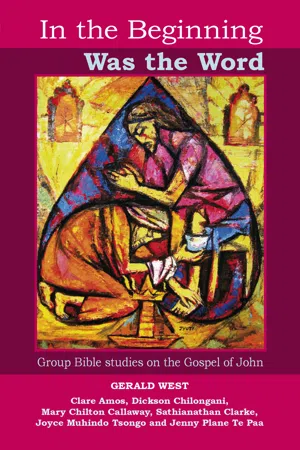
- English
- ePUB (mobile friendly)
- Available on iOS & Android
eBook - ePub
About this book
These bible studies from the Gospel of John have been designed so that everyone can participate. Fundamental to the process is that the members of each group feel free to share their interpretations, their experiences and their contexts with others. Within the richness of the Gospel these studies follow the 'I am' sayings of Jesus, and John's theological use of them, and the 'Signs' in the Gospel of John.
Information
Topic
Theology & ReligionSubtopic
Biblical StudiesI AM

John 1.1–18
The one who is in the bosom of the Father
The facilitator invites two people to read the passage antiphonally:
Reader A: verses 1–5, 10–11, 14
Reader B: verses 6–9, 12–13, 15–18
The facilitator invites the group to read the following note silently:
The first Christians were inspired to begin the story of Jesus in different ways. The canon of Holy Scripture honours the unique theological voice of each writer by keeping their books distinct, and attending to the detail of each deepens our understanding of the whole. St Paul begins his letter to the Romans by proclaiming the Son ‘who was descended from David according to the flesh and was declared to be Son of God with power according to the spirit of holiness by resurrection from the dead, Jesus Christ our Lord’ (Romans 1.3–4). Mark begins with the Holy Spirit descending on Jesus when John baptized him (Mark 1.9–11). Matthew and Luke begin with accounts of Jesus’ birth, highlighting Mary’s being with child from the Holy Spirit. However, even all these variations on how to begin the Gospel story didn’t prepare the early Christians for the radical proclamation of John’s Gospel. As biblical scholar Gail O’Day describes it:
All three of the other Gospels shape their beginnings around moments in human history. A beginning point in human time and history is too constraining for the way that John wants to tell the Jesus story, however. For John, the story of Jesus cannot be contained inside the normal human calculations of time or even space. John’s opening words move readers outside of their own time frame and the created universe. They place readers instead in the presence of God that transcends both time and space. ‘In the beginning was the Word, and the Word was with God, and the Word was God.’
The famous opening verse sets the pattern for the entire Prologue, which lyrically echoes themes from the Old Testament (John’s Scriptures) that will be wonderfully transformed in John’s Gospel. For example, the central image of the Prologue, Jesus as the Word, drew on scriptural traditions that had been richly developed in the centuries before Jesus’ birth. The first readers of John’s Gospel would have recognized the personified Word from Isaiah 55.11 and Wisdom of Solomon 18.14–15 (which is still used today in the Roman Catholic Church on Christmas Eve). The Prologue introduces three scriptural themes in particular that come up again and again in John’s Gospel, and we turn now to these.
The first Old Testament theme that John evokes is creation. In a radical break with the earlier Gospels, John’s Gospel begins with the opening words of Genesis 1.1, ‘In the beginning’. In addition, verses 1–5 draw on the scriptural tradition of Wisdom, who was with God at creation (Proverbs 8.22–31) and is ‘a reflection of eternal light, a spotless mirror of the working of God, and an image of his goodness’ (Wisdom of Solomon 7.26). John presents the mystery of the incarnation in traditional images that are given surprising new meaning. The Word who long ago created the world now enters it in the flesh to bring about a new creation. Verse 5 points back to the creation of light in Genesis 1.3–5 and forward to the story of Jesus in the Gospel. In addition, the repeated reference to days in the first chapter, culminating in Jesus’ first sign (2.1), is seen by many scholars as John’s invitation to read the beginning of Jesus’ ministry as the start of a new creation.
The second Old Testament theme that John develops is presence. To appreciate this theme fully, it is helpful to look at the architecture of the Prologue. In ancient literature, the begin-ning and the end of a narrative often echo each other to form a kind of frame around the piece. So in the Prologue, the opening ‘the Word was with God’ and the ending ‘who is close to the Father’s heart’ form a frame by their word-pictures of Jesus being in God’s presence. Inside this frame, especially in verses 9–17, is the story of what happened when the Word came to be present on earth among us. Verse 14 lyrically weaves together multiple images of God’s presence. One of these images is presented to us in the Greek verb translated as ‘live among’ (skenoun), which means literally to pitch a tent. During their forty years of travelling in the wilderness towards the Promised Land, the Israelites were instructed to make a tent – the Tabernacle – where the LORD could dwell in the midst of his people (Exodus 25.8–9). Even after the Israelites had built the Temple, it was the Tabernacle within it that signalled God’s holy presence. In fact the verb ‘to pitch a tent’ gave rise in early Judaism to the word Shekinah, still used today as a name for God’s presence among his people. John’s use of this highly evocative verb implies that the Word is one with the LORD. The phrase ‘The Word became flesh and lived [literally, in Greek, “pitched hist tent”] among us’ therefore poetically expresses a truth that the Church would be able to agree on and articulate in the creed a couple of hundred years later at the Council of Nicaea. In the Prologue this theme that links Jesus to the loving God who camped with his people Israel in the desert also anticipates the theme of the Father’s presence in Jesus that will unfold throughout John’s Gospel.
John’s third theme explores human responses to God’s presence. Verses 10–11 recall the scriptural tradition of the Israelites repeatedly rejecting the prophets who were calling them back to their true identity as God’s people. At the same time, of course, the words of verse 11 foreshadow the ministry, passion and death of Jesus which continued this tradition of rejection. The Prologue therefore anticipates the question that is implied at the beginning of almost every story within John’s Gospel: How are these people going to respond to Jesus? At the conclusion of John’s Gospel in 20.30–31, the question is implic-itly posed to the reader, ‘How are you going to respond?’
The ‘I am’ sayings that are the subject of these Bible studies are hinted at in verse 18. The Greek words behind the first two words of the phrase ‘who is [ho own] close to the Father’s heart/bosom’ imply much more than they say. Meaning liter-ally ‘the one who is’ or ‘the Being’, these are two of God’s four words to Moses at the burning bush in Exodus 3.14. Moses asked God, ‘If … they ask me, “What is his name?” what shall I say to them?’ In the Greek translation of Exodus used in the early Church, God answered him with the words ego eimi ho own, ‘I am the one who is’ or perhaps ‘I am the Being One’. So the Prologue that began by giving Jesus a divine title, ‘the Word’, thus closes with an even more arresting divine name, one that foreshadows the blaze of glory that will come with the ‘I am’ (ego eimi) in the Gospel stories. Each ‘I am’ will develop one or more of the themes hinted at in the Prologue. Each echoes the Old Testament in a different way, while at the same time revealing another dimension of who Jesus is. Together these sayings bear witness to the mystery of Christ as a new revelation of God and yet with God since the beginning. And each presents us again with the question of how we respond to who Jesus is and whom he is calling us to become.
- Question What early memories do you have of hearing John’s Prologue read aloud? What have these words meant for you in the course of your ministry?
After each member of the group has shared, the facilitator closes with a prayer.
The facilitator encourages group members to identify at least one new insight from the Bible study, and to record it.
John 1.19–34
He confessed … ‘I not am the Messiah’
The facilitator asks someone to open with a brief prayer.
The facilitator asks someone in the group to read John 1.19–34.
The facilitator reads or invites the group to read the following note:
It is the priests and Levites from Jerusalem, sent by the Ioudaioi, who confront and question John (‘a man sent from God’, verse 6) and then prompt his testimony in verse 19. In most cases in John’s Gospel the term Ioudaioi (a Greek word) refers to the Jewish authorities, a small religious, economic and political elite. It only occasionally refers to Jewish people more generally.
From a historical perspective, the term Ioudaioi in John’s Gospel refers both to the time of Jesus and to the time when the Gospel itself was written. So Ioudaioi refers to two different yet related groups: the Jewish leadership in the time of Jesus, but also the leadership of Pharisaic Judaism in the later historical period when John’s Gospel was written down. This period, after the destruction of the Jerusalem Temple in AD 70, was a time when there was growing tension between Christian Jews and Pharisaic rabbinic Judaism. Both historical sets of Ioudaioi are vigilant and watchful so as to preserve the religious and socio-economic status quo. John’s testimony is directed to both.
John has been introduced in 1.6 quite suddenly, and with no qualifying term, unlike the Synoptic Gospels. In Mark he is introduced as ‘the baptizing one’ (1.4), and in Matthew ‘the Baptizer’ (3.1). But in John’s Gospel he is simply ‘John’. His status is that of a witness. In 1.20 he speaks. His opening declaration is emphatic: ‘I not am the Christ’. This strange grammatical form prepares the way for the many times in John’s Gospel in which Jesus will say, ‘I am’.
Placing the word ‘not’ between the ‘I’ and the verb ‘am’ is in marked contrast to the ‘I am’ formula Jesus will use on many occasions, and which this series of Bible studies explores. John avoids placing the ‘I’ alongside the ‘am’, making it clear that when he quotes from Isaiah 40.3 in verse 23 he is in no way claiming to be the Messiah.
Both Jesus’ own contemporaries and the first readers of John’s Gospel would have been familiar with the ‘I am’ for-mula of God’s self-disclosure in the Septuagint translation of Exodus 3.14, as well as its extensive use in Isaiah. In denying that he is ‘I am’, John asserts that he is no rival to Jesus; indeed, he is the one who will bear witness to ‘one whom you do not know’ (verse 26).
John also rejects every other version of messianic identity; he is not Elijah and he is not the prophet (verse 21). No, no, no, he is not any form of messiah. He is a voice. What John says is an adaptation of Isaiah 40.3. The primary task of the voice is to call everyone, and specifically those who are in leadership, to ma...
Table of contents
- Cover
- Author information
- Title page
- Imprint
- Table of contents
- The Bible study team
- Introduction
- I AM
- SIGNS
- Notes
Trusted by 375,005 students
Access to over 1.5 million titles for a fair monthly price.
Study more efficiently using our study tools.
Frequently asked questions
Yes, you can cancel anytime from the Subscription tab in your account settings on the Perlego website. Your subscription will stay active until the end of your current billing period. Learn how to cancel your subscription
No, books cannot be downloaded as external files, such as PDFs, for use outside of Perlego. However, you can download books within the Perlego app for offline reading on mobile or tablet. Learn how to download books offline
Perlego offers two plans: Essential and Complete
- Essential is ideal for learners and professionals who enjoy exploring a wide range of subjects. Access the Essential Library with 800,000+ trusted titles and best-sellers across business, personal growth, and the humanities. Includes unlimited reading time and Standard Read Aloud voice.
- Complete: Perfect for advanced learners and researchers needing full, unrestricted access. Unlock 1.5M+ books across hundreds of subjects, including academic and specialized titles. The Complete Plan also includes advanced features like Premium Read Aloud and Research Assistant.
We are an online textbook subscription service, where you can get access to an entire online library for less than the price of a single book per month. With over 1.5 million books across 990+ topics, we’ve got you covered! Learn about our mission
Look out for the read-aloud symbol on your next book to see if you can listen to it. The read-aloud tool reads text aloud for you, highlighting the text as it is being read. You can pause it, speed it up and slow it down. Learn more about Read Aloud
Yes! You can use the Perlego app on both iOS and Android devices to read anytime, anywhere — even offline. Perfect for commutes or when you’re on the go.
Please note we cannot support devices running on iOS 13 and Android 7 or earlier. Learn more about using the app
Please note we cannot support devices running on iOS 13 and Android 7 or earlier. Learn more about using the app
Yes, you can access In the Beginning Was the Word by Gerald West in PDF and/or ePUB format, as well as other popular books in Theology & Religion & Biblical Studies. We have over 1.5 million books available in our catalogue for you to explore.