- English
- ePUB (mobile friendly)
- Available on iOS & Android
eBook - ePub
About this book
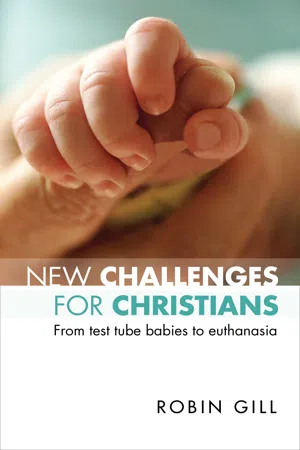
Theologians are involved in a wide variety of public committees concerned with ethical issues arising from modern science, and are still holding their own against critics such as Richard Dawkins. It is important that a wide range of people are aware of how to be responsibly involved in these discussions, and to avoid the knee-jerk reactions of fundamentalists.
Information
Part 1
Groundings

Churchgoing and moral attitudes
1996
Does churchgoing shape people’s moral attitudes and behaviour? Until recently sociologists, and indeed many theologians, have tended to be sceptical. There is long-standing evidence that churchgoers tend to be more orthodox in their religious beliefs than non-churchgoers – although even here belief is by no means confined to churchgoers or disbelief to non-churchgoers. But it has been more difficult to find convincing evidence that churchgoing has much effect upon moral attitudes, let alone upon moral behaviour.
Is this because the evidence does not exist, or is it rather that scholars have never looked properly for it? At last we have some convincing evidence that it is the latter. For the first time the annual British Social Attitudes (BSA) survey presents strong evidence for the significance of churchgoing in three separate moral areas.
Many newspapers reported the general findings from the latest report of BSA.1 They particularly noticed perceptions of greater inequality as well as a surprising resilience in family relationships despite growing divorce. What they largely failed to notice is that in this family area, as well as in attitudes towards euthanasia and towards sex and swearing in films and on television, churchgoers differ significantly from non-churchgoers. In fact, in each area there is a clear process – measured by the statistical process of regression analysis – showing that the more frequently individuals go to church, the more likely they are to hold ‘traditional’ moral values.
Each year BSA – described by The Times as the Rolls-Royce of surveys – have asked people about their religious affiliation and about whether and how often they go to a place of worship, alongside a host of other questions on politics, health, culture, leisure and moral attitudes. Yet they have seldom analysed religion as a moral variable. They have usually assumed that it is factors such as gender, age and social class which are the important variables, even on moral issues. The 1984 and 1987 surveys were exceptions. Analysing data on personal honesty, they noted that churchgoers did appear to be different from others. For instance, they found that whereas only 9 per cent of weekly churchgoers thought it was not really wrong for a householder to overclaim on insurance for flood damage to make £500, this rose to 12 per cent for monthly attenders, to 18 per cent for infrequent attenders, to 22 per cent for non-attenders and to 24 per cent for those claiming no religion. Another ten honesty questions between the two surveys found a comparable trend. Some of these questions asked for a general moral judgment and others for a specific judgment about what those being asked might do in such a situation. Overall, churchgoers appeared significantly more honest than non-churchgoers.
Nevertheless, these earlier reports maintained that it was only in matters of personal morality that churchgoers were distinct. On social issues differences between churchgoers and others could be accounted for by age (with the exception of Roman Catholics on abortion). They assumed that churchgoers, on average more elderly than the general population, simply reflected the social values of an older generation.
I was puzzled by this claim since it was made without much supporting evidence. As I already had indications from other (largely ignored) surveys that churchgoing may shape moral attitudes beyond the purely personal, I decided to investigate the issue more directly. So six months ago I set up a research project examining previous data from the BSA surveys, specifically testing whether or not churchgoing affects morality. The project still continues but it has already shown that the moral distinctiveness of churchgoers has been seriously underestimated by many scholars. In at least ten different moral areas – including attitudes towards work, unjust laws, racism, environmental concern and action, charitable giving, and involvement in voluntary work in the community – churchgoing is a very good predictor of behaviour.2
The new BSA survey appears to confirm this, showing a very rough comparison of trends. All reflect mean scores: a series of responses are combined to give a scale between permissive and traditional attitudes (the report uses the terms ‘libertarian’ and ‘authoritarian’ which, of course, gives a rather different slant). So the family-orientation scale combines responses to such statements as ‘People should keep in touch with close family members even if they don’t have much in common’ and the contrasting ‘On the whole, my friends are more important to me than members of my family.’ The euthanasia scale is particularly sophisticated, combining pro- or anti-euthanasia responses on eight very different cases – ranging from a permanent vegetative state (PVS) patient to someone without a terminal illness who was simply tired of life.
Two observations about this evidence. First, there is a great deal of overlap between churchgoers and non-churchgoers. These are not isolated groups. For example, in analysing a 1994 question about whether people thought that the right to show nudity and sex in films and magazines had gone too far, I found that 88 per cent of churchgoers thought that it had. Nonetheless, 63 per cent of non-churchgoers and 50 per cent of those claiming no religion also had the same view. And there was one middle-aged weekly churchgoer who thought that it had not gone far enough (there always is one!).
Second, on average churchgoers are distinct from non-churchgoers and they are distinct across age groups. Again on the question about nudity, at least 85 per cent of weekly attenders in all age groups thought that it had gone too far. There were very significant generational differences in the no-religion group: in the oldest group 90 per cent objected to media nudity, whereas in the youngest group it was only 38 per cent. Nonetheless, age was not the only factor involved – churchgoing was also clearly significant.
But is it really churchgoing which shapes morality? It might simply be that people with traditional moral attitudes are more likely to go to church. There may be some truth in this, yet there are also indications that it is not the whole of the truth. For example, the fact that the youngest generation of churchgoers shows distinct moral views counts against it. Presumably this is a group which has largely been socialized to be churchgoers, differing from, say, parents who decide to start going to church in order to encourage their children to have a sense of morality. Again, the evidence from surveys such as John Finney’s 1992 Finding Faith Today, as well as Mass Observation research reported in the January 1949 British Weekly, suggests that most people go back to church as a result of having Christian friends, partners or spouses. Conversely, they stop going to church because they move house, lose interest or change lifestyle, rather than because they change their religious or moral beliefs. Beliefs may be retained by lapsed churchgoers for many years (what Grace Davie terms ‘believing without belonging’3), although they may not be passed on so readily to their children.
Only in-depth qualitative research (which I hope to do later) can finally unravel the complex relationship between churchgoing and moral attitudes and behaviour. Yet the British Social Attitudes data is already proving more interesting than many might have supposed. Perhaps it really is the contents of worship – singing hymns of faith, listening to the Bible, engaging in intercessory prayer and even hearing regular sermons – that may after all shape our moral visions.
Is Christian ethics distinctive?
1999
Bishop Richard Holloway’s views on sex and drugs are characteristically robust. Over the last week they have provoked considerable controversy. However, at the heart of his new book Godless Morality1 is a serious and important issue which still concerns and divides scholars in Christian ethics. Is it possible to express what is distinctive about Christian ethics without denying the validity of other forms of ethics? Does Christian ethics inevitably clash with secular ethics and perhaps also with ethics drawn from other religious traditions? Or can Christian ethicists successfully work alongside other ethicists, both with those from other religious traditions and with those disavowing any religious tradition at all?
Richard Holloway puts his own stance pithily in his subtitle, Keeping Religion out of Ethics. Baroness Warnock, who carefully separates her own influential writings on ethics from her more private Christian faith, commends the book warmly on its cover. In contrast, his colleague Dr Kevin Scott argues this week in The Scotsman that
at bottom, Richard Holloway seems to believe that the Church has nothing to offer and if it does offer something, it does so with an ulterior motive of seeking to bring people under its power . . . But in his dismissal of Christian moral authority, in the deconstruction of the ministry of his own parish priests, he deconstructs his own episcopacy.2
Can Richard Holloway’s position really be sustained in Christian ethics? The radical Dominican scholar Herbert McCabe has argued for something very like it on the basis of his understanding of natural law. For example, it could be argued that moral reasoning is common to all people regardless of their religious faith. The latter is to do with salvation, not morality. However, such a neat division is quite difficult to sustain in practice and classical theologians such as Thomas Aquinas saw clear continuities between natural law and revelation. The primary Christian virtues of faith, hope and love do seem to have both moral and religious implications.
A contrasting position, which has become popular in much Christian ethics today, holds that it is only within communities of faith that we can acquire moral virtues at all. The US Christian ethicist Stanley Hauerwas has been immensely influential over the last two decades.3 Hauerwas argues that Christian ethics should be primarily concerned with Christian character within worshipping communities. As the world at large becomes increasingly estranged from these communities, so Christians rapidly become ‘resident aliens’. As a result, we must renounce the Enlightenment and challenge secular society with our Christian faith and with the values derived directly from it. Conversion, not co-operation, is now required.
A third position argues that if Christians can work with others without denying our own faith then we should always attempt to do so. This position has been especially important among those of us working in medical ethics. In all Western countries today Christian doctors and nurses work alongside those with other religious faiths and with none, and patients, in turn, will probably not know whether those treating them share their own faith or not. Of course, there may be areas where there is a considerable conflict – as traditionalist Roman Catholics have found on reproductive issues and Jehovah’s Witnesses have found on blood transfusions. Yet it is overwhelmingly in the interests of most of us, Christians and non-Christians alike, that current medical practice should not conflict with our own values.
Unlike the Holloway approach, this last position argues that Christian ethics differs most from secular ethics at the level of underlying justification. Christians do have distinctive resources – the Bible, Christian tradition and experience in Christian worship – which provide underlying justification for our ethics and moral behaviour. Yet Christians do not necessarily agree with each other on specific moral issues (such as abortion). And unlike the Hauerwas approach, this third position holds that Christian communities overlap at many points with secular communities, from which we can learn as well as seeking to influence them. Faithful co-operation, rather than separation or confrontation, is the hallmark of this final position.
Changing attitudes
1999
The 1998 survey findings of BSA have now been published and, among many other issues, show important changes in attitudes to religion and morality over the last 15 years. BSA is widely used by government and university departments, but seldom by churches. This is a pity because it offers some important clues about trends, free from the sort of spin that now characterizes statistics produced by churches themselves.
Two of the most dramatic changes arise from the question, ‘Do you regard yourself as belonging to any particular religion?’ In 1983, 31 per cent said they had no religion and 40 per cent said that they were Anglican. In 1998 it is now 45 per cent who claim no religion and only 27 per cent who claim to be Anglican. These two striking trends have been plotted by all of the BSA surveys over the last 15 years and do seem to be firmly established. People in Britain today, especially the young, are less inclined than before to claim nominal church membership, opting instead for no religion.
As expected, overall levels of claimed churchgoing across denominations have declined during this same period, but this decline is not nearly as striking as the two other trends. In 1983, 21 per cent of those interviewed claimed to go to church at least once a month, but by 1998 this had dropped to 19 per cent. The drop has been particularly among those claiming to go every week, without a corresponding increase in monthly churchgoers. Despite claims to the contrary, it does seem that somewhat fewer people go to church, not that the same number of people go to church but less often.
A slight health warning is needed here: a gap between stated and actual behaviour has long been noted by sociologists. On the basis of BSA 1998, average Sunday attendance in all denominations added together should have been 15 per cent, whereas Peter Brierley’s 1998 church census suggested a figure exactly half that.1 Frankly, many of us may overestimate our churchgoing, just as we underestimate our eating and drinking! Yet, whichever method of calculating church attendances is used, both ...
Table of contents
- Cover
- About author
- Title page
- Copyright
- Table of Contents
- Preface
- Part 1 Groundings
- Part 2 Genetics and Stem Cells
- Part 3 Abortion and Fertility Treatment
- Part 4 Doctors and Patients
- Part 5 Sexuality and Families
- Part 6 Assisted Dying
- Notes
- Search Items
Trusted by 375,005 students
Access to over 1.5 million titles for a fair monthly price.
Study more efficiently using our study tools.
Frequently asked questions
Yes, you can cancel anytime from the Subscription tab in your account settings on the Perlego website. Your subscription will stay active until the end of your current billing period. Learn how to cancel your subscription
No, books cannot be downloaded as external files, such as PDFs, for use outside of Perlego. However, you can download books within the Perlego app for offline reading on mobile or tablet. Learn how to download books offline
Perlego offers two plans: Essential and Complete
- Essential is ideal for learners and professionals who enjoy exploring a wide range of subjects. Access the Essential Library with 800,000+ trusted titles and best-sellers across business, personal growth, and the humanities. Includes unlimited reading time and Standard Read Aloud voice.
- Complete: Perfect for advanced learners and researchers needing full, unrestricted access. Unlock 1.5M+ books across hundreds of subjects, including academic and specialized titles. The Complete Plan also includes advanced features like Premium Read Aloud and Research Assistant.
We are an online textbook subscription service, where you can get access to an entire online library for less than the price of a single book per month. With over 1.5 million books across 990+ topics, we’ve got you covered! Learn about our mission
Look out for the read-aloud symbol on your next book to see if you can listen to it. The read-aloud tool reads text aloud for you, highlighting the text as it is being read. You can pause it, speed it up and slow it down. Learn more about Read Aloud
Yes! You can use the Perlego app on both iOS and Android devices to read anytime, anywhere — even offline. Perfect for commutes or when you’re on the go.
Please note we cannot support devices running on iOS 13 and Android 7 or earlier. Learn more about using the app
Please note we cannot support devices running on iOS 13 and Android 7 or earlier. Learn more about using the app
Yes, you can access New Challenges for Christians by Robin Gill in PDF and/or ePUB format, as well as other popular books in Theology & Religion & Christian Theology. We have over 1.5 million books available in our catalogue for you to explore.