- English
- ePUB (mobile friendly)
- Available on iOS & Android
eBook - ePub
About this book
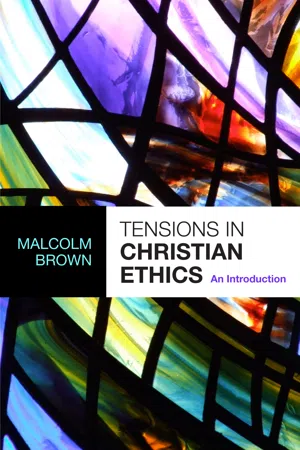
The book draws on the author's teaching of ethics at undergraduate and postgraduate level for the Cambridge Theological Federation since 2000. Its purpose is to introduce the reader to questions in Christian ethics through a careful examination of the fundamental meta-ethical questions posed by the 'state we're in', whether understood as a new phase of modernity or as postmodernity. Brown draws on sources and authors from a variety of Christian traditions, and from Britain, the U.S.A. and Europe. The book will be of use, not only to university departments and denominational and ecumenical teaching institutions but also as a more general exposition of the current state of ethical thinking in the Christian churches.
Information
Part 1
1
Introducing ethics: and Christian ethics
This is a book about ethics and, specifically, about Christian ethics. Even non-ethicists will probably agree with me that the study of ethics is one of the fastest-moving and most controversial fields of study within the wider theological curriculum today. This is, to some extent, a recent phenomenon. In the days when a theology degree from one of the ancient universities was regarded as sufficient preparation for ordination in the Church of England, the key subjects were the Bible, biblical languages, church history and doctrine, and when, in the late nineteenth century, the possession of a degree was felt to be insufficient by itself, it was left to the new theological colleges to cover topics like ethics and pastoralia, the two often being lumped together as adjuncts of one another. The University of Cambridge never did establish a major Chair in Christian ethics nor develop the subject in its undergraduate awards. Even into the 1980s, the study of ethics as a topic for ordination in the Church of England and the Free Churches was often almost indistinguishable from the study of the Church’s pastoral ministry.
So what has changed to place ethics at the cutting edge of theological study today? While it is too simple to identify a specific date as the moment when a whole mindset changed, the year of 1979 is of considerable significance. In that year two global phenomena, often thought at the time to be mere aberrations, can now be seen as harbingers of major changes to the way we understand the world and human relationships. In Iran, militant Islam, represented by the Ayatollah Khomeini, came to power and entered the public consciousness of the West for the first time. In Britain, Margaret Thatcher’s first election victory not only opened the door to an era of market economics and the marketization of increasing tranches of social relationships but also emphasized, often starkly, that the post-war social consensus was over. Soon afterwards, Ronald Reagan’s election as US President confirmed the dominance of similar economic and social policies on both sides of the Atlantic. Today, despite the recession which began in 2007–8, the policies represented by Thatcher and Reagan remain dominant, driving forward the great trends of economic and social globalization. Militant Islam touches everyone’s life – and not only through the increasingly onerous security measures following the attacks of 9/11. Especially in Western Europe, where the processes of secularization were well advanced, militant Islam has prompted something of a reaction against all religion and has given a new impetus to ideas of secularization, often at ‘gut’ level rather than as a systematic programme. Increasingly, public discourse characterizes every faith as irrational, anti-scientific and anti-democratic. A caricature of faith as mere superstition has become common currency in the liberal media. Indeed, many within Christianity, as within Islam and Judaism, seem happy to play up to that image in an increasingly aggressive confrontation with Western culture and Enlightenment notions of rationality. Religion is news again in a way that most theories of secularization have not been well-equipped to explain.
In wider social relationships, the market, with its claim to sit above mere morality, has become the principal mechanism for managing all kinds of human interactions. Even if the post-war consensus embraced a considerable diversity of interests and rival identities, its disappearance has deeply affected how people relate to each other. Nor is this just a British or European phenomenon. The coincidence of 1979 as the date which saw the rise of Khomeini in Iran and Thatcher in Britain is a convenient hook on which to hang an argument, but the changes which those two events symbolize are global in character. On the one hand, the word ‘we’ has been reclaimed for communal, tribal or ideological groupings. ‘Is he one of us?’ was a totemic question for the Thatcherites and, more generally, politics has become increasingly tribal in character so that ‘we’ are defined in quite distinctive groupings. In the twenty-first century, the politics of conflicting identities is, perhaps, even more acute in America as the differences between Democrat and Republican, and between factions within those parties, have become angrier and consensus less conceivable. Even as global markets bring greater uniformity of consumption patterns and media imagery, it has become increasingly difficult to give a coherent account of who ‘we’ are, what ‘we’ believe and how ‘we’ should live our lives – for the distinctive communities, within which ideas about what is good or right are taken for granted, are challenged through intimate media exposure to ‘otherness’ in all its forms.
Nowhere are these contradictions more evident than in the politics – and, behind the politics, in the moral discourses – of the United States of America. I wrote the first draft of this opening chapter against the background of the Obama–McCain presidential election of 2008. Not only were competing visions of America and ‘American-ness’ on offer, but the role of religion was palpable, epitomized in the Republican vice-presidential nominee Sarah Palin. Palin represented – or at least was adopted by – the Christian right which champions creationism, challenges the constitutional separation of Church and state and is furiously opposed to homosexual rights and abortion. This phalanx of American opinion celebrates tight-knit, religiously cohesive and supportive communities which still, to some extent, rest upon frontier narratives of independence and suspicion of the outsider. Obama, in contrast, ran on a platform of somewhat intellectual internationalism, recognizing America’s pivotal global role and characterizing in his own person the melting-pot of groups which together make up the USA. In a highly charged election, anti-Obama propaganda portrayed him as a Muslim – an accusation which reflects the tensions between religions that characterize the post-9/11 world and simultaneously suggests that America’s religious plurality has significant limits. These various tensions have become so acute that, by the beginning of the twenty-first century, the talk was of ‘culture wars’. Yet the paradox is that both groupings champion the theories of the market which, in their pure form, regard the particularities of community, culture, religion (or even, at times, nation) as irrelevant.
Where, in the middle of such heated clashes of culture, can one find the foundations for exploring what it means to live well? This is not only a question for Americans, even though the tensions within that nation epitomize the problem acutely. To be sure, American ideas and influences pervade much of the world through dominance of the global market model and media. But America’s culture wars can be seen as a striking and sharply delineated version of a question which arises in almost every national context. The question is, are fundamental values essentially universal or essentially local in character? In other words, are community, religion and nation the places where we learn and practise what it is to be good, to do right and to live justly, or are these notions best discovered in looking beyond the particular so that, in a highly connected world, there can be an intelligible discussion of what these things mean between people formed in very different traditions. Most pressingly, in a world where violence can escalate into annihilation, how are we to live alongside people whose conception of what is good differs radically from our own?
Talk of what is good involves the consideration of ethics. Words which denote value or which express obligations are the basic building-blocks of ethical thought. Words like ‘good’, ‘right’, ‘just’, ‘fair’, ‘ought’ and ‘must’ only have significant meaning within a framework of ethical understanding. When such words become problematic (as they have undoubtedly become today) the ethicist is called in to repair the holes which open up in human relationships, structures and even in patterns of thought. Without some account of who is meant when people say ‘we’, these value-words become doubly problematical. Are ‘we’ the totality of the human inhabitants of the world? Or are ‘we’ the people who think like me?
Ethics, then, has become interesting again as a response to bewilderment about the state we are all in. The ethicist must first try to give an account of how we got here and then attempt to offer some pointers to how things could be understood better and, perhaps, even become better – working, therefore, with one eye turned towards ideals and the other towards the pragmatics of politics and the complexity of human affairs. While all ethicists are attempting to negotiate a balance between ideals and pragmatics, the debate between those who stress the one and those governed more by the other is intense. For what use are ideals if they are incapable of implementation in any recognizable form? And yet too much reliance on what is practically possible can lead to the catastrophic loss of any guiding moral compass beyond mere expediency. Once ethics is seen to address crucial questions which touch on people’s lives and security, and not as a disconnected exercise in disinterested speculation, the stakes are raised and the debates become proportionately more intense and creative. I make no apology for claiming ethics as one of the most exciting disciplines in the academy today.
. . . and Christian ethics?
The role of Christian faith in forging a sense of shared identity and in governing aspects of public life has changed and left us in largely uncharted territory. Whereas, relatively recently, it might have been possible for a British citizen to assume that he or she was Christian by virtue of being British (an assumption that lives on in some aspects of the debate about multi-culturalism) and that therefore the way the British understood concepts such as ‘good’, ‘just’ and so on, was Christian by default, that linkage no longer holds. Neither the coherent sense of a single national identity, nor the explicit grounding of that identity within a Christian framework, is tenable any longer. In their debased form, assumptions about ‘Christian Britain’ generated the feeling (belief is perhaps too strong a word) that Christian ethics was little more than a kind of sanctified common sense, and the surprising and often deeply challenging aspects of the Bible and the Christian tradition were subsumed in a generalized and consensual moralism.
In the United States, something different but no less disorienting seems to be happening. Vociferous efforts are being made within some sections of the Christian Churches to establish symbolic (and, in some cases, substantive) linkages between overtly Christian principles and national policies. Thus far, gestures such as the erection of a monument depicting the Ten Commandments in a state courthouse have failed, but it is clear that the constitutional separation of Church and state is not universally accepted as a basic building-block of American polity. The presidency of George W. Bush gave considerable succour to the more right-wing Christian lobbies, although it is unclear whether this represented a real influence on policy or (as the sociologist of religion Steve Bruce suggests) a new intensity to the old practice of courting the religious right’s votes while, in practice, framing policy entirely pragmatically.1 But, as in Europe, the point is that the settlement between the Christian faith and the workings of the state are in flux. The equation of Christian identity with national identity is problematic and few can ignore the shifting ground. Some new account of what it means to be Christian, and how Christian accounts of good living are to be worked out, is pressingly necessary.
Christian ethics among the other theological disciplines
The situation described above has been the occasion of some realignment between Christian ethics and other subjects in the theological curriculum. This is not just a matter of how teachers of theology arrange their timetables but affects the wider question of what, and whom, Christian ethics is for.
One of the themes of this book is the question of public theology – whether theology has a contribution to make to public life, citizenship and the ordering of social structures, rather than being mainly about the practices of Christians. Not only do many social questions turn on an interpretation of what is good, just, right and so on, but it is precisely the interpretation of those concepts in the context of the Christian life which determines whether, and how, Christians may be called to have an influence in the public sphere.
Immediately, therefore, Christian ethics is seen to have a profound relationship to Christian doctrine – what we believe about the relationship between God, Christ and the material world shapes how we believe Christians should work within concrete relationships in practice. Christology and soteriology – the person of Christ and the meaning of salvation – are of ultimate importance in determining the Christian’s relationship to the world, to the persistence of sin and to the meaning of the ‘value’ words which lie at the heart of ethical thought. It is, in many ways, the reconnection of ethics to systematic theology which has made the subject so lively and simultaneously so disputatious within the Churches.
That is not where ethics has always been located. Ethics has a distinctly practical side in that it addresses questions which arise from experience and in the application of Christian ideas in people’s lives. Christian ethics has been helped towards a stronger consciousness of its own integrity by the rise in the last fifteen to twenty years of practical theology as a distinctive subject, thus helping to untangle the two disciplines.
Linking ethics too closely to pastoral issues has sometimes had a distinctly debasing effect on the subject. If I try to characterize the study of Christian ethics in, say, the mid-1970s in Britain, the following vignette seems to sum it up:
There ...
Table of contents
- Cover page
- About the Author
- Title-page
- Imprint
- Dedication
- Table of contents
- Preface
- Acknowledgements
- Part 1
- Part 2
- Bibliography
- Search items
Trusted by 375,005 students
Access to over 1.5 million titles for a fair monthly price.
Study more efficiently using our study tools.
Frequently asked questions
Yes, you can cancel anytime from the Subscription tab in your account settings on the Perlego website. Your subscription will stay active until the end of your current billing period. Learn how to cancel your subscription
No, books cannot be downloaded as external files, such as PDFs, for use outside of Perlego. However, you can download books within the Perlego app for offline reading on mobile or tablet. Learn how to download books offline
Perlego offers two plans: Essential and Complete
- Essential is ideal for learners and professionals who enjoy exploring a wide range of subjects. Access the Essential Library with 800,000+ trusted titles and best-sellers across business, personal growth, and the humanities. Includes unlimited reading time and Standard Read Aloud voice.
- Complete: Perfect for advanced learners and researchers needing full, unrestricted access. Unlock 1.5M+ books across hundreds of subjects, including academic and specialized titles. The Complete Plan also includes advanced features like Premium Read Aloud and Research Assistant.
We are an online textbook subscription service, where you can get access to an entire online library for less than the price of a single book per month. With over 1.5 million books across 990+ topics, we’ve got you covered! Learn about our mission
Look out for the read-aloud symbol on your next book to see if you can listen to it. The read-aloud tool reads text aloud for you, highlighting the text as it is being read. You can pause it, speed it up and slow it down. Learn more about Read Aloud
Yes! You can use the Perlego app on both iOS and Android devices to read anytime, anywhere — even offline. Perfect for commutes or when you’re on the go.
Please note we cannot support devices running on iOS 13 and Android 7 or earlier. Learn more about using the app
Please note we cannot support devices running on iOS 13 and Android 7 or earlier. Learn more about using the app
Yes, you can access Tensions in Christian Ethics by Malcolm Brown in PDF and/or ePUB format, as well as other popular books in Theology & Religion & Christian Theology. We have over 1.5 million books available in our catalogue for you to explore.