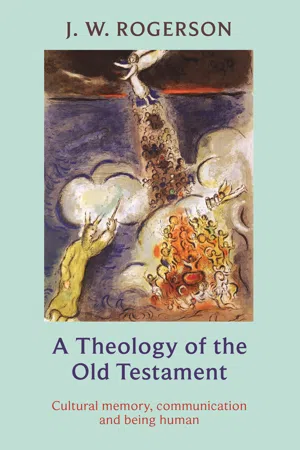
eBook - ePub
Theology of the Old Testament
Cultural Memory, Communication And Being Human
- English
- ePUB (mobile friendly)
- Available on iOS & Android
eBook - ePub
About this book
How should Christians approach the Old Testament? Should we use it to reconstruct what people believed several millennia ago? Or should we ask what the Old Testament says to us today and consider how it addresses today's world? J. W. Rogerson firmly believes that we should take the latter approach. Rogerson, an internationally respected scholar, has dedicated much of his academic life to probing the possibility of the abiding significance of the Old Testament. He shows how texts written for a strange and distant world with different social, religious and cultural factors can still speak to moral issues today.
Information
1
History and cultural memory
The history of the study of the Bible can de described in many ways. One possible description is that it is the story of the gradual discovery that the Bible does not contain infallible information upon every subject that concerns everyday human life. It was noted in the Introduction that voyages of discovery from the sixteenth century made it clear that Genesis 10 and the ‘table of the nations’ that it contains was not an exhaustive geograph-ical description of the world. In the latter part of the seventeenth century the Reformed divine Richard Baxter warned against too broad a view of biblical infallibility and criticized those who ‘feign it be instead of [i.e. hold it to contain infallible information about] all grammars, logic, philosophy, and all other arts and science, and to be a lawyer, physician, mariner, architect, husbandman, and tradesman, to do his work by’.1
Whether intentionally or not, Baxter did not mention history, and it is a fact that biblical interpreters have found this subject the most difficult to come to terms with in the light of modern knowledge. In the early part of the eighteenth century Humphrey Prideaux published a work which coordinated the history contained in the Bible with that known from classical sources about the history of the ancient world. Prideaux handled his non-biblical sources with critical skill and acumen, but where the biblical and non-biblical sources did not agree, preference was given to the former. ‘The sacred writ, as being dictated by the holy spirit of God, must ever be of infallible truth.’2 At the end of the eighteenth century Neologist scholars in Germany such as Johann Gottfried Eichhorn and Johann Philipp Gabler still regarded the opening chapters of Genesis as historical accounts of the beginnings of the human race. Their criticism was a scientific criticism, which stripped the stories of their supernatural elements on the grounds that the first humans, and those who recorded their experiences, had no knowledge of scientific causes, and therefore attributed to divine agencies what modern science can explain naturally. With this proviso, Eichhorn and Gabler accepted the historical reliability of the opening chapters of Genesis, and of the other historical narratives of the Old Testament.3
The first scholar to mount a serious challenge to accepting the general accuracy of the historical narratives in the Old Testament was de Wette, in his Beiträge of 1806–7. He had very unusual reasons for wanting to do this. He had embraced a theory of myth from contemporary literary and Classical Greek and Roman studies, which regarded myths not as fabrications, but as attempts to express in poetic and narrative forms the intui-tions of human beings about the nature of reality.4 They were therefore of fundamental importance for philosophy and religion. The correct way to interpret them was not to strip off their supernatural trappings in order to arrive at a kernel of historical fact. The correct way was to use an aesthetic criticism that sought to uncover the intuitions (Ahnungen) of eternal reality to which they gave expression. Thus, for de Wette, the historical traditions of the Old Testament gave primarily an insight into the beliefs held at the time of writing by those who wrote them. It was not possible to get from them information about the historical Abraham, for example, but only about how Abraham had been seen by later generations as a man of model piety. The texts also had a reference beyond their time of composition in that they expressed timeless intuitions about the nature of humanity in relation to eternity and the contradictions of the present world.5
There was another reason why de Wette took the position that he did, and that was because he accepted the fragmentary view of the composition of the Pentateuch and other narratives.6 The documentary view, that the Pentateuch had been put together from originally complete sources, allowed its advocates such as Eichhorn to argue that Moses was its author and that he had written, or had combined, ancient sources. This then enabled claims to be made for the historical reliability of the material.7 The fragmentary view was that the biblical narratives had been put together from various types of source and that their narrative coherence was the work of their compilers rather than an accurate representation of actual sequences of events. De Wette thought that he was serving the interests of theology and religion by declaring many narratives to be ‘mythical’. To most of his contemporaries and to subsequent generations, he appeared to be the advocate of an excessive and unnecessary historical scepticism.
The publication in 1878 and 1883 of Julius Wellhausen’s History of Israel and Prolegomena to the History of Israel (the latter work being a second edition of the former) set the agenda for the remainder of the nineteenth century and for the twentieth century.8 The issue was not whether the Old Testament contained accurate historical material, but how this material was to be used in a critical reconstruction of ancient Israel’s history. Wellhausen’s opponents believed that he had strayed too far from the overall picture of Israel’s history, as it was presented in the Bible. One view was that he had taken insufficient account of the findings of the newly emerging discipline of Assyriology. In the first part of the twentieth century it was Palestinian archaeology that was held to have undermined Wellhausen’s position fatally. There were also theological factors at work.
George Ernest Wright’s monograph God who Acts: Biblical Theology as Recital, published in 1952, was based upon the conviction that ‘history is the chief medium of revelation’.9 The Bible was not so much the Word of God as the record of the Acts of God.10 Wright was fully aware of the fact that historical events have to be interpreted if they are to have meaning, but in negotiating the matter of objectivity and subjectivity in understanding history, he came down firmly on the side of objectivity as guaranteeing the certainty and truth of divine revelation. History, and historical traditions were the primary sphere in which God revealed himself. Wright continued:
To be sure, God also reveals himself and his will in various ways to the inner consciousness of man, as in other religions. Yet the nature and content of this inner revelation is determined by the outward, objective happenings of history in which individuals are called to participate. It is, therefore, the objectivity of God’s historical acts which are the focus of attention, not the subjectivity of inner, emotional, diffuse and mystical experience.11
Wright believed that with the help of archaeology and the study of ancient Near Eastern history, the historicity of biblical ‘events’ such as the Exodus from Egypt could be verified, and that these ‘events’ were the objective basis for the traditions about them that testified to God. The nature of God was disclosed by what he had done, as embodied in the traditions that commemorated these acts.12
Given such an important theological investment in the acts of God which the Bible was believed to witness to, it was no surprise that Wright and his colleagues, such as John Bright, defended a comparatively traditional reconstruction of Old Testament history. The surprising thing is that as this traditional reconstruction came more and more under attack, especially from the 1980s, there should have developed an attachment to the accuracy of Old Testament historical traditions that was hard to explain, unless it concealed strong religious motivations. For example, the clash between so-called minimalists and so-called maximalists in the 1990s about whether there had been a Davidic and Solomonic empire became so heated that it was difficult to remember that the discussion was supposed to be an academic exercise in which the participants would be willing to accept the force of the better argument, if necessary against their own interests. It appears that while scholars were willing to accept that the Old Testament was not an infallible authority on science and geography, or even on the origins of the human race, some were unwilling to extend that remit to its historical traditions, at any rate, those dealing with ancient Israel’s history from the time of Saul and David.
It is now time to move away from this historical prologue to the chapter, and to address its primary aims. In the following sections I shall first outline and defend a narrative view of history, then discuss the importance of the concept of cultural memory, and third, argue that historical works in the Old Testament can be categorized as ‘hot’ or ‘cold’.
A narrative view of history
It can be argued that the past does not exist; that when people talk or write about the past they are referring to memories or records of things said or done that are stored in many different ways, to which access in the present is possible, and which record only a tiny fragment of what has actually been said or done at any particular time in the inhabited world. The fact that what is recorded about past happenings is so limited, partly explains why it is possible for historians to produce different and sometimes divergent accounts of the past. This is also true of recent events such as the assassination by shooting of President John F. Kennedy in November 1963 or the death in a car accident of Diana, Princess of Wales, in Paris in August 1997. It might have been expected that an event such as Kennedy’s assassination, which was filmed, and witnessed by hundreds of people, would present no problems of reconstruction and interpretation, but this has not been the case. The death of Diana, Princess of Wales, has become the centre of conspiracy theories, such as that she was murdered on the orders of British secret intelligence. It is legitimate to raise the question as to how far it is possible to reconstruct happenings in the ancient world, if it is impossible to do so convincingly in the modern world.
Memories and records of things said and done in the past take many forms including, in today’s world, electronic forms. Access to them in a meaningful way is possible only if they are embodied in a narrative. Suppose that a letter written in the nineteenth century is discovered in an attic. It will not make much sense unless it can be ascertained who wrote it, to whom, and in what circumstances. These details, if they can be discovered, will constitute a narrative in which the letter plays a role, and without which it may convey no useful information. That narrative will have been constructed by an investigator, and will have been shaped by the amount of information that it was possible to obtain, as well as by other narratives pertinent to its background. Suppose that the letter was a passionate declaration of love from a prominent statesman to his secretary, and revealed a relationship about which nothing was apparently otherwise known. Further investigation might then discover that the relationship was indeed known about in certain circles, but was kept secret. The scruples and considerations that kept the matter a secret in the nineteenth century would no longer apply in the twenty-first and the letter might then be the basis for an article which provided a new narrative about the persons concerned.
Switching to an entirely different matter, the modern discovery might not be that of a letter in an attic, but of an inscribed shard in the stratum of an ancient Israelite settlement. Again, of itself it would be meaningless unless a narrative could be constructed in which it could be embodied. How the narrative was constructed would depend on a number of variables, including presuppositions about the course of ancient Israelite history. The discovery of an Aramaic inscription at Tel Dan in 1993 produced narratives that varied between seeing it as a confirmation of certain events recorded in the Old Testament, and regarding it as a forgery.13
The view that in order to become available to the present, the past has to be narrated, is not new. It was hinted at by Walter Benjamin in his Über den Begriff der Geschichte and his essay on ‘Eduard Fuchs, der Sammler und der Historiker’.14 It was set out explicitly by writers such as A. C. Danto in his Analytical Philosophy of History and Hans Michael Baumgarten in Kontinuität und Geschichte.15 The claim of the narrative view of history is that while we do not invent the past, our narrative accounts of it are affected and shaped by factors such as our very limited knowledge of what happened in the past, and our situatednesses in nation, gender, class, political and religious commitment or lack of the same, and aims and interests in wanting to construct narratives about the past, in the first place. It becomes necessary to distinguish between at least two senses of the word ‘history’: history as the past, and history as narratives about the past. Danto posits the existence of a recording angel who notes down everything that happens and who therefore has complete knowledge of the past. As human beings we have only narratives about the past, narratives which have been constructed by human beings on the basis of limited knowledge, and shaped by various presuppositions. Even the distinction between a chronicler and a historian is not without problems. It might be argued that a chronicler lists events while a historian incorporates them into a narrative; but even the chronicler has to be selective in what is recorded, and by noting that a certain battle was fought on a certain dat...
Table of contents
- Cover
- Author Information
- Title page
- Dedication
- Imprint
- Table of Contents
- Preface
- Abbreviations
- Introduction
- 1. History and cultural memory
- 2. Creation accounts as critiques of the world of human experience and human actions
- 3. Aspects of communication: interpersonal relationships
- 4. Disrupted communication: social relationships
- 5. Disrupted communication: divine–human relationships
- 6. What does it mean to be human?
- Bibliography
- Search items for references to the Bible and ancient Jewish texts
- Search items for names
- Search items for subjects
Trusted by 375,005 students
Access to over 1.5 million titles for a fair monthly price.
Study more efficiently using our study tools.
Frequently asked questions
Yes, you can cancel anytime from the Subscription tab in your account settings on the Perlego website. Your subscription will stay active until the end of your current billing period. Learn how to cancel your subscription
No, books cannot be downloaded as external files, such as PDFs, for use outside of Perlego. However, you can download books within the Perlego app for offline reading on mobile or tablet. Learn how to download books offline
Perlego offers two plans: Essential and Complete
- Essential is ideal for learners and professionals who enjoy exploring a wide range of subjects. Access the Essential Library with 800,000+ trusted titles and best-sellers across business, personal growth, and the humanities. Includes unlimited reading time and Standard Read Aloud voice.
- Complete: Perfect for advanced learners and researchers needing full, unrestricted access. Unlock 1.5M+ books across hundreds of subjects, including academic and specialized titles. The Complete Plan also includes advanced features like Premium Read Aloud and Research Assistant.
We are an online textbook subscription service, where you can get access to an entire online library for less than the price of a single book per month. With over 1.5 million books across 990+ topics, we’ve got you covered! Learn about our mission
Look out for the read-aloud symbol on your next book to see if you can listen to it. The read-aloud tool reads text aloud for you, highlighting the text as it is being read. You can pause it, speed it up and slow it down. Learn more about Read Aloud
Yes! You can use the Perlego app on both iOS and Android devices to read anytime, anywhere — even offline. Perfect for commutes or when you’re on the go.
Please note we cannot support devices running on iOS 13 and Android 7 or earlier. Learn more about using the app
Please note we cannot support devices running on iOS 13 and Android 7 or earlier. Learn more about using the app
Yes, you can access Theology of the Old Testament by John Rogerson in PDF and/or ePUB format, as well as other popular books in Teología y religión & Biblias. We have over 1.5 million books available in our catalogue for you to explore.