eBook - ePub
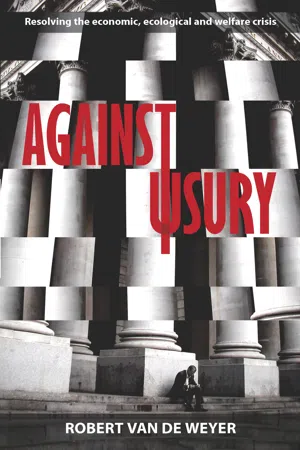
Against Usury
Resolving the economic and ecological crisis
- English
- ePUB (mobile friendly)
- Available on iOS & Android
eBook - ePub
About this book
Robert Van de Weyer argues that humanity faces a trio of chronic crises -- economic, ecological, and in the provision of welfare services -- whose causes are various connected forms of usury. Following the religious teaching of Christianity and Islam, which have traditionally condemned usury as the fundamental source of social injustice, he defines usury as the unequal allocation of risk. He offers practical proposals as to how usury may be reduced or eliminated, showing that the solution to each crisis depends on solving the others.
Information
Topic
Theology & ReligionSubtopic
Religion1
Neshek/Riba/Usury

1.1 Definition of usury
The scriptures of Judaism, Christianity and Islam are universal in their condemnation of usury. The Jewish Bible – the Old Testament – pronounces: ‘You shall not lend money to my people, even to the poor amongst you; you shall not become a creditor, not shall you charge interest’ (Exodus 22.25). Jesus acknowledged the existence of interest paid and charged by banks in the parable of the talents (Luke 19.23); and he condemned all lending at interest (Luke 6.35). The Qu’ran is peppered with denunciations, such as: ‘Those charging usury are in the same position as those controlled by the devil’s influence’ (2.275).
Similar condemnations may be found in other ancient writings. In ancient Greece both Plato and Aristotle regarded usury as dishonest, while the Roman writer Cato, in De Re Rustica, compared usury with murder. And medieval Christian philosophers such as Thomas Aquinas, influenced by both the Bible and Aristotle, wrote at length on the evil of usurious practices.
The usual definition of usury is the lending of money at interest. But closer inspection of the scriptural texts, especially the Qu’ran, suggests that this is actually only one form. The Qu’ran observes that some people equate usury with commerce, presumably arguing that interest on loans is merely the price of money; but while ‘God permits commerce, he prohibits usury’ (2.275). In Arabia in Muhammad’s time there was a great deal of commercial investment, particularly the financing of caravans that carried goods from Mecca to Jerusalem and back; Muhammad himself was the steward of such a caravan. The Qu’ran is thus saying that investors should not lend at fixed interest to those organizing a caravan, but instead should put up their money on equal terms, sharing the risks.
The Fifth Lateran Council, convened by Pope Julius II in 1512, echoed this Qu’ranic view. It noted that money is ‘a thing that produces nothing’, and it defined usury as applying money ‘to the acquiring of gain and profit without any work, any expense or any risk’. The Council did not outlaw investment itself, in which one person provides funds for another person for a commercial venture. Its condemnation was reserved for those situations where the investor carries no risk, and so will incur no expense if the venture fails.
Usury, then, has two elements. First, the consequences of a usurious decision must unfold over a significant period, so there is a degree of risk involved. A simple sale and purchase of a good or service can never be usurious, because the transaction is completed immediately, or at least very quickly, so there is no risk. For usury to occur, there must be a gap between the making of decisions and their results.
Second, the risk is allocated unequally, with one party having a relative degree of certainty. In the case of lending at interest for some commercial project, the lender receives the same return regardless of how the project fares; the borrower by contrast enjoys the profit if it proves successful, and carries the loss if it fails. More generally, usurious economic activities are those where one or more parties know the consequences for themselves from the outset, while at least one party does not.
This definition of usury embraces other economic acts condemned by the scriptures. The Qu’ran outlaws insurance (39.38) where an individual pays a sum in order to receive a greater sum if some adverse event occurs – thereby transferring the risk of that event to the other party. The Old Testament and Jesus Christ himself denounce in numerous places (for example Luke 12.21) the accumulation of idle wealth as a means of protecting oneself against famine and other natural disasters; this in effect transfers the risk of such events to those without wealth, since the wealthy can protect themselves by demanding the services of the poor.
The Hadith (the sayings of Muhammad) condemn in various places – for example, in Ash-Shifa by Qudi Iyad – a particular kind of transaction called gharar. Islamic jurists have understood this as any practice involving risk, where one party carries the risk while the other party enjoys certainty. Islam traditionally distinguishes the charging of interest on loans (riba) from gharar. In fact, the crucial feature of riba, compared with the sharing of profits, is the unequal allocation of risk.
It will be argued later that in the modern context many loan arrangements, such as the sale of debentures by public companies, do in practice involve the sharing of risk, since in the event of default the loan contract is typically renegotiated; so such loan arrangements need not be regarded as usurious. Islamic jurists reply that the terms of a financial contract, not the outcome in the event of default, determine whether it is usurious; and it will be agreed that wise investors – of any religion or none – should follow strict Islamic practice. Nonetheless, it will be argued that, within the world of finance, the present banking system is guilty of the most acute, and most harmful, form of usury; and it is here that reform is most urgently needed.
The definition of usury proposed here also embraces acts that barely occurred in the times of Jesus and Muhammad, some of which have little impact, while others are hugely important. In addition to the financial usury of the banking system, it will be argued that there are two modern forms of usury that are especially harmful. One is taxation as it is currently levied: it is usurious through transferring a substantial portion of the ‘upside’ risk of enterprise and work to the state, while leaving untouched the ‘downside’. The other is pollution, notably the emission of greenhouse gases: it is usurious through transferring terrifying risks to future generations.
1.2 Mystery of usury
When we assess the risk or probability of some event occurring, we typically calculate the frequency with which that type of event has occurred in the past. So the actuary at an insurance company adds up the number of houses in an area that caught fire in the past year, and assesses the risk of a particular house catching fire in the coming year as that number divided by the total number of houses – setting the insurance premium accordingly. Similarly, in assessing the risk of a business becoming insolvent, a bank lending money sees how many similar businesses have become insolvent – and sets the interest rate accordingly. If asked to justify this procedure, we claim that there are stable links of causation resulting in stable frequencies; sometimes – as in the frequency of smokers dying of lung cancer – we can point to these links.
While not refuting this justification altogether, the scriptures of Judaism, Christianity and Islam make a serious qualification. The ultimate cause of all things, they claim, is God. And while God ordained laws governing the universe, these laws are deeply mysterious, far beyond our capacity to discern and understand (for example, Isaiah 55.8). Hence patterns and frequencies of events may change at any time in ways we cannot predict, and we have no means of assessing the probability of such a change. The story of the great flood, which appears near the start of the Jewish and Christian Bible (Genesis 7) and is repeated in the Qu’ran (7.64), is one among many scriptural stories of unexpected interruptions to the accustomed order of events.
Although he was an atheist, the philosopher David Hume shared this view. In An Enquiry Concerning Human Understanding (1748), he recognized that our perception of the world around us is based mainly on inductive logic, according to which we expect the future to be similar to the past. Yet while this generally holds true, sometimes it does not; and we have no means of predicting when inductive logic will fail. More profoundly, our notion of causation is itself merely a matter of induction: we claim that one type of event causes another type of event because in the past those two types of event have always been closely associated, with the first preceding the second. We never actually see directly the causal links in the universe. As a result any attempt to justify inductive logic in terms of causation is as flawed as inductive logic itself. We are thus caught in what became known as the ‘riddle of induction’: daily life requires inductive logic, yet we cannot rely on it.
When applied to social institutions, such as an economy, there is a deeper reason for the riddle of induction, on which many believers and atheists would agree. If human beings have free will, then they can act in ways that could not have been foreseen – just as believers think God can act. Economists mostly think that in an economy as a whole the vagaries of free will tend to cancel themselves out, so that individuals acting unexpectedly in one way will be offset by others acting in the opposite way; they dignify this assumption with the name ‘the law of large numbers’. They conclude that for all practical purposes the path of an economy is predictable, and they believe the inaccuracies in their actual predictions arise from lack of information. But while the law of large numbers may apply to most natural events, there is no reason for it to apply to human decisions. On the contrary, it is striking how the general patterns of human behaviour change in ways that confound even the shrewdest observers – rapid changes in fashions in clothing being a simple example.
It follows that our assessments of risk can be no more than informed guesses. Actuaries and bankers refer to the possibility of interruptions in the accustomed order as ‘systemic risk’, and in effect they ignore it. So if companies had been offering fire insurance in London in early 1666, they would have had to deafen themselves to any warnings that the entire city might burn down, because in such an event they would inevitably have failed. Similarly banks making loans prior to 2008 refused to consider the possibility that large portions of their loans might turn bad at once. Such wilful ignorance implicitly acknowledges that religion and philosophy are right.
The mysterious nature of risk also bedevils those who try to reduce or even eliminate risk through diversity. Insurance companies typically try to protect themselves against systemic risk by insuring a wide variety of different risks – sickness, death, road accidents, theft, and so on, as well as fire – or achieve the same effect through various forms of re-insurance. Similarly banks and others investing in business diversify the types of business in which they put money, in the hope that, if one type of business performs badly, others will thrive.
This strategy, however, relies as much on inductive logic as do risk calculations, and is prone to the same flaws. Any attempt to diversify risk assumes it is possible to determine which risks are independent from one another – that the risk of, say, investing in commercial property is independent from that of investing in firms making toys. Yet this is at best a matter of induction based on past experience. And there may be all sorts of links that we fail to discern: since there is a long-standing negative correlation between the birth rate and real interest rates, returns on toys and commercial property in fact may be positively correlated, albeit with a time lag. Indeed, following the crash of 2008, banks found that loans of almost every type began to turn bad simultaneously.
A modern philosopher, Nelson Goodman, has indicated a further problem with induction. In The New Problem of Induction (1966), he argues that our language distorts our perception of particular patterns in the world around us, and may even blind us to other patterns; since we cannot think outside our language, we have no means of knowing where our distortions and blind spots lie. Thus we may have a systematic tendency to make certain types of error in perceiving where risk exists, and no means of compensating for them. Psychologists may also point to our temperament as a factor in determining how we assess risk: so optimists tend to make low estimates of risk, while pessimists do the opposite. And the scriptures point to a further possible factor: in the Old Testament, Job’s comforters exemplify a common human tendency, refuted by Job and later by Jesus (John 9.3), to regard immorality as increasing the risk of personal or economic misfortune.
So when usurers transfer risk from themselves to others, the nature of that transfer is shrouded in a double mystery. There is the mystery of risk itself, and the mystery of our perception of risk.
1.3 Inequity of usury
We normally assume that economic transactions, where the parties have entered them freely without duress – and where there is no kind of fraud – must also be equitable. When people make a purchase from a shop, or buy a block of shares in a company, we imagine that they have informed themselves as to the nature of what they are acquiring, and judge it to suit their interests. And we imagine that those making the sales have made a similar appraisal of their own interests. As a result the parties share the benefits.
Thomas Aquinas, the great medieval theologian, articulated this assumption in his theory of the just price (Summa Theologica 2.2). He argued that in normal circumstances transactions only occur if the sellers set the price sufficiently high for themselves to benefit, and sufficiently low for the buyers also to benefit. So marketplaces are generally moral. Half a millennium later, the great economist Adam Smith drew a similar conclusion. He observed in The Wealth of Nations that when we go to the baker, we are motivated by a self-interested desire for bread; he sells us bread from a self-interested desire for our money and what it can buy. So when households and bakers exchange money and bread, both achieve their purposes. And the forces of supply and demand across the market as a whole will set the price of bread at a level that reflects both the cost of producing bread and the satisfaction gained from consuming it.
However, Aquinas also explored situations where transactions become inequitable. His main example was the single supplier of a good in a particular locality, who takes advantage of a temporary shortage by pushing the price steeply upwards – such as the supplier of building materials in the wake of a natural disaster. Adam Smith went further, showing that any situation where the seller enjoys some degree of monopoly, or where all the sellers of a particular product collude to act as a monopoly, will lead to inequity. The monopolist has the power to raise the price of his goods well above their cost of production, and self-interest will prompt him to do so. So in any transaction the monopolist is liable to benefit far more than the purchaser.
When Aquinas considered usury, he effectively likened the usurer to the monopolist. In his mind the typical usurer is a...
Table of contents
- Cover
- About the author
- Dedication
- Title page
- Imprint
- Table of contents
- Forewords by Professor Philip Booth and Tarek El Diwany
- Preface
- Prologue
- 1. Neshek/Riba/Usury
- 2. Tarbit/Qurud/Forms
- 3. Dyn/Hisab/Crisis
- 4. Zedek/Mudaraba/Equity
- 5. Anti-Usury Manifesto
- Epilogue
- Glossary of terms and people
- Bibliography
Trusted by 375,005 students
Access to over 1.5 million titles for a fair monthly price.
Study more efficiently using our study tools.
Frequently asked questions
Yes, you can cancel anytime from the Subscription tab in your account settings on the Perlego website. Your subscription will stay active until the end of your current billing period. Learn how to cancel your subscription
No, books cannot be downloaded as external files, such as PDFs, for use outside of Perlego. However, you can download books within the Perlego app for offline reading on mobile or tablet. Learn how to download books offline
Perlego offers two plans: Essential and Complete
- Essential is ideal for learners and professionals who enjoy exploring a wide range of subjects. Access the Essential Library with 800,000+ trusted titles and best-sellers across business, personal growth, and the humanities. Includes unlimited reading time and Standard Read Aloud voice.
- Complete: Perfect for advanced learners and researchers needing full, unrestricted access. Unlock 1.5M+ books across hundreds of subjects, including academic and specialized titles. The Complete Plan also includes advanced features like Premium Read Aloud and Research Assistant.
We are an online textbook subscription service, where you can get access to an entire online library for less than the price of a single book per month. With over 1.5 million books across 990+ topics, we’ve got you covered! Learn about our mission
Look out for the read-aloud symbol on your next book to see if you can listen to it. The read-aloud tool reads text aloud for you, highlighting the text as it is being read. You can pause it, speed it up and slow it down. Learn more about Read Aloud
Yes! You can use the Perlego app on both iOS and Android devices to read anytime, anywhere — even offline. Perfect for commutes or when you’re on the go.
Please note we cannot support devices running on iOS 13 and Android 7 or earlier. Learn more about using the app
Please note we cannot support devices running on iOS 13 and Android 7 or earlier. Learn more about using the app
Yes, you can access Against Usury by Robert Van der Weyer,Robert Van de Weyer in PDF and/or ePUB format, as well as other popular books in Theology & Religion & Religion. We have over 1.5 million books available in our catalogue for you to explore.