- English
- ePUB (mobile friendly)
- Available on iOS & Android
eBook - ePub
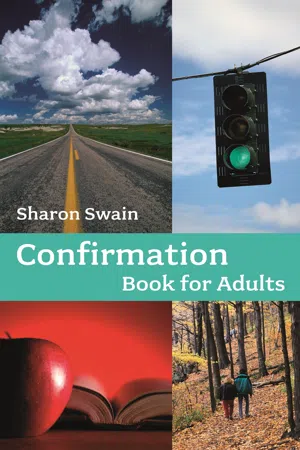
Confirmation Book for Adults
About this book
Confirmation Book for Adults is a confirmation course to use with adults, designed to cover a range of learning styles. The content covers the traditional ground of such courses, beginning from the questions adult confirmation candidates bring to faith development. It is organised around 10 sessions, though these can be used flexibly, and contain different ways to reflect on the material, including discussion and activities.
Information
Topic
Theology & ReligionSubtopic
Christian DenominationsPart 1
BEGINNINGS

BEGINNINGS
1
God calls us
Becoming a Christian is a personal decision for each individual to make, and everyone will have a different story to relate about what led up to the decision and how it was made. Some will have been ‘Christened’ as a baby and taken to church each week. They will have been encouraged by parents and godparents, and brought up in the faith throughout their childhood. Others may have chosen to reject God at an early stage and only begun to think about him during a difficult time in life, perhaps because of an illness or the death of a loved one. Some may have decided to keep their options open, perhaps because their parents believed that they should make their own life choices, but turned to God at a happy time in life, at their marriage or at the birth of a child. Others can identify the exact moment when they accepted God into their lives. The one thing all these have in common is that each individual was called by God.
For many people the process of becoming a Christian actually takes place slowly, almost unnoticed, over many years. God continues to call them again and again in very many different ways, throughout their life. Sometimes the call is not recognized, while at other times it can be deliberately ignored. Whatever our response, though, God continues to call us, hoping that we will turn to him. In the Bible we see God continually calling his people.
Bible work
Notice how many different ways God finds to get people’s attention, and the way that individuals respond to him:
- Genesis 12.1–4: Abram.
- 1 Samuel 3.1–10: Samuel.
- Isaiah 6.1–8: Isaiah.
- Matthew 1.20–23 and 2.13: Joseph.
- Luke 1.26–38: Mary.
- Matthew 9.9: Matthew.
- John 1.43–51: Philip and Nathanael.
In the past men and women have heard God’s voice in their dreams or through the visitation of a messenger. Others have heard an actual voice. Like us, some have questioned the authenticity of the call, while others have ignored the message. Some, however, did respond to God’s call and went on to become patriarchs (those earliest Fathers of the Church in the Old Testament), prophets (who sought to keep the Jewish nation true to their call from God) and disciples (who followed Jesus’ command to take the good news of the gospel to the whole world).
Hearing God’s call today
Today, God still calls his people. It can be hard to recognize his call, however, and sometimes we can only see the touch of his hand in retrospect when we look back at the events in our lives. Perhaps we can see it in the time we chose an unexpected path, or when a disaster ultimately turned into a triumph. Whether or not we actually recognize God’s call, he continues to call us in many different ways. Just as in the past, God may call us through the influence of others, through his word in the Bible as we read it or hear it preached in church, through our conscience, through the grandeur or beauty of the natural world, and of course he may call us through prayer.
Over the centuries millions of Christians have heard the call from God, each in their own unique way. Two who spoke about their experience of being called are St John of the Cross in the sixteenth century, and C. S. Lewis in the twentieth century. Each responded differently.
- St John of the Cross noted that God met us halfway, reminding us of the way the Prodigal or Lost Son (Luke 15.11–24) is welcomed back by his father, who comes out to greet him before his son has arrived home and even before he has asked for his forgiveness: ‘O Lord, my God, who will seek you with simple and pure love, and not find that you are all one can desire, for you show yourself first and go out to meet those who seek you?’ (The Collected Works of St John of the Cross, Washington, DC, ICS Publications, 1991, p. 85)
- C. S. Lewis, on the other hand, decided that he believed in God because of his own powers of deduction. He simply could not explain the creation of the world in any other way: ‘I arrived where I now am, not by reflection alone, but by reflection on a particular current experience. I am an empirical theist. I have arrived at God by induction.’ (William Griffin, C. S. Lewis: The authentic voice, Oxford, Lion, 1986, p. 72)
The call is always tailored to us. For C. S. Lewis, the way to God came through intellectual argument!
What God’s call brings
In ordinary life when someone calls us there is often a task associated with the call. Whether it is a friend ringing to ask whether we can drive him to the garage to pick up his car, or a member of the family wanting us to help celebrate her birthday, the call frequently requires a response from us. So it is when God calls us. When he calls, he usually has a job for us to do. The call rarely comes in isolation. For example, the disciples were called to take the good news of the gospel to the world. In the twenty-first century, Christians too are called to be God’s people in order to share with the world the good news of Jesus Christ.
In many instances, the call will also bring with it a more specific job. Very often we may feel we are not capable of carrying out the task, but God knows when we are ready to do his work and we need to learn to trust his judgement. Moses was called to lead the Israelites, even though he was a poor speaker and felt totally unable to do the job. He explains this to God, only for God to find a solution to his problem:
What of your brother Aaron the Levite? I know that he can speak fluently . . . You shall speak to him and put the words in his mouth; and I will be with your mouth and with his mouth, and will teach you what you shall do.
(Exodus 4.14–15)
In the New Testament, similarly, the disciples are given a job. Jesus sends them out to take the good news to the people:
Then Jesus called the twelve together and gave them power and authority over all demons and to cure diseases, and he sent them out to proclaim the kingdom of God and to heal . . . They departed and went through the villages, bringing the good news and curing diseases everywhere.
(Luke 9.1–2, 6)
Jesus appears to give the disciples this task early in their ministry, not long after their call to follow him. They too would surely have lacked confidence in their ability to carry out the task, yet they obey Jesus’ command and proclaim the Kingdom of God to the people. The lesson we should learn from these two stories is that those who are called by God will be given the necessary gifts to carry out the task.
The Confirmation group
Although we are personally called, and we make an individual decision to become a Christian, Christianity is essentially a corporate faith. It is simply not possible to be a Christian alone, for we must travel with others on our journey of life, and we need the companionship of others to continue to grow spiritually. We need to ‘rub off our sharp edges’ against other people. We must learn to help others as well as learn from them, in order that we ourselves and the whole Christian community may continue to grow more God-like.
Those who come for Confirmation usually explore their faith together in a Confirmation group. The group may meet for a few weeks, or may spend months together. Sometimes those who are preparing for Confirmation will stay together as a ‘home’ or ‘cell’ group after the Confirmation. The group may include adults and teenagers, and there may be a wide age range, as well as an even wider range of experience. It must be noted that those with the most life experience may not necessarily be the most spiritually mature! The child looking at a caterpillar will see the insect in a way that an adult, rushing to do the next piece of work that day, will fail to see. She will notice the colours, the shape, the articulated body of the caterpillar, and find awe in the small. Age does not necessarily mean we are closer to God: we may have been ignoring God’s call for a long ...
Table of contents
- Cover
- About the author
- Title page
- Imprint
- Dedication
- Table of contents
- Introduction
- Part 1
- Chapter 1
- Chapter 2
- Part 2
- Chapter 3
- Chapter 4
- Chapter 5
- Chapter 6
- Chapter 7
- Chapter 8
- Part 3
- Chapter 9
- Chapter 10
- Chapter 11
- Appendix
- Glossary
- Search items
Trusted by 375,005 students
Access to over 1.5 million titles for a fair monthly price.
Study more efficiently using our study tools.
Frequently asked questions
Yes, you can cancel anytime from the Subscription tab in your account settings on the Perlego website. Your subscription will stay active until the end of your current billing period. Learn how to cancel your subscription
No, books cannot be downloaded as external files, such as PDFs, for use outside of Perlego. However, you can download books within the Perlego app for offline reading on mobile or tablet. Learn how to download books offline
Perlego offers two plans: Essential and Complete
- Essential is ideal for learners and professionals who enjoy exploring a wide range of subjects. Access the Essential Library with 800,000+ trusted titles and best-sellers across business, personal growth, and the humanities. Includes unlimited reading time and Standard Read Aloud voice.
- Complete: Perfect for advanced learners and researchers needing full, unrestricted access. Unlock 1.5M+ books across hundreds of subjects, including academic and specialized titles. The Complete Plan also includes advanced features like Premium Read Aloud and Research Assistant.
We are an online textbook subscription service, where you can get access to an entire online library for less than the price of a single book per month. With over 1.5 million books across 990+ topics, we’ve got you covered! Learn about our mission
Look out for the read-aloud symbol on your next book to see if you can listen to it. The read-aloud tool reads text aloud for you, highlighting the text as it is being read. You can pause it, speed it up and slow it down. Learn more about Read Aloud
Yes! You can use the Perlego app on both iOS and Android devices to read anytime, anywhere — even offline. Perfect for commutes or when you’re on the go.
Please note we cannot support devices running on iOS 13 and Android 7 or earlier. Learn more about using the app
Please note we cannot support devices running on iOS 13 and Android 7 or earlier. Learn more about using the app
Yes, you can access Confirmation Book for Adults by Sharon Swain in PDF and/or ePUB format, as well as other popular books in Theology & Religion & Christian Denominations. We have over 1.5 million books available in our catalogue for you to explore.