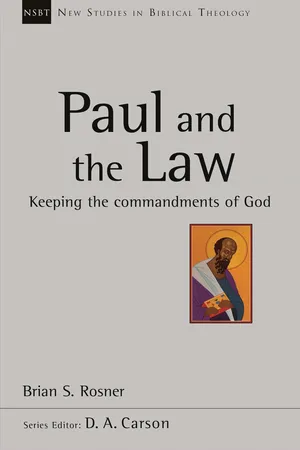
For neither circumcision counts for anything nor uncircumcision, but keeping the commandments of God' (1 Cor. 7: 19). The apostle Paul's relationship to the Law of Moses is notoriously complex and much studied. Difficulties begin with questions of definition (of the extent of Paul's corpus and the meanings of 'the law') and are exacerbated by numerous problems of interpretation of the key texts. Major positions are entrenched, yet none of them seems to know what to do with all the pieces of the puzzle. Inextricably linked to Paul's view of the law is his teaching concerning salvation history, Israel, the church, anthropology, ethics and eschatology. Understanding 'Paul and the law' is critical to the study of the New Testament, because it touches on the perennial question of the relationship between the grace of God in the gift of salvation and the demand of God in the call for holy living. Misunderstanding can lead to distortions of one or both. This fresh and valuable study is something of a breakthrough, bringing neglected evidence to the discussion and asking different questions of the material, while also building on the work of others. Brian Rosner argues that Paul undertakes a polemical re-evaluation of the Law of Moses, which involves not only its repudiation as law-covenant and its replacement by other things, but also its wholehearted re-appropriation as prophecy (with reference to the gospel) and as wisdom (for Christian living).
- English
- ePUB (mobile friendly)
- Available on iOS & Android
eBook - ePub
About this book
Information
Topic
Theology & ReligionSubtopic
Biblical CommentaryChapter One
‘Circumcision is nothing’
The puzzle of Paul and the law
Paul’s views on the law are complex.
(Ben Witherington III)1
Paul and the law – The subject is complex.
(Donald A. Hagner)2
Current discussion of Paul’s view of the law . . . has become extraordinarily complex.
(D. A. Carson)3
There is nothing quite so complex in Paul’s theology as the role and function which he attributes to the law.
(James D. G. Dunn)4
There is a general agreement that Paul’s view of the law is a very complex and intricate matter which confronts the interpreter with a great many puzzles.
(Heiki Räisänen)5
Understanding Paul’s relationship to the Law of Moses is fraught with difficulty.6 Not only is the subject notoriously complex and much studied (some would say studied too much), but major positions are also entrenched. Difficulties begin with questions of definition, of both the extent of Paul’s corpus and the meanings of ‘the law’, and are exacerbated with numerous problems of interpretation of the key texts, decisions about which lead to vastly differing syntheses of Paul’s teaching. Like a big jigsaw puzzle with most of the pieces missing, and the box lid thrown out, there seem to be numerous possible configurations, none of which fits every piece. Some doubt whether Paul himself knew what he was talking about.
Those who write about Paul and the law are typically greeted with a barrage of accusations, ranging from unthinking conservatism to complete eccentricity, from advocating licence to imposing legalism, from cheapening grace to ignoring the demands of God.7 If few scholars know exactly what they think about the subject, most can tell you what they do not think.
Indeed, it is tempting to agree with 1 Timothy 1:7, which judges that those who want to be ‘teachers of the law’ do ‘not know what they are talking about or what they so confidently affirm’ (TNIV). Many would counsel with Titus 3:9 that it is best to avoid ‘arguments and quarrels about the law, because these are unprofitable and useless’ (TNIV)!8 Those who write on Paul and the law may feel an affinity with Hebrews 5:11: ‘We have much to say about this, but it is hard to explain because you are slow to learn’ (NIV 1984). However, given the failure to arrive at a consensus at many points on the subject this would hardly be a fair retort!
Too much, however, is at stake to ignore the topic. It is not only the study of Paul and his letters that depends on a clear understanding of the apostle to the Gentiles’ stance towards the Jewish law; his teaching concerning salvation, salvation history, Israel, the church, anthropology, ethics and eschatology are all inextricably linked to his view of the law. Needless to say, no serious examination of Paul’s relationship to the Law of Moses can afford to underestimate the complexity of the subject, which is after all a subset of one of the biggest questions in the study of early Christianity, namely the parting of the ways between the nascent movement and the mother faith.
The reason understanding Paul and the law is so critical to the study of the New Testament is that it touches on the perennial question of the relationship between the grace of God in the gift of salvation and the demand of God in the call for holy living. Misunderstanding Paul and the law leads to distortions of one or both. From the beginning, even in Paul’s day, his teaching on the law has raised hackles on one of two fronts. People think either that the free gift of salvation has been compromised, or a solid basis for the demand of God for obedience and a holy life has been removed. If justification is not by works of the law, does that not lead to licence? If one removes the law, is the result not lawlessness? Do those without the law not end up as outlaws? And if we are still under the law in some sense, does that not compromise the free gift of salvation?
With reference to the history of research, Richard Hays warns, ‘Like the stone steps of an ancient university building, the topic of “Paul and the Law” has been worn smooth by the passing of generations of scholars.’9 John W. Martens uses a different metaphor to make the same point: ‘Scholarship on Paul and the law is a vast array of acres and acres of cultivated fields.’10
Three theological positions in particular have a strong interest in Paul’s view of the law. Each tends to focus on an emphasis in Paul’s letters that is clearly present, but plays down other aspects of the subject. Broadly speaking, Lutheranism holds that Paul believed that Christ abolished the law and that the law is the counterpoint to the gospel. The primary role of the law is to lead us to despair of any hope of obedience leading to God’s acceptance and to drive us to seek God’s mercy in Christ. For the most part the law is not seen as playing a big role in the Christian life (although Luther himself made effective use of the law in his catechisms). Secondly, the Reformed view agrees that salvation is by grace and not by obeying the law, but once saved we are under the moral law and must obey it in order to please God. Thirdly, the so-called New Perspective on Paul, which is really a new perspective on Paul in relation to Judaism, thinks that the problem of the law for Paul is not that salvation is by grace and not works, but that Paul’s opposition to the law was simply that it was used by Jews to exclude Gentiles from the people of God; Jewish ethnocentrism is the reason Paul opposed the law. There is something to learn from each of these perspectives. In my view the challenge is to hold on to their valid insights in a manner that does justice to the full range of evidence and, with important qualifications, does not deny the validity of other perspectives.
However, the present study does not focus on the history of interpretation. Nor do I document the pedigree of every position I defend; this is not merely to avoid the toil and tedium, but to prevent prior treatments obscuring a fresh appraisal of the primary sources themselves. Neither does this book offer a comprehensive investigation and typology of the usage of ‘law’ in Paul’s letters; much can be missed by focusing too tightly and too early on the explicit evidence to the neglect of other lines of enquiry that set such things in context.11
Instead, my goal is to bring some neglected evidence to the discussion and to defend some proposals that sharpen and build on the work of others. Every researcher approaches the subject with a particular profile that impacts the shape of his or her investigation. Most scholars come at Paul and the law above all as interpreters of Romans and/or Galatians. This is understandable, given the fact that the vast majority of Paul’s references to nomos occur in these two letters. To use a metaphor, if the ‘law is the main subplot of Romans’,12 in Galatians the law is personified and appears as a main character in the drama.
The exegetical problems in connection with the law in Romans and Galatians alone are well known:
• Is Christ the end of the law or its goal, or both?
• Are we no longer under the law’s jurisdiction or just its condemnation?
• Do believers fulfil the law or does Christ do it for us?
• Is ‘the law of Christ’ the law reconfigured, or a new set of commandments, or something else?
• Are we under the moral law? Must we keep the Ten Commandments?
• Are ‘works of the law’ identity markers separating Israel from the nations, or works demanded by the law?
• Is Paul’s opposition to doing the law just his concern that it marks off Jews from Gentiles?
To make matters worse, the standard positions on these questions are entrenched. Paul and the law is the New Testament studies version of the Battle of the Somme, the 1916 World War One allied attack on the Western Front in France: lots of close fighting in trenches, with no clear winners, hardly any progress, many casualties and no sign of an armistice or even a détente. My strategy, to extend the metaphor, is not to enter the fray head on, but to come in from a different direction. More precisely, it is not Paul and the law that is the Battle of the Somme, but Paul and the law fought on predictable lines in Romans and Galatians that fits this unflattering description. There is much vital evidence that has been neglected. Many books on the subject concentrate exclusively on what I cover just in chapter 2!
My background and perspective are somewhat different. Although I have tau...
Table of contents
- Cover
- Title
- Copyright
- Contents
- List of tables
- Series preface
- Author’s preface
- Abbreviations
- 1 ‘Circumcision is nothing’: The puzzle of Paul and the law
- 2 ‘Not under the law’: Explicit repudiation of the law as law-covenant
- 3 Not ‘walking according to the law’: Implicit repudiation of the law as law-covenant
- 4 ‘Under the law of Christ’: Replacement of the law
- 5 ‘Witness to the gospel’: Reappropriation of the law as prophecy
- 6 ‘Written for our instruction’: Reappropriation of the law as wisdom
- 7 ‘Keeping the commandments of God’: A hermeneutical solution
- Bibliography
- Index of authors
- Index of Scripture references
Trusted by 375,005 students
Access to over 1.5 million titles for a fair monthly price.
Study more efficiently using our study tools.
Frequently asked questions
Yes, you can cancel anytime from the Subscription tab in your account settings on the Perlego website. Your subscription will stay active until the end of your current billing period. Learn how to cancel your subscription
No, books cannot be downloaded as external files, such as PDFs, for use outside of Perlego. However, you can download books within the Perlego app for offline reading on mobile or tablet. Learn how to download books offline
Perlego offers two plans: Essential and Complete
- Essential is ideal for learners and professionals who enjoy exploring a wide range of subjects. Access the Essential Library with 800,000+ trusted titles and best-sellers across business, personal growth, and the humanities. Includes unlimited reading time and Standard Read Aloud voice.
- Complete: Perfect for advanced learners and researchers needing full, unrestricted access. Unlock 1.5M+ books across hundreds of subjects, including academic and specialized titles. The Complete Plan also includes advanced features like Premium Read Aloud and Research Assistant.
We are an online textbook subscription service, where you can get access to an entire online library for less than the price of a single book per month. With over 1.5 million books across 990+ topics, we’ve got you covered! Learn about our mission
Look out for the read-aloud symbol on your next book to see if you can listen to it. The read-aloud tool reads text aloud for you, highlighting the text as it is being read. You can pause it, speed it up and slow it down. Learn more about Read Aloud
Yes! You can use the Perlego app on both iOS and Android devices to read anytime, anywhere — even offline. Perfect for commutes or when you’re on the go.
Please note we cannot support devices running on iOS 13 and Android 7 or earlier. Learn more about using the app
Please note we cannot support devices running on iOS 13 and Android 7 or earlier. Learn more about using the app
Yes, you can access Paul and the Law by Brian S Rosner in PDF and/or ePUB format, as well as other popular books in Theology & Religion & Biblical Commentary. We have over 1.5 million books available in our catalogue for you to explore.